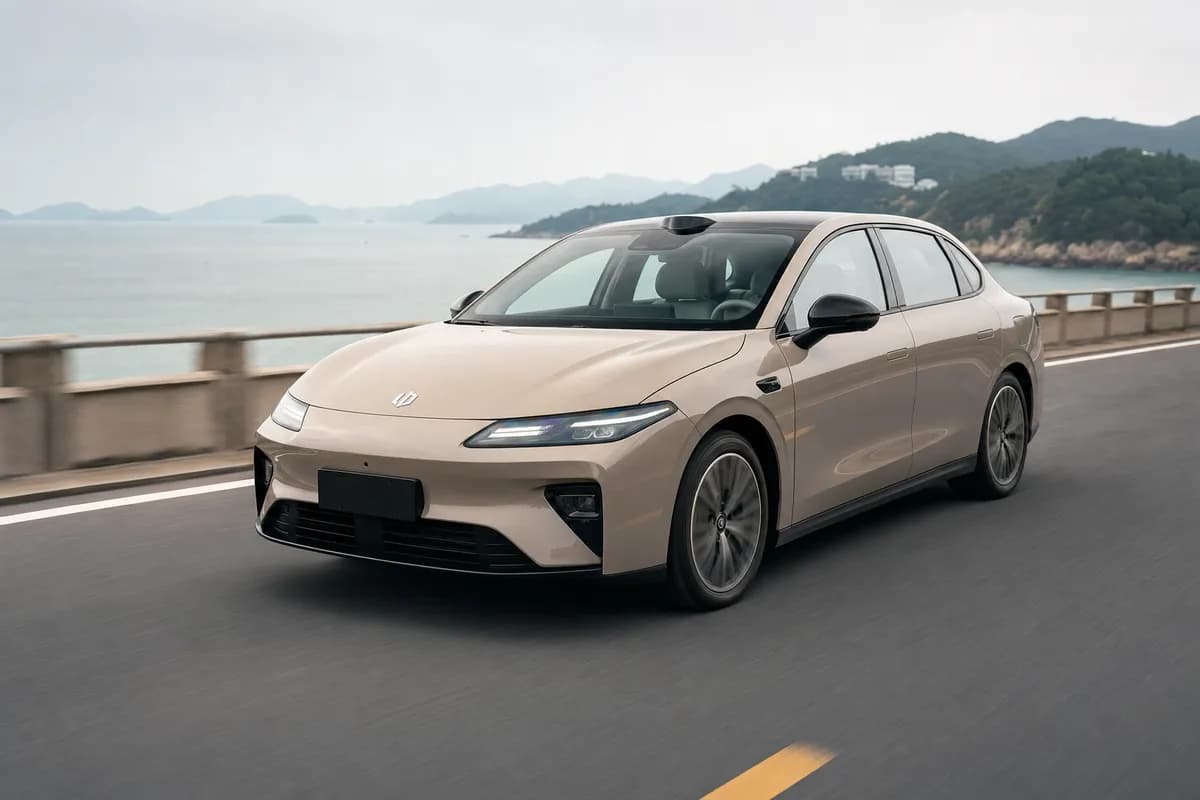
The 2024 BMW iX3 is not the electric SUV that kicks your door down wearing carbon-fiber knuckle dusters. It does not chase Tesla’s acceleration circus, it does not look like a rolling concept car, and it does not shout “future” through a megaphone.
The handicap? Packaging. Because this is not a ground-up EV architecture like the Hyundai Ioniq 5, Kia EV6, Tesla Model Y, or BMW’s own iX, the iX3 does not pull the full skateboard-platform party trick. There is no front boot, the floor is not as wildly spacious as the best dedicated EVs, and the design proportions remain conventional rather than futuristic.
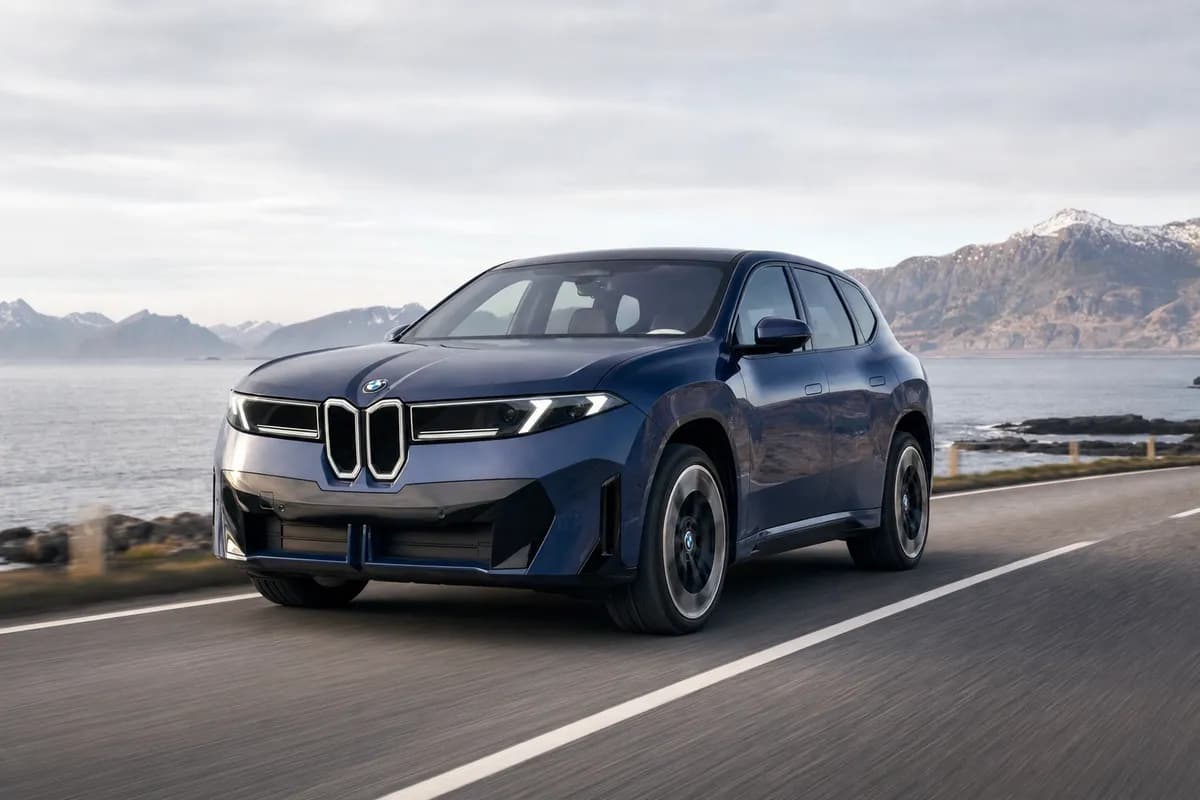
But here is the thing: conventional works. The iX3 looks clean, mature, and refreshingly free of electric-car cosplay. The closed-off kidney grille, blue trim details, aerodynamic wheels, and smoother bumpers are enough to separate it from a diesel X3 without turning it into a rolling appliance. If the Mercedes EQC looked like it was trying too hard and the Tesla Model Y looks like a bar of soap left in the sun, the iX3 lands in the sweet spot: premium, restrained, and unlikely to embarrass you in five years.
Size-wise, it remains very much in the premium mid-size SUV class. Boot space is 510 litres with the rear seats up and 1,560 litres folded, which is down slightly on a regular X3 but still genuinely useful. A family holiday, a Labrador, a folding bike, or a regrettable flat-pack furniture expedition are all within reach. Rear-seat room is solid rather than limo-like, with enough knee and headroom for adults, though the central rear passenger still gets the short straw thanks to the transmission tunnel legacy of the combustion platform. EV revolution, meet old engineering baggage.
Powertrain: Rear-Wheel Drive, Not Drag-Strip Theatre
The 2024 BMW iX3 uses BMW’s fifth-generation eDrive system, with a single electrically excited synchronous motor mounted at the rear. Output is 286 hp and 400 Nm of torque, sent exclusively to the rear wheels. That makes it one of the few electric SUVs in this class that still feels deliberately BMW in layout, rather than simply electrically convenient.
Performance is brisk, not brutal. The iX3 accelerates from 0-62 mph in 6.8 seconds and tops out at 112 mph. In an age where even moderately priced EVs can rearrange your internal organs from a traffic light, those figures may look modest. A Tesla Model Y Long Range is quicker, hitting 62 mph in around 5.0 seconds. A Genesis GV60 can be quicker still depending on version. Even BMW’s smaller iX1 xDrive30 is punchier off the line thanks to dual-motor all-wheel drive.
But numbers are not the whole story, unless you drive exclusively by spreadsheet. On the road, the iX3’s throttle calibration is excellent. It pulls smoothly, cleanly, and without the unpleasant rubber-band lurch some EVs deliver when engineers confuse “instant torque” with “neck injury.” Around town, it is beautifully measured. On a fast A-road, it has enough shove to overtake without drama. On a motorway, it settles into quiet, confident progress.
The rear-drive layout matters. There is a naturalness to the way the iX3 deploys power that many front-biased electric SUVs lack. Stamp on the accelerator out of a wet roundabout and you can feel the rear axle doing the work, not in a smoky hooligan way, but in that subtle BMW manner where the car seems to pivot from the correct end. It is not an M car. It is not even pretending. But it does avoid the numb, understeery blandness that infects too many electric crossovers.
The battery is an 80 kWh gross pack, with around 74 kWh usable capacity. Official WLTP range is up to roughly 285 miles, depending on specification and wheel choice. In normal mixed driving, expect something in the 230-260 mile region if you are not treating the accelerator like a voting button on a game show. Cold weather and motorway speeds will, as ever, take their cut. Physics remains undefeated.
On the Road: Composed, Quiet, and Surprisingly Engaging
The best thing about the iX3 is not the acceleration. It is the ride and body control. BMW has clearly spent more time tuning this car than making it win a pub argument. The adaptive suspension gives the iX3 a properly polished feel, absorbing broken surfaces with far more maturity than a Tesla Model Y, which can still feel brittle and restless over poor roads. The BMW is quieter, calmer, and more expensive-feeling at speed.
Steering is accurate rather than chatty. That is not a surprise; modern electric assistance has largely turned steering feel into a nostalgic memory, like pop-up headlights and affordable insurance. But the iX3 still points cleanly, weights up predictably, and gives you enough confidence to lean on the chassis. The battery sits low, so despite weighing around 2.2 tonnes, the car does not flop about like a sedated walrus.
Push harder and the limitations arrive, but politely. The front end grips well, the rear stays tidy, and the stability systems are smooth in their interventions. You are always aware of the mass, especially under hard braking or rapid direction changes, but the iX3 never feels clumsy. Compared with an Audi Q4 e-tron, it is more satisfying to guide down a road. Compared with a Volvo XC40 Recharge, it feels less frantic and more mature. Compared with a Tesla Model Y, it lacks the shove but has far superior damping and cabin refinement.
Regenerative braking is well judged. You can select different recuperation levels, including an adaptive mode that uses navigation and traffic data to decide how much regen to apply. It sounds like one of those systems designed by people who say “mobility solution” in meetings, but it works surprisingly well. Approaching junctions or slower traffic, the car harvests energy smoothly without the jerky guesswork some systems deliver.
There is also a B mode for stronger one-pedal-style driving. It is not quite as aggressive as Nissan’s e-Pedal or some Tesla settings, but it suits the BMW’s character. This is an EV that prefers finesse to gimmickry.
Cabin and Technology: Premium Without the Circus
Inside, the iX3 feels reassuringly conventional, which may be exactly what many buyers want. You get BMW’s familiar dashboard architecture, excellent front seats, proper materials, and an infotainment system that remains one of the best in the business. The 12.3-inch digital instrument display and 12.3-inch central touchscreen are crisp, quick, and backed up by the iDrive controller — a small rotary miracle in a world increasingly determined to bury basic functions in glass menus.
Apple CarPlay and Android Auto are standard, wireless, and simple to use. Voice control works reasonably well, though like most car voice assistants it occasionally behaves as if you have asked it to translate ancient Sumerian. The native navigation is strong, especially for EV route planning, and displays charging stops intelligently. BMW’s head-up display is also superb: clear, well-positioned, and far less distracting than constantly glancing down at a central screen like in a Tesla.
Material quality is a win. The switchgear has proper damping, the seats are supportive over long distances, and the cabin insulation is excellent. At motorway speeds, tyre and wind noise are kept well in check. The iX3 does not have the lounge-like drama of the larger iX, but it also does not have the iX’s polarising styling or price tag. Call that a fair trade.
Standard equipment is generous in most markets, particularly in M Sport and M Sport Pro trims. Expect features such as adaptive suspension, a panoramic glass sunroof, heated front seats, a Harman Kardon surround sound system on higher trims, adaptive LED headlights, parking assistance, and BMW’s suite of driver assistance technologies. Exact specification depends on country, because car makers enjoy turning equipment lists into regional treasure hunts.
There are irritations. Some touch-sensitive controls feel like progress for progress’s sake. The rear bench is comfortable but not class-leading for foot space. And while the cabin is beautifully made, it lacks the minimalist wow factor some EV buyers expect after spending this much money. If you want spaceship theatre, go sit in a Hyundai Ioniq 5 or BMW iX. If you want a premium SUV that does not require a tutorial before you change the climate setting, the iX3 is better.
Charging, Efficiency, and the Sustainability Pitch
The iX3 can DC fast-charge at up to 150 kW, taking the battery from 10-80 percent in around 34 minutes under ideal conditions. That is competitive but no longer spectacular. A Hyundai Ioniq 5 or Kia EV6 on an 800-volt architecture can charge much faster when plugged into the right hardware, often completing a similar 10-80 percent session in about 18 minutes. The BMW is not slow, but the Korean twins are the charging nerds’ weapon of choice.
On an 11 kW AC wallbox, a full charge takes roughly seven and a half hours, which means overnight charging is easy. For most owners, that matters far more than peak DC performance. Charge at home, wake up with a full battery, and suddenly petrol stations feel like places from a documentary about the early 2000s.
Efficiency is respectable. Official consumption is generally around 18.5-19.0 kWh per 100 km depending on specification, and our first-drive impression suggests the iX3 can be genuinely efficient when driven smoothly. BMW has used clever aerodynamics, low-rolling-resistance tyres, and a highly efficient motor design to make the most of a battery that is not enormous by current SUV standards.
One sustainability point worth noting: BMW’s electrically excited synchronous motor does not rely on rare-earth permanent magnets. That matters, because the environmental story of an EV is not just about what comes out of the tailpipe — or rather, what does not. Battery sourcing, manufacturing energy, materials, and lifespan all count. BMW has also made plenty of noise about renewable energy use in production and supply-chain transparency. Some of it is corporate brochure polish, naturally, but the technical direction is sound.
Still, let us not pretend a 2.2-tonne luxury SUV is saving the polar bears single-handedly. The iX3 is sustainable in relative terms, not monastic ones. It is a cleaner alternative to an X3 xDrive30d or X3 M40i, particularly if charged on low-carbon electricity, but it is still a large, resource-intensive premium vehicle. If your only goal is maximum environmental virtue, buy a smaller EV, ride a bike, or stay home and argue with strangers online.
Verdict: The Thinking Buyer’s Electric BMW SUV
The 2024 BMW iX3 is not the fastest electric SUV, not the longest-range electric SUV, and not the most futuristic electric SUV. Good. The market already has plenty of EVs trying to impress people in the first five seconds of a test drive. The iX3 is more interested in impressing you after five months.
Its strengths are exactly the ones that matter in daily use: excellent refinement, polished ride quality, intuitive technology, real-world range that should suit most families, and a driving character that still feels faintly, satisfyingly BMW. It bridges luxury and sustainability not by reinventing the SUV, but by making electrification feel normal, premium, and genuinely desirable.
Would I buy one over a Tesla Model Y Long Range? If you want maximum range, acceleration, and charging-network simplicity, the Tesla still makes a brutally rational case. But if you care about ride comfort, cabin quality, traditional controls, and driving polish, the BMW is the better car to live with.
Would I buy one over a Hyundai Ioniq 5 or Kia EV6? Those cars offer faster charging, bolder design, and better EV packaging for less money. But they do not have the BMW’s premium finish, rear-drive composure, or badge cachet. Whether that matters depends on your priorities and your tolerance for explaining why your expensive SUV is not German.
Against the Audi Q4 e-tron, the iX3 feels more engaging and more mature. Against the Volvo XC40 Recharge, it is less punchy but more refined. Against BMW’s own iX1, it is larger, smoother, and more luxurious, though not as quick in dual-motor form. Against the larger BMW iX, it is less dramatic but far easier to recommend to normal human beings.
Final verdict: The 2024 BMW iX3 is the electric SUV for buyers who want the EV transition without the theatre. It is not revolutionary, but it is deeply competent, quietly satisfying, and better to drive than most of its rivals. If sustainability matters but so do comfort, quality, and a proper BMW feel, the iX3 hits a very convincing groove.
Score it not as an EV headline act, but as a luxury SUV that happens to be electric. On that basis, the iX3 is one of BMW’s smartest products: calm, credible, and just quick enough to remind you the future does not need to arrive sideways in a cloud of marketing nonsense.
Affiliate disclosure: This article contains affiliate links. RevvedUpCars may earn a small commission on qualifying purchases at no extra cost to you.