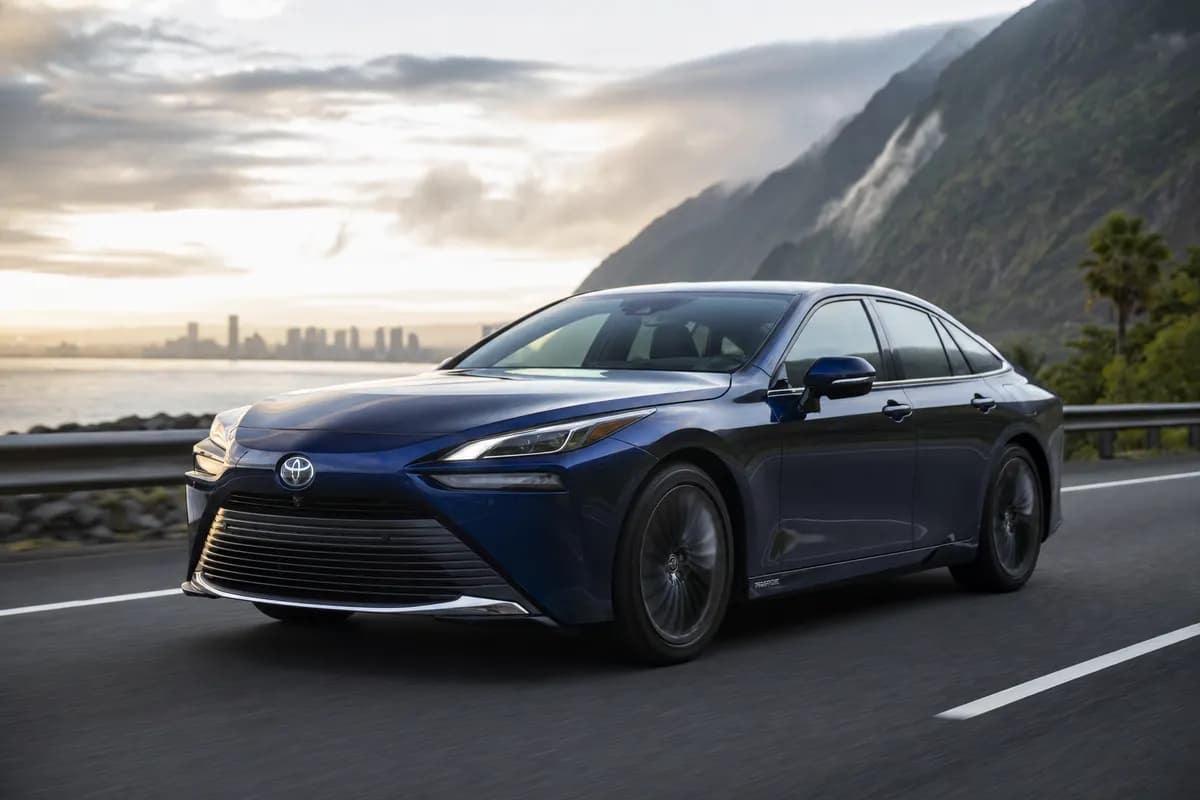
Toyota has spent more than three decades betting that hydrogen can do for cars what gasoline did for the 20th century: deliver long range, quick refueling, and energy independence without tailpipe carbon emissions. The Toyota Mirai proves the technology works.
The car itself is also far more convincing than the first-generation Mirai. The original model looked and felt like a technology demonstrator. The second-generation Mirai is longer, lower, quieter, and more premium. It uses Toyota’s GA-L platform, the same broad architecture family associated with larger rear-drive Lexus products. It produces 182 horsepower and 221 lb-ft of torque, which is adequate rather than quick, but the driving experience is smooth and refined.
Toyota has also expanded hydrogen beyond the Mirai badge. It has tested hydrogen fuel cell heavy trucks in partnership with truck makers, supplied fuel cell systems for buses and commercial vehicles, and developed hydrogen prototypes including a fuel cell Hilux pickup in Europe. Toyota also continues to work with BMW on next-generation fuel cell technology, with BMW planning a small-series hydrogen vehicle later in the decade.
That matters because Toyota’s hydrogen strategy is no longer just about selling sedans. The company is positioning fuel cells as one part of a broader “multi-pathway” approach that includes hybrids, plug-in hybrids, battery EVs, synthetic fuels, and hydrogen. In Toyota’s view, different markets and vehicle types may need different solutions.
The Case For Hydrogen: Fast Refueling, Long Range, And Heavy-Duty Potential
The strongest argument for hydrogen is not that it beats battery EVs in every use case. It does not. The strongest argument is that hydrogen can solve some problems batteries still struggle with, especially where uptime, payload, and refueling speed matter.
For passenger cars, the Mirai’s headline advantages are simple:
- Fast refueling: A hydrogen car can be refueled in minutes, closer to a gasoline vehicle than a battery EV.
- Long driving range: The Mirai XLE’s EPA-rated 402 miles is competitive with long-range battery EVs.
- Low local emissions: The car emits no carbon dioxide, nitrogen oxides, or particulates from the tailpipe.
- Cold-weather consistency: Fuel cell systems can be less range-sensitive to cold weather than some battery EVs, though they are not immune to efficiency losses.
These strengths become more relevant for vehicles that are heavier, travel predictable routes, and cannot sit for long charging windows. That is why hydrogen fuel cells may make more sense in commercial trucks, buses, port equipment, trains, and industrial fleets than in privately owned passenger cars.
A long-haul Class 8 truck needs to carry heavy loads over long distances with minimal downtime. A large battery can do the job, but it adds weight, requires high-power charging, and may need significant depot electrical upgrades. Hydrogen can offer faster refueling and potentially lower weight at very long ranges. Toyota’s fuel cell truck work at the Port of Los Angeles and with heavy-duty partners is aimed squarely at this opportunity.
There is also an energy-system argument. Hydrogen can be produced from renewable electricity when power is abundant, stored for long periods, and used later in fuel cells. In theory, this makes hydrogen a useful tool for balancing grids with high levels of wind and solar energy. It can also serve sectors that are difficult to electrify directly.
That is the optimistic version of Toyota’s hydrogen case: fuel cells are not a replacement for every battery EV, but a complementary technology for places where batteries are inconvenient, too heavy, or too slow to recharge.
The Problem: Infrastructure Has Not Kept Up
The Mirai’s biggest weakness is not the car. It is the world around the car.
In the United States, retail hydrogen fueling for passenger vehicles remains overwhelmingly concentrated in California. Even there, the network has been fragile. Station counts have hovered in the dozens rather than the hundreds, availability has been inconsistent, and drivers have faced outages, queues, and sharp price increases. Shell’s decision to close its California light-duty hydrogen stations underlined a reality Toyota cannot ignore: building and operating retail hydrogen infrastructure is expensive, complicated, and difficult to scale.
That makes the Mirai a very different ownership proposition from a battery EV. A Tesla Model 3, Hyundai Ioniq 6, or Ford Mustang Mach-E can charge at home, at work, or on a growing public fast-charging network. The driver may need to plan longer trips, but electricity is everywhere. Hydrogen is not.
For most Americans, a Mirai is not merely inconvenient. It is unusable. If a driver does not live near a reliable hydrogen station, the car is effectively off the shopping list. That is why Toyota sells or leases Mirai models in only limited markets, primarily California.
The economics are also challenging. Hydrogen fuel prices in California have at times climbed above gasoline-equivalent costs by a wide margin. A Mirai holds about 5.6 kilograms of hydrogen. When hydrogen is expensive, filling the tank can cost far more than charging a comparable EV and can rival or exceed the cost of running a gasoline vehicle. Automakers have often used fuel cards or included fuel allowances to soften the blow for early adopters, but subsidies do not solve the underlying cost problem.
Infrastructure is where the “game-changer” argument meets its hardest test. A fuel cell car needs not only clean hydrogen, but clean hydrogen delivered to the right location at the right pressure, stored safely, dispensed reliably, and sold at a price drivers will accept. That entire chain is still immature for passenger vehicles.
Clean Hydrogen Is The Crucial Missing Piece
Hydrogen vehicles are often described as zero-emission, but that phrase needs precision. The vehicle has zero tailpipe carbon emissions. The fuel may not.
Most hydrogen produced globally today is “gray” hydrogen, made from natural gas through steam methane reforming. That process emits significant carbon dioxide unless paired with carbon capture. “Blue” hydrogen uses fossil fuel feedstock with carbon capture, reducing emissions but not eliminating them. “Green” hydrogen is made by splitting water with renewable electricity, but it remains a small share of global supply and is still relatively expensive.
This distinction is central to the Mirai’s environmental case. If a fuel cell vehicle runs on green hydrogen, it can be genuinely low-carbon. If it runs on hydrogen made from fossil gas without effective carbon capture, the climate benefit narrows significantly.
Battery EVs face their own supply-chain and electricity-source questions, but they have a major efficiency advantage. A battery EV uses electricity directly. A hydrogen fuel cell pathway typically involves generating electricity, using it to make hydrogen, compressing or liquefying that hydrogen, transporting it, dispensing it, converting it back into electricity in the vehicle, and then powering the motor. Each step loses energy.
That is why battery EVs usually deliver far better well-to-wheel efficiency. A modern EV can convert a high share of grid electricity into motion. A hydrogen fuel cell vehicle generally consumes much more primary electricity per mile if the hydrogen is made from renewable power. In a world where clean electricity is still a limited resource, that matters.
Toyota’s counterargument is that efficiency is not the only metric. Energy storage, refueling time, industrial flexibility, and grid balancing also count. That is fair. But for ordinary passenger cars, where home charging is practical for many buyers, hydrogen’s efficiency penalty is difficult to overcome.
How The Mirai Compares With Battery EVs
The Mirai’s most natural competitors are not gasoline sedans. They are long-range battery EVs.
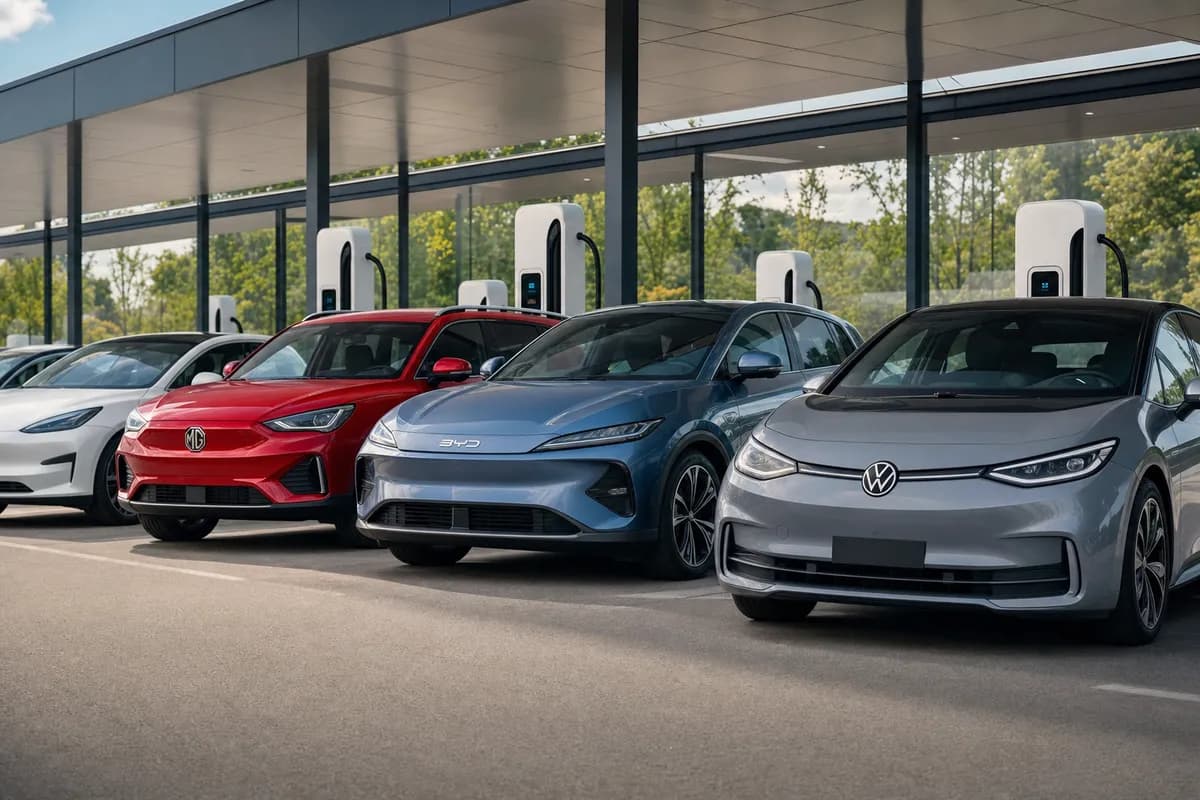
Consider the broad comparison. A Toyota Mirai XLE offers up to 402 miles of EPA range and quick refueling, but only where hydrogen stations exist. A Tesla Model 3 Long Range, Hyundai Ioniq 6, BMW i4, or Mercedes-Benz EQE can offer strong range, better performance, and access to a much larger charging ecosystem. Many EV owners charge at home overnight, which eliminates most public charging needs for daily driving.
Performance is another difference. The Mirai is refined, but it is not fast. Its 182-hp output trails most similarly priced EVs. Battery-electric sedans commonly offer instant torque, quicker acceleration, and more packaging flexibility because they do not need high-pressure hydrogen tanks. The Mirai’s tanks occupy space within the vehicle structure, contributing to a cabin and trunk layout that is less space-efficient than some EVs of similar size.
Cost is equally important. The Mirai has often been offered with heavy incentives, lease deals, and included hydrogen fuel credits. Those offers can make the car attractive for a narrow group of California drivers. But without incentives, the economics are difficult. High hydrogen prices, limited resale confidence, and restricted fueling access weigh on ownership costs.
Battery EVs have their own obstacles: charging reliability can be uneven, apartment dwellers may lack home charging, and some buyers remain concerned about road-trip charging times. But the direction of travel is clear. Charging networks are expanding, automakers are adopting the North American Charging Standard, and battery costs have generally trended downward over the long term despite periodic raw-material volatility.
Hydrogen passenger-car infrastructure, by contrast, has not shown the same momentum. That is the key difference. Battery EVs still have friction. Hydrogen cars have a dependency problem.
Verdict: Not A Gimmick, But Not A Mass-Market Breakthrough Either
Toyota’s hydrogen fuel cell vehicles are not a gimmick. The Mirai is a real car, the technology is proven, and fuel cells may play an important role in decarbonizing parts of transportation that batteries cannot easily serve. Toyota deserves credit for pushing fuel cell durability, packaging, and system cost down over multiple generations.
But as a consumer-car solution, hydrogen remains a long way from being a game-changer. The barriers are not theoretical. They are visible every time a Mirai owner checks whether the nearest station is online, whether hydrogen is available, and how much the next fill will cost.
For passenger vehicles, battery EVs have won the first major round because they use existing electrical infrastructure, can charge at home, and are supported by rapid investment in public charging. Hydrogen still needs a dedicated fuel network, a cleaner and cheaper supply chain, and enough vehicles on the road to justify station investment. That chicken-and-egg problem has persisted for years.
The more realistic future is not hydrogen cars replacing battery EVs. It is hydrogen finding a role where its strengths are strongest: heavy trucks, buses, fleet vehicles, industrial equipment, and regions with coordinated clean-hydrogen policy. Toyota’s fuel cell work may ultimately matter more in those sectors than in the Mirai showroom.
The bottom line: Toyota’s hydrogen vehicles are technologically impressive and strategically important, but for most drivers they are not yet practical. Hydrogen is a promising tool for specific transportation problems. It is not, at least today, the broad consumer-EV alternative Toyota once hoped it could become.
Affiliate disclosure: This article contains affiliate links. RevvedUpCars may earn a small commission on qualifying purchases at no extra cost to you.