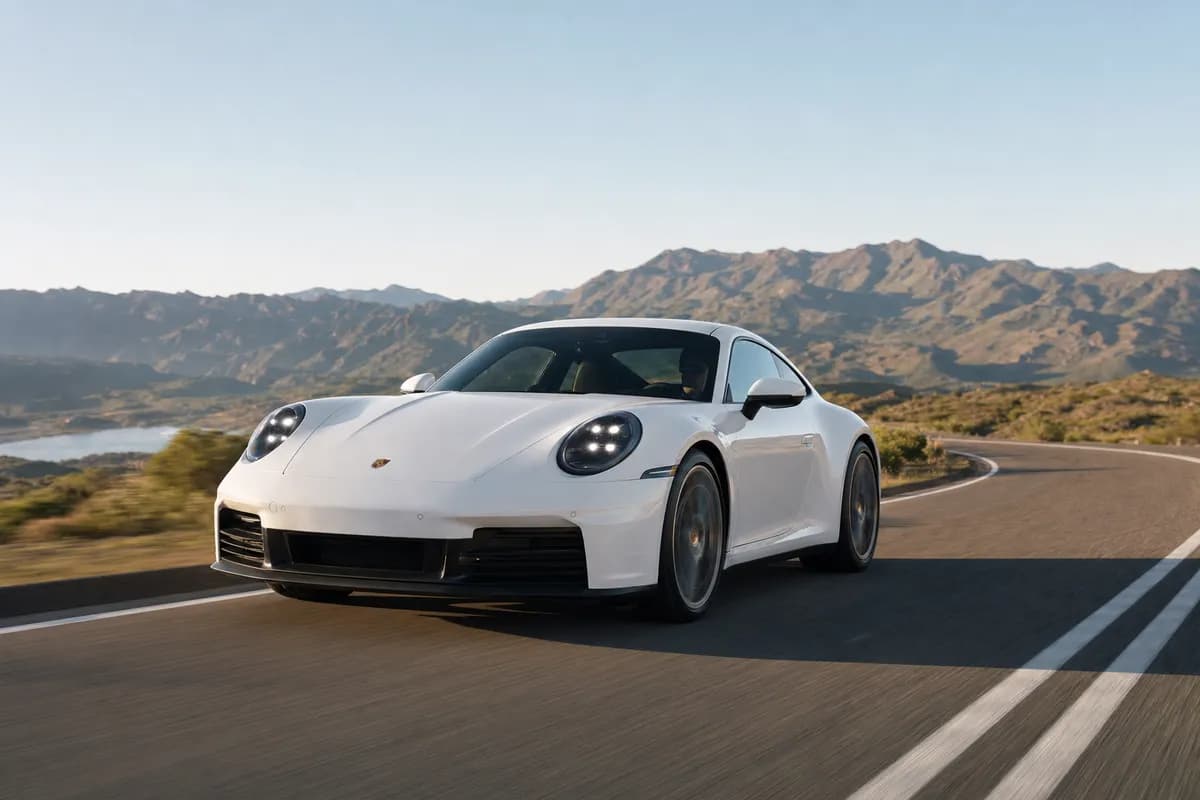
Porsche is not turning the 911 Carrera into a silent, battery-electric sports car in 2025. What it is doing is more significant for the model’s immediate future: bringing high-voltage hybrid technology into the 911 family while preserving the rear-engined, flat-six formula that…
Porsche is not turning the 911 Carrera into a silent, battery-electric sports car in 2025. What it is doing is more significant for the model’s immediate future: bringing high-voltage hybrid technology into the 911 family while preserving the rear-engined, flat-six formula that has defined the car for six decades. The arrival of the 992.2-generation 911 Carrera range, led by the new 911 Carrera GTS T-Hybrid, marks the first production 911 with meaningful electric assistance. It is a carefully limited step, but for Porsche’s most protected nameplate, it is a major one.
The 911 Enters Its Hybrid Era, But Not As A Plug-In
The most important point is also the easiest to misunderstand: the 2025 Porsche 911 Carrera is not going fully electric. Porsche has repeatedly indicated that the 911 will be among the last models in its lineup to abandon combustion, and the company has not announced a battery-electric 911 for 2025. Instead, electrification arrives through a performance hybrid system in the 911 Carrera GTS.
The updated 992.2 lineup starts with the standard 911 Carrera Coupe and Carrera Cabriolet, which continue with a 3.0-liter twin-turbocharged flat-six. That engine has been revised using components related to the previous GTS and Turbo models, and it now produces 388 horsepower and 331 lb-ft of torque. Porsche quotes 0-60 mph in as little as 3.7 seconds with the Sport Chrono package and a top speed of 183 mph.
The bigger change sits one step higher in the range. The 2025 911 Carrera GTS adopts Porsche’s new T-Hybrid system, built around a new 3.6-liter flat-six, an electrically assisted turbocharger, a compact high-voltage battery, and an electric motor integrated into the eight-speed PDK dual-clutch transmission. Total system output is 532 horsepower and 449 lb-ft of torque.
That gives the 911 Carrera GTS Coupe a claimed 0-60 mph time of 2.9 seconds and a top speed of 194 mph. Compared with the previous 911 Carrera GTS, output rises by 59 horsepower, and Porsche says acceleration improves by three-tenths of a second. On the Nürburgring Nordschleife, Porsche has cited a lap time of 7:16.934, 8.7 seconds quicker than the comparable outgoing GTS.
The 911’s first hybrid system is not designed to deliver electric-only commuting. It is designed to make the combustion engine respond faster, pull harder, and meet tightening emissions rules without diluting the car’s core character.
How Porsche’s T-Hybrid System Works
Porsche’s hybrid strategy for the 911 is very different from the plug-in systems used in models such as the Cayenne E-Hybrid and Panamera E-Hybrid. Those cars can drive meaningful distances on electric power alone. The 911 Carrera GTS T-Hybrid cannot. Its battery is small, its electric motor is focused on performance support, and the system is packaged to preserve weight distribution, cooling, and response.
At the heart of the system is a newly developed 3.6-liter boxer engine. The displacement increase from 3.0 liters gives Porsche more combustion capacity, while the hybrid components help fill in torque and sharpen transient response. The engine uses a single electrically assisted turbocharger rather than the twin-turbo setup used in many recent 911 models.
The electric turbo is the system’s key engineering move. An electric motor is placed between the turbine and compressor, allowing the turbocharger to spool before exhaust gas alone would normally do the job. That reduces lag and improves throttle response, a priority in a 911 where driver feedback matters as much as raw speed. The same unit can also recover energy from exhaust gas and send it back into the high-voltage system.
A second electric motor is integrated into the PDK transmission. It can add up to about 54 horsepower and 110 lb-ft of torque directly into the driveline. Energy comes from a compact 400-volt battery with roughly 1.9 kWh of gross capacity. This is closer in concept to a performance-focused hybrid buffer than to a plug-in battery pack.
The system also allows Porsche to run electrically powered auxiliaries, including air conditioning, reducing mechanical load on the engine. The result is a 911 that still feels mechanically direct but can use electrical energy to improve boost control, torque delivery, and efficiency under real-world driving conditions.
- 2025 911 Carrera: 3.0-liter twin-turbo flat-six, 388 horsepower, 331 lb-ft of torque.
- 2025 911 Carrera GTS T-Hybrid: 3.6-liter flat-six with electric turbo and integrated motor, 532 horsepower, 449 lb-ft of torque.
- Battery: compact 400-volt pack with about 1.9 kWh gross capacity.
- Transmission: eight-speed PDK dual-clutch automatic.
- Claimed 0-60 mph: 3.7 seconds for the Carrera with Sport Chrono, 2.9 seconds for the Carrera GTS Coupe.
This is not electrification for marketing theater. Porsche had to solve a difficult packaging problem. The 911 has limited space, a rear-mounted engine, and a customer base that notices weight, sound, brake feel, and throttle calibration. A large plug-in battery would have added mass and complexity in ways that could compromise the car’s defining traits. The T-Hybrid system is Porsche’s answer: use electric power where it improves the 911, not where it turns the 911 into something else.
Why 2025 Matters For The Carrera Line
The 911 Carrera has always evolved cautiously. Turbocharging spread through much of the range. Dual-clutch transmissions became dominant. Rear-axle steering, active anti-roll systems, adaptive dampers, and increasingly sophisticated stability control have all changed how the car performs. Yet Porsche has usually introduced those changes in ways that feel incremental from the driver’s seat.
Hybridization is different because it changes the powertrain’s energy source. Even if the 911 Carrera GTS T-Hybrid still runs primarily on gasoline, electric assistance now plays a direct role in how the car accelerates. That makes 2025 a dividing line for the model family.
The move also reflects regulatory pressure. Porsche sells the 911 globally, including in markets with tightening fleet emissions targets. A high-performance flat-six is increasingly difficult to justify without some form of efficiency improvement. Hybrid technology helps Porsche reduce emissions and improve response without downsizing the car into a characterless compliance exercise.
It also helps Porsche protect the 911’s position in a changing sports-car market. The Taycan has already shown that Porsche can build a convincing electric performance car. The new Macan Electric moves one of Porsche’s volume models into the battery-electric segment. The Cayenne and Panamera continue to use plug-in hybrid systems with larger batteries and electric-only capability. Against that backdrop, the 911 needed an electrification strategy that acknowledged the future without abandoning the reasons buyers still choose it over an EV.
There is another business reason: the 911 is one of Porsche’s highest-margin products and one of the most valuable sports-car brands in the world. Porsche cannot afford to guess wrong. A fully electric 911 launched too early could alienate loyal customers and invite comparisons with cars designed from the outset as EVs. A hybrid 911 lets Porsche gather real-world data, refine high-voltage performance systems, and prepare customers for a more electrified future at a measured pace.
How It Compares With Other Electrified Performance Cars
Porsche is not alone in using electricity to support combustion performance rather than replace it outright. Chevrolet took a similar philosophical route with the Corvette E-Ray, which pairs a 6.2-liter V8 with a front electric motor for a combined 655 horsepower and all-wheel drive. Like the 911 GTS T-Hybrid, the E-Ray uses a relatively small battery and does not focus on long electric-only range. Its mission is traction, acceleration, and response.
The comparison is useful because it shows two very different interpretations of electrified sports-car performance. The Corvette E-Ray uses its electric motor to drive the front axle, creating an all-wheel-drive hybrid layout. The Porsche 911 Carrera GTS T-Hybrid keeps its electric support integrated around the rear-mounted flat-six and transmission, with all-wheel drive available on Carrera 4 GTS models. The Corvette emphasizes total system shove and traction from a larger-displacement engine. The Porsche emphasizes compact packaging, turbo response, and the familiar 911 driving rhythm.
Ferrari has gone further with plug-in hybrid supercars such as the 296 GTB, which combines a turbocharged V6 with a larger electric system and can operate in electric-only mode for short distances. But that car sits in a different price and performance class. The 911 Carrera GTS remains a daily-usable sports car, not a limited-production exotic.
Within Porsche’s own showroom, the contrast is just as important. A Taycan delivers instant electric torque, low-slung battery packaging, and quiet, repeatable acceleration. A 911 Carrera GTS T-Hybrid delivers revs, gearshifts, exhaust sound, and a rear-engined balance that no skateboard-platform EV can replicate. The two cars are not substitutes. They are parallel answers to different performance questions.
That distinction matters because the sports-car market is no longer divided simply between gasoline and electric. It now includes combustion cars, mild hybrids, performance hybrids, plug-in hybrids, and full EVs, each with different compromises. Porsche’s 2025 911 strategy places the Carrera GTS in the performance-hybrid category, where electrification is used as a precision tool rather than the main event.
What Buyers Should Expect From The 2025 911 Carrera
For buyers considering a 2025 911 Carrera, the first decision is whether the hybrid GTS is worth the step up. The standard Carrera remains the cleaner, simpler car. It has less power, but it also avoids the added complexity of the T-Hybrid system. For many drivers, 388 horsepower in a rear-engined 911 will be more than enough, especially with Porsche’s chassis tuning and PDK calibration.
The GTS, however, is now more than a trim level with extra power and sharper suspension tuning. It is the technology flagship of the Carrera range. The hybrid system gives it a distinct powertrain identity, and its acceleration numbers move it close to territory once reserved for the 911 Turbo. That narrows the performance gap within the 911 family and makes the GTS a more serious proposition for buyers who want near-supercar speed without moving into the Turbo price band.
There are trade-offs. Hybrid hardware adds weight and complexity. Long-term maintenance costs are not yet proven in the way older 911 engines are. Some purists will also object to the lack of a manual transmission in the hybrid GTS. Porsche’s PDK is one of the best dual-clutch gearboxes in production, but the absence of a clutch pedal matters in a car whose identity is closely tied to driver involvement.
Still, Porsche has avoided the most obvious pitfalls. It did not overload the 911 with a large plug-in battery. It did not chase electric-only range at the expense of mass. It did not remove the flat-six. The car still has the basic ingredients buyers expect: rear-engine packaging, compact dimensions by modern performance-car standards, sharp steering, strong brakes, and a cabin built around the driver.
Pricing also reinforces the hierarchy. In the U.S., the updated 911 Carrera starts just above $120,000 before destination and options, while the Carrera GTS T-Hybrid starts considerably higher, in the mid-$160,000 range before typical Porsche options. Cabriolet, all-wheel-drive, and Targa variants push the price higher still. As ever with Porsche, the final number depends heavily on the options sheet.
Verdict: A Careful Step, Not A Revolution
The 2025 Porsche 911 Carrera’s move toward electric power is both cautious and consequential. The standard Carrera remains combustion-only, while the Carrera GTS introduces the first true hybrid system in a production 911. That distinction matters. Porsche is not replacing the 911’s character with an electric drivetrain. It is using electrical hardware to make the flat-six more responsive, more powerful, and more viable in a regulatory environment that is becoming less friendly to pure combustion performance.
For enthusiasts hoping Porsche would resist electrification entirely, the 2025 GTS is the clearest sign yet that even the 911 cannot stand outside the industry’s broader shift. For buyers worried that electrification would erase what makes a 911 special, the T-Hybrid approach should be reassuring. The system is compact, performance-focused, and built around the engine rather than in place of it.
The result is not the end of the traditional 911. It is the beginning of a new phase: one where electric power becomes part of the Carrera’s performance toolkit. By 2025, the 911 has not gone electric. It has learned how to use electricity without forgetting why it exists.
Affiliate disclosure: This article contains affiliate links. RevvedUpCars may earn a small commission on qualifying purchases at no extra cost to you.