Europe’s latest emissions rules are no longer just a regional compliance exercise. By tightening fleet CO2 limits, confirming a 2035 end date for new combustion-engine cars that emit CO2, and adding Euro 7 standards for pollutants beyond the tailpipe, the European Union is…
Europe’s latest emissions rules are no longer just a regional compliance exercise. By tightening fleet CO2 limits, confirming a 2035 end date for new combustion-engine cars that emit CO2, and adding Euro 7 standards for pollutants beyond the tailpipe, the European Union is reshaping product plans from Detroit to Seoul, Shanghai and Tokyo. The result is a global market that is splitting faster: more electric cars for Europe and China, more hybrids where charging remains uneven, and fewer low-volume combustion models that cannot justify the cost of compliance.
The regulatory stack: CO2, Euro 7 and the 2035 deadline
The most important European rule for carmakers is still the EU’s fleet-average CO2 regulation. It does not ban any single model today, but it makes the average emissions of all new cars sold by each manufacturer increasingly expensive to miss. The penalty is severe: €95 for every gram of CO2 above the target, multiplied by every car registered. For a large automaker, even a small miss can become a nine-figure problem.
The next major step arrives in 2025, when fleet CO2 targets tighten by 15% versus the 2021 baseline. The 2030 target is much tougher: a 55% cut for passenger cars and a 50% cut for vans. In 2035, the target becomes a 100% reduction for new cars and vans, effectively requiring zero tailpipe CO2 emissions for new registrations, although the EU has left a narrow political opening for vehicles running exclusively on synthetic e-fuels.
Alongside CO2 rules, Europe has also approved Euro 7, the next pollutant-emissions standard. The final version is less severe for cars than early proposals suggested. For petrol and diesel cars, Euro 7 largely keeps the Euro 6 exhaust limits, avoiding the most expensive engine redesigns that manufacturers warned would push small cars out of the market. But Euro 7 adds new requirements that matter globally: limits on brake-particle emissions, tyre-abrasion monitoring, stricter durability rules and minimum battery-durability standards for electrified vehicles.
For cars and vans, Euro 7 is due to apply to new vehicle types from late 2026 and to all new registrations from late 2027. That timing matters because it overlaps with the 2025 CO2 step and the development cycle for cars that will still be on sale into the early 2030s. Automakers are therefore asking a blunt question: is it worth spending more on a combustion platform that may only have a few years of European life left?
Europe’s showroom mix is already changing
The European market has been moving away from diesel for years, but the new regulatory environment is accelerating the shift. Diesel once dominated European family cars and company fleets. Today it is increasingly concentrated in large SUVs, vans and long-distance fleet applications. Petrol remains strong in lower-priced models, but the growth areas are battery-electric vehicles, hybrids and plug-in hybrids that can lower a manufacturer’s fleet-average CO2 figure.
The data shows a market in transition rather than a smooth electric takeover. Battery-electric vehicles reached a 14.6% share of EU new-car registrations in 2023, helped by strong demand in Germany, France, the Netherlands and Scandinavia. In 2024, the EU battery-electric share slipped to about 13.6% as Germany ended major purchase incentives and private buyers became more price-sensitive. At the same time, conventional hybrids grew sharply, taking a larger share than diesel in many markets.
That mix explains why automakers are pursuing several strategies at once. Volkswagen is expanding the ID family while preparing more affordable EVs such as the production version of the ID.2all concept. Renault has revived the Renault 5 as a small electric car and is positioning the lower-cost Renault 4 E-Tech and electric Twingo to defend its home market. Stellantis is spreading electric and hybrid powertrains across the Peugeot 208, Opel Corsa, Fiat 600, Jeep Avenger and Citroen e-C3. BMW continues to sell combustion, plug-in hybrid and electric versions in parallel, including the 3 Series, 5 Series, i4 and i5.
There is a clear reason for that product diversity. European customers are not moving at the same speed. Norway is effectively an EV-first market. Italy and Spain remain more price-sensitive and have slower charging buildout. Germany is large but volatile because policy changes can quickly change demand. France has used incentives and leasing schemes to support smaller EVs, but it has also introduced environmental scoring that favors vehicles with lower production emissions, indirectly affecting imports from coal-heavy manufacturing regions.
For manufacturers, the new rules make every model’s role more precise. A high-margin petrol SUV can still be profitable, but it needs to be balanced by enough zero-emission or low-emission sales. A cheap combustion city car may no longer work if the cost of emissions compliance, safety technology and inflation leaves little margin. That is one reason Europe has seen the retreat of models such as the Ford Fiesta and Volkswagen up!, while new small EVs are being developed with aggressive cost targets.
Global product plans are being rewritten around Europe
Europe is not the world’s largest car market; China is. But Europe remains one of the most influential because its rules are strict, its buyers are wealthy, and its standards often shape engineering decisions for vehicles sold elsewhere. A platform developed to satisfy European emissions and safety rules can be adapted globally. A combustion engine upgraded only for a shrinking European niche is harder to justify.
This is pushing global automakers toward flexible architectures. Hyundai and Kia use dedicated EV platforms such as E-GMP for models including the Hyundai Ioniq 5, Ioniq 6, Kia EV6 and Kia EV9, while also offering hybrids in markets where full EV adoption is slower. Toyota, long skeptical of a rapid all-EV shift, is benefiting from Europe’s current hybrid demand with models such as the Yaris Hybrid, Corolla Hybrid and RAV4 Hybrid, while preparing a broader EV rollout beyond the bZ4X. Honda, Mazda and Subaru face more pressure because their European volumes are smaller, making compliance costs harder to spread.
American automakers are also affected. Ford has stopped selling several traditional European passenger cars and is concentrating on commercial vehicles, SUVs and EVs. The Explorer EV and Capri EV for Europe are built on Volkswagen’s MEB platform, a sign of how expensive it has become to develop region-specific electric architectures alone. General Motors, after selling Opel and largely leaving Europe, is returning cautiously with Cadillac EVs rather than trying to compete in the mass market.
For premium brands, Europe’s rules are speeding up electrification but not eliminating combustion overnight. Mercedes-Benz has invested heavily in EQ models including the EQA, EQE and EQS, but it has also adjusted its EV timelines as demand has proven uneven. BMW’s strategy of offering combustion, plug-in hybrid and electric variants on related architectures has looked conservative to some investors, but it gives the company flexibility as regulations tighten at different speeds across Europe, the U.S. and China.
The bigger structural shift is investment allocation. Capital that might once have gone into new diesel engines or niche petrol models is now going into batteries, software, power electronics and lower-cost EV manufacturing. Even when a company sells more hybrids than EVs today, the long-term European rulebook points toward zero tailpipe emissions. That changes supplier contracts, factory planning and labor needs well beyond Europe.
China’s EV push and Europe’s response are now linked
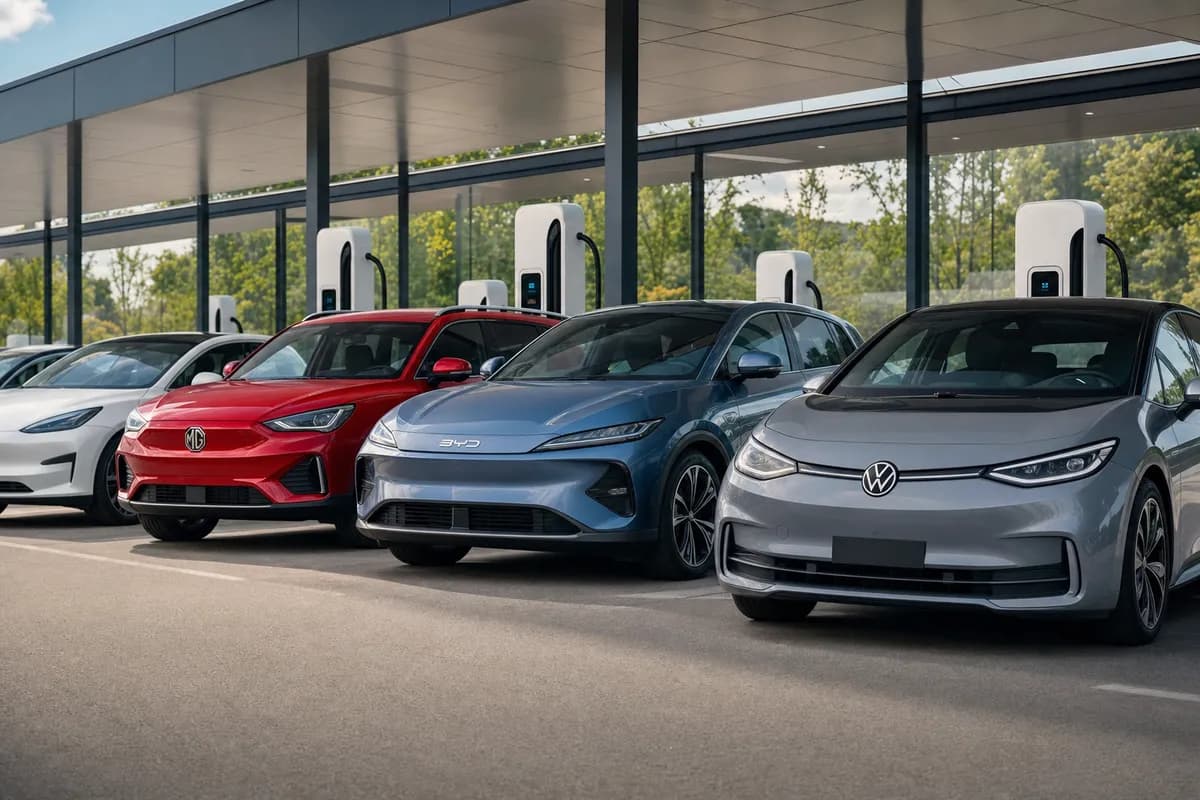
No global market impact is more visible than the rise of Chinese electric vehicles in Europe. Brands including BYD, MG, Nio, Xpeng, Leapmotor and Zeekr see Europe as a critical export region because EU rules create structural demand for EVs. China’s domestic market has already scaled battery supply chains, and that scale gives Chinese manufacturers a cost advantage European rivals are struggling to match.
The comparison is stark in the lower and middle parts of the market. The MG4 became one of Europe’s most competitive compact EVs by offering long range, strong equipment levels and pricing that often undercut established brands. BYD entered Europe with models such as the Atto 3, Dolphin and Seal, bringing in-house battery technology and aggressive vertical integration. The Volvo EX30, developed under Geely ownership and initially sourced from China, showed how Chinese manufacturing can also support European-branded products.
Europe’s answer has not been to weaken emissions rules. Instead, it has combined industrial policy with trade action. The EU opened an anti-subsidy investigation into China-made battery-electric vehicles and introduced additional duties on several manufacturers, with different rates for BYD, Geely, SAIC and others on top of the standard 10% import tariff. Tesla received a lower individual rate for China-built cars than many rivals. The exact cost impact varies by brand, but the message is clear: Europe wants EV adoption, yet it also wants more of the value chain inside Europe.
That is already influencing manufacturing decisions. BYD is building a passenger-car plant in Hungary. Chery has moved to produce vehicles in Spain. Stellantis has partnered with Leapmotor to bring lower-cost EVs to Europe while using its distribution and regulatory expertise. Volvo has said it will add EX30 production in Belgium. These moves are not only about avoiding tariffs; they are about proving local commitment in a market where emissions regulation, industrial policy and consumer incentives are increasingly connected.
The global consequence is a more regionalized EV industry. Battery plants in Hungary, Germany, France, Spain and Sweden are part of Europe’s attempt to reduce dependence on Asia. The U.S. is doing something similar through the Inflation Reduction Act, which ties EV tax credits to North American assembly and battery sourcing. China, meanwhile, continues to dominate much of the battery supply chain and is pushing exports as domestic competition compresses margins. European emissions rules are one of the forces pulling these strategies into direct conflict.
Winners, losers and the pressure on affordability
The companies best positioned for the new European rules are those with credible EVs, strong hybrids, efficient supply chains and enough scale to absorb regulatory costs. That favors Toyota in hybrids, Tesla in EV efficiency and software-led manufacturing, Hyundai-Kia in broad electrified lineups, and large European groups such as Volkswagen, Stellantis and Renault if they can reduce EV costs quickly enough.
The pressure is greatest on brands that rely on inexpensive combustion cars, low European volume or older engine families. Small cars are the hardest business case. Buyers expect low prices, but the cost of emissions compliance, cybersecurity rules, driver-assistance systems and electrification is rising. If a manufacturer cannot sell a small car profitably, it may either move upmarket or exit the segment. That is bad news for affordability and for younger buyers who still need basic transport.
There is also a risk that regulations push the market toward heavier vehicles if policy is not carefully balanced. EVs have no tailpipe emissions, but they are often heavier than equivalent petrol cars because of battery mass. Euro 7’s brake and tyre-particle provisions are an early attempt to address non-exhaust emissions, which matter more as tailpipes get cleaner. That could influence tyre design, regenerative-braking calibration and vehicle weight targets across global platforms.
Plug-in hybrids occupy a complicated middle ground. They can cut official CO2 figures dramatically when charged regularly, but real-world emissions depend heavily on driver behavior. European regulators are moving toward more realistic utility factors for plug-in hybrids, using data from onboard fuel-consumption monitoring. That could reduce the compliance benefit of large PHEV SUVs that are rarely plugged in. Expect future plug-in hybrids to need longer electric range, faster charging and better software prompts to remain attractive under the rules.
For consumers, the impact will be mixed. More EV competition should bring better range, faster charging and lower prices over time. The Renault 5 E-Tech, Citroen e-C3, Fiat Grande Panda, Hyundai Inster and future Volkswagen ID.2 are all aimed at making electric cars more accessible. But in the short term, buyers may face fewer cheap petrol options, higher prices for remaining combustion models and uneven charging access depending on where they live.
Europe’s emissions policy is doing what it was designed to do: forcing manufacturers to change the products they sell. The unresolved question is whether the industry and charging network can move quickly enough to keep the mass market affordable.
Verdict: Europe is setting the pace, but not the whole route
New European emission regulations are not simply cleaning up cars sold in Europe. They are redirecting global investment, changing which models get developed, accelerating Chinese EV exports, and forcing legacy manufacturers to choose where combustion engines still make commercial sense. The rules have turned CO2 performance into a boardroom issue and made electric scale a competitive necessity.
But the impact is not a straight line to an all-EV world by the end of the decade. The European market remains fragmented, incentives are inconsistent, and charging infrastructure is still a practical barrier for many households. Hybrids are gaining because they fit today’s consumer reality, while EVs are being pushed by tomorrow’s regulatory requirement. Automakers that can manage both timelines will be in the strongest position.
The global car market is therefore entering a more complex phase. Europe is setting one of the toughest regulatory directions, China is setting the benchmark for EV cost and speed, and the U.S. is using industrial policy to localize production. Car companies can no longer design one global powertrain strategy and expect it to work everywhere.
The clear conclusion is that Europe’s emissions rules are now a global market force. They will make cars cleaner, accelerate the decline of diesel and reshape supply chains. They will also raise difficult questions about affordability, jobs and industrial competitiveness. For buyers, the change will show up model by model: fewer old-style combustion cars, more hybrids in the near term, and a much broader range of electric vehicles as manufacturers race to meet the next deadline.
Affiliate disclosure: This article contains affiliate links. RevvedUpCars may earn a small commission on qualifying purchases at no extra cost to you.