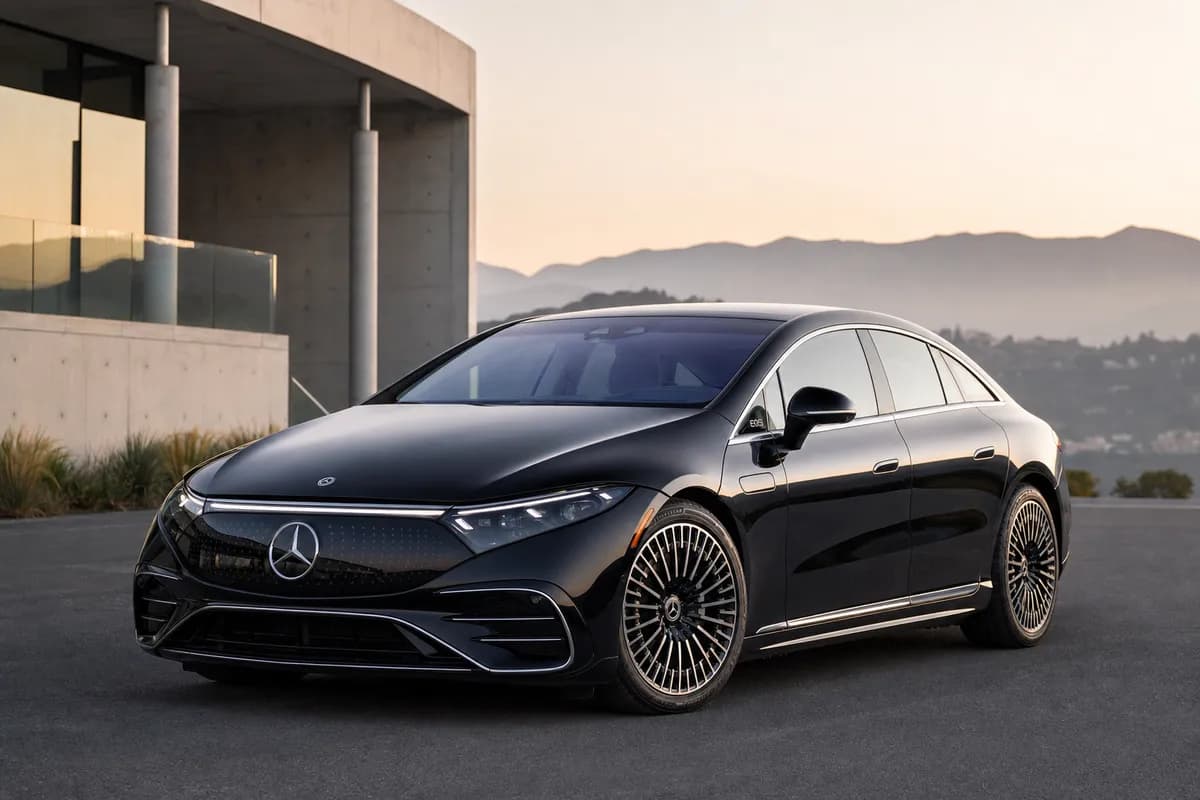
Mercedes-Benz’s EQS enters 2024 as the company’s clearest statement that a flagship luxury car can be electric without abandoning the comfort, technology and long-distance refinement expected from the three-pointed star. The EQS is not simply an S-Class with a battery.
Mercedes-Benz’s EQS enters 2024 as the company’s clearest statement that a flagship luxury car can be electric without abandoning the comfort, technology and long-distance refinement expected from the three-pointed star. The EQS is not simply an S-Class with a battery. Built on Mercedes’ dedicated EVA2 electric architecture, it packages a large battery, slippery aerodynamics, a lounge-like cabin and high-end digital systems into a sedan designed to move the brand’s luxury identity into the EV era.
Mercedes’ Electric Flagship Takes Shape
The EQS remains the top electric sedan in the Mercedes-Benz passenger-car lineup, sitting above the EQE and alongside the EQS SUV as part of the brand’s premium EV push. In 2024, its core proposition is straightforward: deliver S-Class-level refinement with the quietness, instant torque and emissions-free driving of a modern electric vehicle.
The car’s design is a major departure from the traditional long-hood, formal-roofline luxury sedan formula. Mercedes uses what it calls a “one-bow” profile, with a short front overhang, smooth roof arc and fastback-style rear. The goal is not only visual distinction but aerodynamic efficiency. The EQS sedan posts a drag coefficient as low as 0.20, one of the best figures for a production car. That matters because aerodynamic drag is a major factor in highway range, especially for large EVs carrying heavy battery packs.
Unlike the combustion-powered S-Class, the EQS is built around its battery and electric drivetrain from the start. The flat battery pack sits low in the structure, helping lower the center of gravity, while the cab-forward layout creates more interior space than a similarly sized gasoline sedan would typically offer. At 205.4 inches long, the EQS is close in footprint to an S-Class, but its electric platform changes how that space is used.
Mercedes offers the EQS sedan in several forms, each aimed at a different luxury-EV buyer:
- EQS 450+ Sedan: Rear-wheel drive, focused on maximum efficiency and range.
- EQS 450 4MATIC Sedan: Dual-motor all-wheel drive with additional traction and torque.
- EQS 580 4MATIC Sedan: A more powerful dual-motor model positioned as the core high-performance luxury choice.
- Mercedes-AMG EQS Sedan: The AMG-tuned version with substantially higher output and a sharper dynamic brief.
The lineup gives Mercedes a broad spread, from quiet executive transport to performance EV. It also places the EQS directly against the Tesla Model S, BMW i7, Lucid Air and Porsche Taycan, all of which take different approaches to the same question: what should a premium electric sedan be?
Range, Charging and Performance: The Numbers That Matter
The EQS’s strongest technical case is its combination of range, refinement and charging capability. The 2024 EQS 450+ sedan is EPA-rated at up to 352 miles of range, making it the longest-range version of the U.S. lineup. The EQS 450 4MATIC and EQS 580 4MATIC sit slightly lower, while the AMG EQS trades range for performance.
Key 2024 EQS sedan figures include:
- EQS 450+: 355 horsepower, 419 lb-ft of torque, rear-wheel drive, EPA range up to 352 miles.
- EQS 450 4MATIC: 355 horsepower, 590 lb-ft of torque, all-wheel drive, EPA range around the mid-300-mile mark depending on specification.
- EQS 580 4MATIC: 516 horsepower, 631 lb-ft of torque, all-wheel drive, EPA range up to about 340 miles.
- AMG EQS: Up to 649 horsepower in standard configuration, with higher output available temporarily through AMG performance functions, and EPA range below the non-AMG models.
The EQS uses a lithium-ion battery pack with about 108.4 kWh of usable capacity in most U.S. versions. On a DC fast charger, Mercedes says the EQS can charge at up to 200 kW and recover from 10% to 80% in roughly 31 minutes under ideal conditions. On a Level 2 home charger, a full recharge typically takes overnight, depending on the charger output and starting state of charge.
Those charging numbers are competitive, though no longer class-leading in every metric. The Lucid Air offers more range in some trims, with the Grand Touring rated at up to 516 miles. The Tesla Model S remains highly efficient and benefits from deep charging-network integration. The BMW i7 offers a more traditional luxury-sedan shape and a more familiar rear-seat executive experience, but with lower maximum EPA range than the most efficient EQS.
Where the Mercedes makes its case is not raw range alone. The EQS is tuned for isolation and effortlessness. Power delivery is smooth rather than theatrical in the standard models, and the cabin is among the quietest in the EV segment. Rear-axle steering, available up to 10 degrees depending on configuration, also makes the large sedan feel smaller in urban driving and more stable at higher speeds.
That matters for the kind of buyer Mercedes is targeting. The EQS is not designed to be the quickest EV at the lowest price. It is designed to feel calm, precise and expensive in the way a flagship Mercedes should.
Luxury Inside: Hyperscreen, Comfort and the New Digital Cabin
The EQS cabin is where Mercedes most clearly separates the car from mainstream electric sedans. The centerpiece is the available MBUX Hyperscreen, a 56-inch curved glass panel stretching across the dashboard. It incorporates a digital instrument cluster, central infotainment display and passenger-side screen into one continuous visual element.
Not every buyer will prefer the Hyperscreen’s digital-first approach, but it gives the EQS a futuristic identity that aligns with its exterior design. The system supports navigation with EV route planning, charging-stop integration, over-the-air updates, voice control and detailed energy-use displays. Mercedes’ “zero layer” interface is designed to surface frequently used functions without requiring drivers to dig through menus.
Cabin quality remains central to the EQS pitch. Depending on trim and options, buyers can specify Nappa leather, open-pore wood, ambient lighting, heated and ventilated seats, massaging front seats, Burmester 3D or 4D sound systems, and rear-seat comfort features. The EQS also uses extensive sound insulation and the natural quietness of electric propulsion to create a luxury-car atmosphere that is different from, but clearly related to, the S-Class tradition.
The hatchback-style rear opening gives the EQS practical cargo flexibility that many traditional sedans lack. Cargo space is generous for the class, and the low load floor makes the car more useful than its sleek roofline might suggest. Rear-seat headroom is adequate but not as limousine-like as the most formal luxury sedans, including the S-Class and BMW i7. That is a trade-off created by the EQS’s aerodynamic roof shape.
Safety and driver-assistance technology also play a large role. The EQS offers Mercedes’ suite of active safety systems, including adaptive cruise control, lane-keeping assistance, blind-spot monitoring, automatic emergency braking and advanced parking assistance. In markets and conditions where regulation allows, Mercedes has also been moving forward with more advanced automated-driving capability, though availability varies by region and model year.
The important point is that the EQS cabin is not just about screens. It is about translating the established Mercedes luxury formula into an EV: low noise, high comfort, polished controls and a strong sense of occasion.
Sustainability Beyond the Badge
The EQS is positioned as a more sustainable flagship, but that claim needs context. An electric luxury sedan still requires significant resources to build, particularly because of its large battery. The sustainability case depends on how the car is manufactured, how the battery materials are sourced, how efficiently it operates and how clean the electricity is over its lifetime.
Mercedes builds the EQS at Factory 56 in Sindelfingen, Germany, a highly flexible production site designed to operate with a carbon-neutral balance in vehicle production. The facility uses renewable electricity and energy-efficient manufacturing systems, supporting Mercedes’ broader Ambition 2039 plan to make its new-vehicle fleet net carbon-neutral across the value chain by 2039.
The EQS also incorporates selected recycled and resource-conscious materials. Mercedes has used materials such as recycled nylon in carpeting and other interior applications, while continuing to expand the use of lower-impact materials across its EV lineup. The company has also emphasized responsible sourcing standards for battery raw materials, including cobalt and lithium, though the broader EV supply chain remains a major challenge for the entire industry.
From an operational standpoint, the EQS produces no tailpipe emissions. In regions with low-carbon electricity, that gives it a substantial lifecycle emissions advantage over a comparable gasoline luxury sedan. In regions still dependent on coal-heavy power grids, the advantage narrows but does not disappear over time, particularly as grids continue to decarbonize.
Efficiency is also part of sustainability. The EQS’s aerodynamic body and careful energy management help offset its size and weight. Even so, this is a large luxury vehicle, and it will never be as resource-efficient as a smaller EV. Mercedes is selling a cleaner alternative to a high-end combustion flagship, not a minimalist mobility solution.
The EQS shows the progress and the limits of luxury electrification: it removes tailpipe emissions and improves energy efficiency, but it still asks the industry to solve battery sourcing, material use and charging infrastructure at scale.
How the EQS Compares in a Fast-Moving Luxury EV Market
The EQS arrived early among traditional luxury-brand electric flagships, but the market has moved quickly. Tesla continues to dominate EV awareness with the Model S, even as that car has become less of a conventional luxury sedan and more of a technology-performance benchmark. Lucid has raised expectations for range and electric efficiency. BMW has taken a more conservative approach with the i7, offering electric power in a shape and cabin philosophy closer to a 7 Series. Porsche focuses on driver engagement with the Taycan.
Against those rivals, the EQS has clear strengths and some compromises.
- Versus Tesla Model S: The Mercedes offers a richer cabin and more traditional luxury feel, while Tesla counters with stronger efficiency, simpler packaging and broad charging-network advantages.
- Versus BMW i7: The EQS is more aerodynamically radical and generally more EV-specific in feel. The i7 offers a more conventional executive-sedan experience, especially for rear-seat passengers.
- Versus Lucid Air: Lucid leads on maximum range and efficiency in key trims. Mercedes responds with brand heritage, dealer support, cabin isolation and established luxury execution.
- Versus Porsche Taycan: The Taycan is sharper and more driver-focused. The EQS is quieter, roomier and more comfort-oriented.
Pricing places the EQS firmly in the premium tier. The 2024 EQS 450+ starts above $100,000 in the U.S., with the EQS 580 and AMG versions climbing substantially higher once options are added. That makes the car a direct replacement consideration for buyers who might otherwise choose an S-Class, a 7 Series, a high-end Model S or a well-equipped Lucid Air.
The buying decision depends heavily on priorities. Drivers who want maximum range per dollar may look elsewhere. Buyers who want the most engaging handling will likely prefer Porsche. Customers who want an unmistakably Mercedes interpretation of electric luxury will find the EQS more convincing.
Verdict: A Flagship EV With a Clear Purpose
The 2024 Mercedes-Benz EQS succeeds because it does not try to copy every other electric sedan. It is not the cheapest, lightest or longest-range EV in the segment. Instead, it focuses on what Mercedes does best: comfort, quietness, technology, safety and a polished premium experience.
Its sustainability story is credible but not absolute. The EQS is a cleaner alternative to a large gasoline luxury sedan, especially when charged with renewable or low-carbon electricity. Its carbon-neutral production approach, use of selected recycled materials and efficient aerodynamics add substance to the message. But its size, weight and battery demand mean it should be viewed as progress within the luxury segment, not a complete answer to transportation sustainability.
For Mercedes, the EQS is more than a single model. It is a test of whether the brand’s traditional luxury values can survive the shift to electrification. In 2024, the answer is yes, with qualifications. The EQS delivers a refined, technologically advanced and genuinely premium EV experience, while also showing how much work remains as luxury automakers balance performance, comfort and environmental responsibility.
For buyers ready to move from an S-Class or another high-end sedan into electric motoring, the EQS is one of the most complete options available. It is at its best as a quiet long-distance cruiser, a technology showcase and a statement that sustainable luxury is becoming less of a contradiction and more of an expectation.
Affiliate disclosure: This article contains affiliate links. RevvedUpCars may earn a small commission on qualifying purchases at no extra cost to you.