Ford’s 2024 lineup is not a quiet model-year shuffle. The company has refreshed its best-selling vehicle, launched a new generation of Ranger, brought back the Ranger Raptor for the U.S.
- F-150: A significant mid-cycle refresh for America’s best-selling pickup, including updated styling, standard digital displays, new tailgate technology, and broader hybrid availability.
- Ranger: A full redesign, bringing a more mature midsize truck to the U.S. market and adding the long-awaited Ranger Raptor.
- Mustang: A new-generation S650 Mustang with updated engines, a heavily revised interior, and the 500-hp Dark Horse performance model.
- Electric vehicles: Updated Mustang Mach-E trims, the new Mach-E Rally, and a revised F-150 Lightning lineup with a more practical Flash trim.
- Entry-level affordability: Maverick remains Ford’s most accessible truck, but Ford changed the powertrain mix by making the 2.0-liter EcoBoost the standard engine and the hybrid system optional.
That last point matters. Ford is not trying to compete in every segment anymore. It has left the traditional sedan business in the U.S., apart from Mustang, and it continues to put most of its energy into trucks, SUVs, vans, and performance vehicles. The 2024 lineup sharpens that focus rather than broadening it.
F-150 Gets a Meaningful Refresh, Not Just a New Face
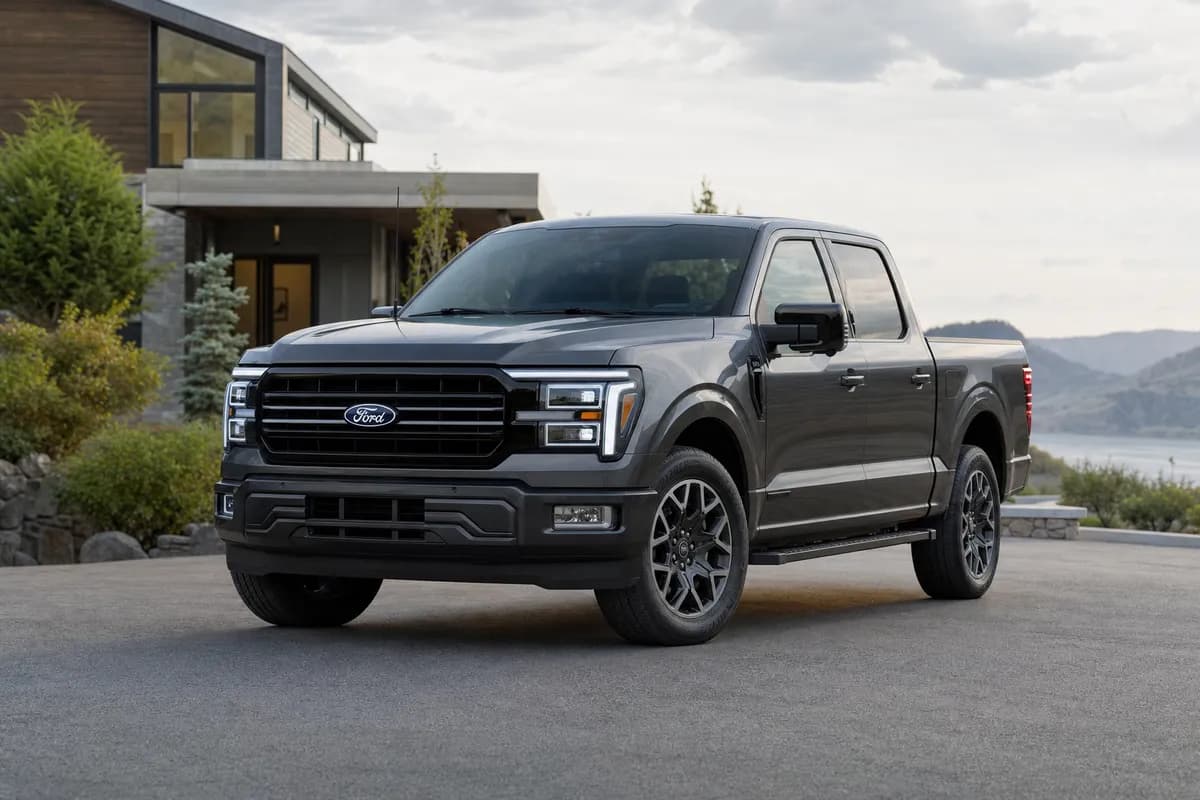
The 2024 Ford F-150 is the company’s most consequential product update of the year. Ford did not reinvent the truck, but it changed enough to keep the F-150 competitive against the Chevrolet Silverado, GMC Sierra, Ram 1500, and Toyota Tundra.
Visually, the 2024 F-150 gets a revised front end, new grille designs, updated lighting, and cleaner trim differentiation. The bigger changes are in the features and powertrain strategy. Every 2024 F-150 now comes with a 12-inch digital instrument cluster and a 12-inch center touchscreen, giving the truck a more consistent technology baseline across the range.
Ford also introduced the available Pro Access Tailgate, a swing-out tailgate section designed to make bed access easier when towing or when parked close to another vehicle. It is Ford’s answer to the multi-function tailgate battle that has been building across the pickup market, and it is particularly useful for contractors and recreational users who regularly work out of the bed.
The engine lineup remains broad, but Ford reshuffled the offering. The 2.7-liter EcoBoost V6 becomes the standard engine, replacing the previous naturally aspirated 3.3-liter V6. Output is 325 horsepower and 400 lb-ft of torque. Buyers can still move up to the 5.0-liter V8, the 3.5-liter EcoBoost V6, or the 3.5-liter PowerBoost hybrid. The PowerBoost remains the torque-rich choice, rated at 430 horsepower and 570 lb-ft of torque, and it continues to offer available onboard generator functionality through Pro Power Onboard.
For performance buyers, the F-150 Raptor continues with a high-output 3.5-liter EcoBoost V6, while the 2024 F-150 Raptor R gets a major bragging-rights upgrade: its supercharged 5.2-liter V8 is rated at 720 horsepower. That puts it directly in the conversation with the most extreme factory off-road pickups, even as Ram prepares to move away from the supercharged TRX formula.
The bigger market story, however, is hybrid adoption. Ford is working to make the PowerBoost hybrid a more mainstream F-150 choice, not just a specialty option. That is a practical move. Full-size pickup buyers still care about towing, payload, range, and price, and hybrids offer a lower-disruption path to improved efficiency than full electrification for many truck customers.
Ranger Finally Grows Up, and Ranger Raptor Arrives
The redesigned 2024 Ford Ranger is one of the most important new models in Ford’s lineup. The previous U.S.-market Ranger was capable but felt dated next to newer rivals such as the Chevrolet Colorado, GMC Canyon, Nissan Frontier, and Toyota Tacoma. The 2024 model is a clean reset.
The new Ranger uses a tougher, more squared-off design that visually aligns it with the F-150. The cabin is substantially improved, with a more vertical dashboard, larger screens, and better storage solutions. Ford offers a 10.1-inch or available 12-inch center touchscreen, depending on trim, and the truck finally feels like a modern midsize pickup rather than a stopgap product.
The standard engine is a 2.3-liter EcoBoost four-cylinder rated at 270 horsepower and 310 lb-ft of torque, paired with a 10-speed automatic transmission. Ford also announced an available 2.7-liter EcoBoost V6 for the Ranger lineup, giving buyers a stronger option for towing and daily use. Maximum towing capacity is rated at up to 7,500 pounds when properly equipped, keeping Ranger competitive in the midsize class.
The headline addition is the 2024 Ford Ranger Raptor. For years, U.S. buyers watched other markets get the Ranger Raptor while Ford sold only the full-size F-150 Raptor here. That changes for 2024. The Ranger Raptor uses a 3.0-liter twin-turbo EcoBoost V6 rated at 405 horsepower and 430 lb-ft of torque, along with full-time four-wheel drive, locking front and rear differentials, Fox Live Valve shocks, wider bodywork, and reinforced chassis components.
This is not just a graphics package. Ranger Raptor gives Ford a serious entrant in the factory-built midsize off-road segment, where the Chevrolet Colorado ZR2, GMC Canyon AT4X, Jeep Gladiator Rubicon, and Toyota Tacoma TRD Pro all compete for buyers who want capability without stepping up to a full-size truck.
For Ford, Ranger Raptor also fills a useful price and size gap. The F-150 Raptor is large, expensive, and not ideal for every trail or driveway. Ranger Raptor brings the Raptor formula into a more maneuverable package while keeping enough power to feel special.
Mustang Enters a New Generation While Rivals Fade
The 2024 Ford Mustang is a new-generation car, and its timing is significant. Chevrolet has ended Camaro production, Dodge has moved away from the traditional V8 Challenger, and the affordable American pony car segment has narrowed dramatically. Ford is now the last Detroit automaker selling a traditional gas-powered pony car with a V8 and a manual transmission.
The seventh-generation Mustang, known internally as S650, keeps the basic formula intact: front engine, rear-wheel drive, coupe or convertible body styles, and turbocharged four-cylinder or V8 power. But the design, interior, electronics, and performance models have all been revised.
The 2.3-liter EcoBoost model is rated at 315 horsepower and 350 lb-ft of torque. It comes only with a 10-speed automatic transmission, a notable change for buyers who previously wanted a manual in the entry-level car. The Mustang GT retains the 5.0-liter Coyote V8, rated at 480 horsepower in standard form and up to 486 horsepower with the available active-valve performance exhaust.
The new performance flagship is the Mustang Dark Horse. It uses a strengthened version of the 5.0-liter V8 rated at 500 horsepower and 418 lb-ft of torque. Buyers can choose a 10-speed automatic or a Tremec six-speed manual transmission. The Dark Horse also adds performance hardware including upgraded cooling, chassis tuning, larger brakes, and track-focused equipment.
Inside, Ford has made the Mustang much more digital. The cockpit features a 12.4-inch digital instrument cluster and an available 13.2-inch center touchscreen running Ford’s latest infotainment software. The shift will not please every traditionalist, but it positions Mustang closer to modern performance cars that rely heavily on configurable displays and drive-mode graphics.
The key point is that Ford did not turn the Mustang into an EV, a crossover, or a nostalgia piece. The Mustang Mach-E serves the electric crossover audience. The 2024 Mustang coupe and convertible remain aimed at buyers who still want a mechanical, rear-drive performance car. In today’s market, that makes it increasingly unusual.
EV Lineup Becomes More Targeted: Mach-E, Lightning, and E-Transit
Ford’s 2024 electric-vehicle story is more complicated than it looked two years ago. Demand is still growing, but not evenly, and buyers have become more sensitive to price, charging access, and real-world usability. Ford has responded by adjusting trims, cutting complexity, and focusing on versions that make sense for specific customers.
Mustang Mach-E Adds Rally Flavor and Better Positioning
The 2024 Mustang Mach-E remains Ford’s core electric SUV. The model lineup includes familiar trims such as Select, Premium, GT, and the off-road-styled Mustang Mach-E Rally. The Rally is the most distinctive new addition, aimed at buyers who want a more playful EV rather than a conventional electric crossover.
The Mach-E Rally uses dual-motor all-wheel drive and is rated at 480 horsepower and 700 lb-ft of torque when equipped with the performance upgrade. It also gets a raised suspension, rally-inspired wheels, underbody protection, a rear spoiler, and a dedicated RallySport drive mode. Its EPA-estimated range is up to 265 miles, which is lower than the longest-range Mach-E versions but reasonable given its performance and all-wheel-drive setup.
For range-focused buyers, the 2024 Mach-E remains competitive. Depending on configuration, EPA-estimated range reaches up to 320 miles for rear-wheel-drive extended-range versions. Ford has also worked to improve charging performance and route planning, while access to Tesla Superchargers through adapters has begun changing the ownership equation for Ford EV drivers in North America.
F-150 Lightning Gets a More Practical Trim Structure
The F-150 Lightning remains one of the most important electric trucks on sale, but Ford has had to recalibrate expectations around electric pickups. The 2024 lineup adds the F-150 Lightning Flash, a trim designed to bundle high-demand features with the extended-range battery. Flash targets buyers who want the big battery, modern tech, and useful equipment without jumping all the way to the most expensive trims.
The Lightning continues to offer serious output. Depending on battery and trim, it produces up to 580 horsepower and 775 lb-ft of torque. EPA-estimated range reaches up to 320 miles on extended-range versions, while standard-range models are aimed more at fleet, urban, and predictable-use customers.
The challenge for Lightning is not performance. It is use case. Electric trucks work extremely well for commuting, job-site power, and local hauling, but towing heavy loads over long distances still exposes the current limitations of battery range and charging time. Ford’s 2024 changes acknowledge that reality by making Lightning more focused, rather than pretending every F-150 buyer is ready to go electric.
E-Transit Remains the Quiet Commercial EV Play
The E-Transit does not generate the same headlines as the Mustang Mach-E or F-150 Lightning, but it may be just as important strategically. Commercial vans often run fixed routes, return to base, and can charge overnight—conditions that are well suited to electrification.
For 2024, Ford has continued developing the E-Transit offering with range and charging improvements depending on configuration. The business case is straightforward: fleets care about operating costs, uptime, and predictable routes. E-Transit gives Ford a foothold in electric commercial vehicles at a time when delivery companies, municipalities, and service fleets are under pressure to cut emissions.
SUVs and Affordable Models: Evolution Rather Than Reinvention
Not every 2024 Ford model gets a major overhaul. Several nameplates carry forward with smaller changes, but they still play important roles in the lineup.
The Ford Maverick remains one of the most compelling small trucks on the market, but Ford changed the powertrain strategy for 2024. The 2.0-liter EcoBoost engine is now standard, while the 2.5-liter hybrid becomes optional. That reverses the original Maverick formula, where the hybrid was the standard powertrain and a major part of the truck’s value story.
The hybrid still matters. It delivers excellent efficiency for a pickup and appeals to urban buyers who want truck utility without full-size truck fuel bills. But the change reflects demand realities and production constraints. Ford has been able to sell every Maverick it can build, and simplifying the standard offering around the EcoBoost gives the company more flexibility.
The Bronco and Bronco Sport continue to anchor Ford’s off-road SUV image. The full-size Bronco remains available in multiple configurations, including two-door and four-door body styles, with serious trail hardware on trims such as Badlands and Raptor. The Bronco Sport continues as the smaller, more road-friendly option with legitimate light-trail capability, especially in Badlands form.
The Escape carries on after its recent refresh, offering gas, hybrid, and plug-in hybrid variants. It remains Ford’s mainstream compact SUV, though it competes in one of the toughest segments in the market against the Toyota RAV4, Honda CR-V, Hyundai Tucson, Kia Sportage, and Chevrolet Equinox.
The Explorer is largely a carryover for 2024 ahead of a more substantial update for the 2025 model year. That makes the 2024 Explorer a transitional entry in Ford’s lineup. It still offers strong powertrain choices, including the 2.3-liter EcoBoost and available 3.0-liter EcoBoost V6, but its interior technology and packaging have faced increasing pressure from newer three-row rivals.
The Edge also remains available for 2024, but its long-term future in the U.S. is limited as Ford rethinks its midsize SUV and manufacturing plans. For buyers, that means the Edge may still be a practical two-row SUV choice, but it no longer feels like a central part of Ford’s future product strategy.
Verdict: Ford’s 2024 Lineup Is Focused, Not Experimental
Ford’s 2024 lineup is defined by disciplined updates to its strongest products rather than a broad attempt to chase every market trend. The F-150 refresh protects the company’s most important franchise. The redesigned Ranger and new Ranger Raptor finally give Ford a modern midsize truck family. The new Mustang keeps a traditional performance formula alive at a time when its direct rivals are disappearing. And the EV lineup is becoming more targeted as Ford adjusts to real-world demand.
The major takeaway is that Ford is not abandoning electrification, but it is also not letting EVs define the entire brand. Hybrids, especially in trucks, are becoming more important. Gas-powered performance still has a place. Commercial EVs may prove more durable than some retail EV experiments. And pickups remain the financial backbone of the business.
For shoppers, the 2024 lineup offers more meaningful choices than the usual model-year update. The F-150 is more tech-forward, the Ranger is finally competitive, the Mustang is newly relevant, and the Mach-E and Lightning are better aligned with specific buyer needs. Ford’s challenge now is execution: building enough of the right models, controlling prices, and maintaining quality in a lineup that spans everything from a $20,000-class small truck idea to a 720-hp off-road pickup.
In that sense, Ford’s 2024 lineup is less about reinvention and more about sharpening the tools that already work. For a company built on trucks, performance, and increasingly practical electrification, that is the right move.
Affiliate disclosure: This article contains affiliate links. RevvedUpCars may earn a small commission on qualifying purchases at no extra cost to you.