Ferrari’s next major motorsport shift is not a retreat from combustion. It is a bet that the fastest way to protect its racing identity is to master hybrid power better than anyone else.
Ferrari’s next major motorsport shift is not a retreat from combustion. It is a bet that the fastest way to protect its racing identity is to master hybrid power better than anyone else. By 2026, Formula 1’s new power-unit rules will make electrification a far larger part of lap time, while Ferrari’s Le Mans-winning 499P has already proved that hybrid technology can sit at the center of the brand’s modern competition program without diluting its character.
Why 2026 Is Ferrari’s Real Hybrid Pivot
Ferrari has been racing hybrid power units in Formula 1 since 2014, so the idea of an electrified Scuderia is not new. What changes in 2026 is the balance of the formula. F1’s next-generation regulations will dramatically increase the role of the electric motor, simplify the hybrid system, and force manufacturers to extract more performance from less fuel.
The current F1 hybrid system uses a turbocharged 1.6-liter V6 engine paired with an MGU-K electric motor and an MGU-H unit that recovers energy from the turbocharger. In 2026, the MGU-H disappears. That removes one of the most technically complex and expensive parts of the current power unit, but it also reshapes how teams recover and deploy energy.
The MGU-K, the motor-generator connected to the drivetrain, will become far more powerful. Output rises from roughly 120 kW today to 350 kW in 2026, equal to about 469 hp. The internal combustion engine is expected to contribute around 400 kW, or about 536 hp, with the total power target remaining near current F1 levels. In practical terms, the electric side moves from being a performance supplement to a central part of the car’s acceleration, race strategy, and energy management.
- Current F1 hybrid output from the MGU-K: about 120 kW, or 161 hp.
- 2026 F1 hybrid output from the MGU-K: about 350 kW, or 469 hp.
- 2026 combustion engine target: about 400 kW, or 536 hp.
- Fuel: 100 percent sustainable fuel mandated under the new rules.
- Fuel load target: around 70 kg for a Grand Prix, significantly lower than earlier hybrid-era levels.
That is the heart of Ferrari’s bold move. The company is not simply adding batteries to a racing car. It is preparing for a rule set in which electrical efficiency, deployment maps, braking regeneration, software control, and thermal management will define competitiveness as much as combustion power and aerodynamics.
For Ferrari, 2026 is also a rare reset. Mercedes dominated the opening phase of the turbo-hybrid era from 2014. Red Bull Racing, powered by Honda-built technology, took control of the later phase. The next regulations give Ferrari a chance to change the order, but only if Maranello delivers a power unit that is efficient, durable, and easy for the chassis team to package.
Ferrari Has Already Tested The Formula At Le Mans
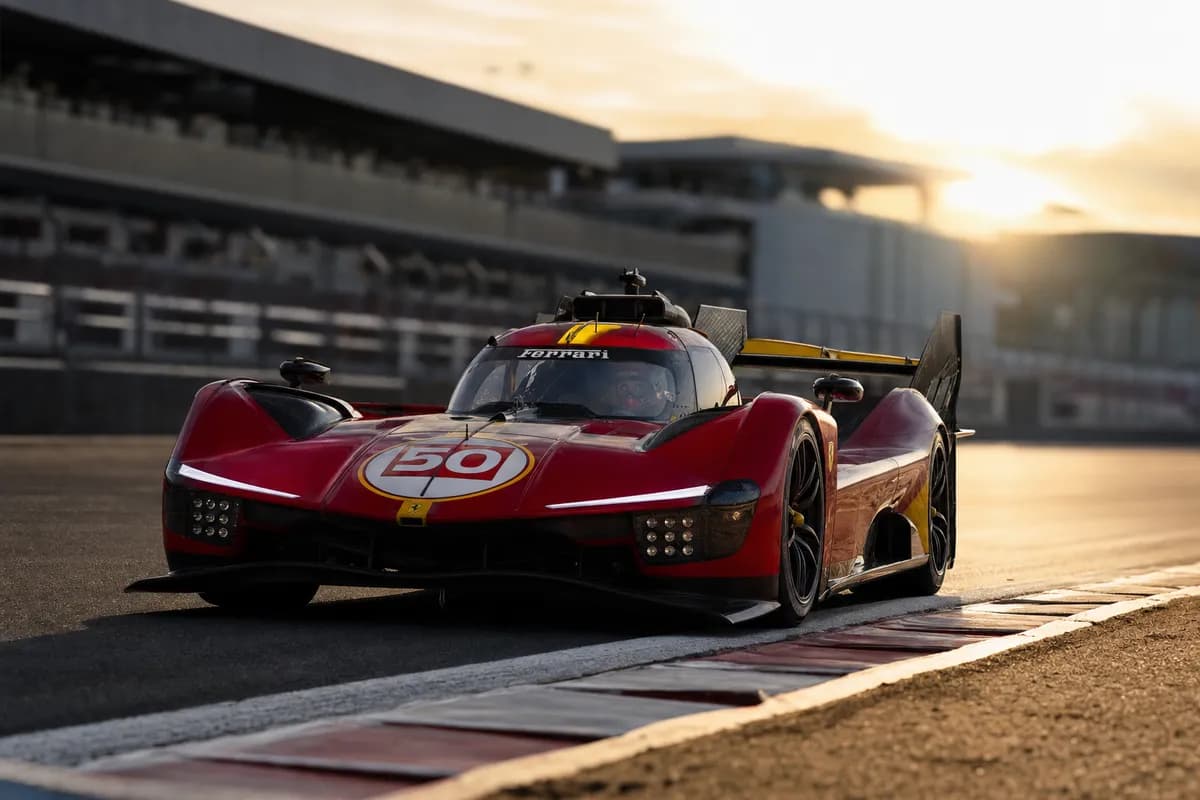
The clearest evidence that Ferrari can make hybrid motorsport work is not in F1. It is the 499P, the Le Mans Hypercar that brought Ferrari back to the top class of the FIA World Endurance Championship after a 50-year absence. The 499P won the 24 Hours of Le Mans outright in 2023 and repeated the achievement in 2024, giving Ferrari two of its most important modern racing victories.
The 499P is a purpose-built prototype, not a modified road car. It uses a 3.0-liter twin-turbo V6 engine driving the rear wheels and an electric motor on the front axle. Under Le Mans Hypercar rules, the combined output is capped at 500 kW, or about 671 hp. The front electric motor can provide up to 200 kW, but deployment is governed by speed thresholds and balance-of-performance rules.
That layout matters. Ferrari chose the LMH route rather than the lower-cost LMDh platform used by brands such as Porsche, BMW, Cadillac, and Acura. LMDh cars use a spec hybrid system shared across the category. Ferrari’s LMH approach gave the company more freedom to design its own hybrid architecture, chassis, aerodynamics, and control systems.
The result is not just a trophy winner. It is a rolling laboratory for energy recovery, battery behavior, front-axle electric drive, brake-by-wire tuning, and thermal stability over long-distance races. A 24-hour event exposes weaknesses that a short sprint can hide. If a hybrid system can survive Le Mans while delivering consistent performance through traffic, heat, night running, wet conditions, and driver changes, it has proved something meaningful.
The 499P also shows Ferrari’s current racing philosophy more clearly than any press release. The company is willing to use electrification where it improves performance, but it is not presenting hybrid technology as an aesthetic exercise. The system is there because it helps the car accelerate, recover energy, manage tire loads, and exploit regulations.
The Road-Car Link Is Stronger Than It Looks
Ferrari’s hybrid racing strategy is closely tied to its road-car transition. The company has already moved beyond the idea that electrification is incompatible with a Ferrari badge. The SF90 Stradale pairs a 4.0-liter twin-turbo V8 with three electric motors for a combined 986 hp. The 296 GTB uses a 3.0-liter twin-turbo V6 and a plug-in hybrid system for 819 hp. Both cars use electrification to sharpen response, add torque, and extend the performance envelope.
Those numbers are important because they show how Ferrari has framed hybridization for its customers. The battery and motor are not sold primarily as economy tools. They are performance multipliers. Instant torque fills gaps before the turbochargers are fully awake. Electric front-axle drive can improve traction and corner exit. Regeneration can support repeated high-load use.
Ferrari has also said that by 2026, it expects roughly 60 percent of its product range to be hybrid or electric, with the remainder still powered by internal combustion engines. The company’s first full battery-electric vehicle is due in the middle of the decade. That does not mean Ferrari is abandoning engines. It means combustion will increasingly be paired with electric systems, or positioned as part of a more selective portfolio.
Motorsport supports that transition because it gives Ferrari a credible development narrative. High-performance hybrid systems are difficult to tune. They require compact batteries, powerful inverters, precise cooling, fast control software, and careful calibration between brake feel and regeneration. Racing accelerates that work because failure is public and measurable.
There are limits to the road-car transfer, and Ferrari knows it. A 2026 F1 car is not a 296 GTB. A Le Mans Hypercar is not an SF90. Race cars operate under specific rules, with extreme maintenance schedules and specialized fuels. But the engineering disciplines overlap. Power density, heat rejection, software integration, and energy flow are increasingly the core of high-performance car development.
Not Every Ferrari Race Car Will Go Hybrid Immediately
Ferrari’s transition should not be misread as a clean break across every racing category. GT racing is the obvious example. The Ferrari 296 GT3, which replaced the 488 GT3, is based on the 296 road car but does not use the road car’s plug-in hybrid system. It keeps the 3.0-liter twin-turbo V6 but removes the electric hardware because GT3 regulations emphasize cost control, reliability, and customer racing simplicity.
That decision is not a contradiction. It is a reminder that racing technology follows rulebooks. Hybrid systems add cost, weight, complexity, and safety requirements. In factory prototype racing and Formula 1, that complexity can be justified because the category is built around technical development. In customer GT3 racing, where private teams need durability and manageable operating budgets, the case is different.
This is where Ferrari’s approach looks more pragmatic than ideological. The company is not forcing hybridization into every product or race program before the regulations and business case support it. Instead, it is concentrating electrified development in the places where it can influence brand direction and competitive results: Formula 1, top-level endurance racing, and high-end road cars.
That restraint matters. Motorsport has seen manufacturers overpromise around electrification before. Some programs have treated hybrid badges as marketing shortcuts. Ferrari’s record with the 499P suggests a more serious path: build the technology where it can win, then use the lessons selectively.
The Competitive Stakes In Formula 1 Are Enormous
The 2026 F1 rules will bring one of the deepest competitive resets of the decade. Ferrari will face established and incoming power-unit rivals, including Mercedes, Honda with Aston Martin, Red Bull Ford Powertrains, and Audi. Each will arrive with a different strength. Mercedes has a proven hybrid-era record. Honda has recent title-winning experience. Red Bull is building its first in-house F1 power unit with Ford support. Audi is entering as a full factory force through Sauber.
For Ferrari, the advantage is integration. Unlike a customer team, Ferrari designs the power unit, chassis, cooling package, gearbox, and vehicle systems under one roof. That should help in a rule set where power-unit packaging and energy deployment will directly influence aero choices and tire usage.
The risk is that integration only works if every department hits its targets. A powerful engine that runs too hot can compromise bodywork. A strong electrical system that requires heavy cooling can hurt drag. Aggressive regeneration can unsettle braking balance. A battery that cannot sustain performance over a race stint can force conservative deployment. In 2026, the fastest car will not simply be the one with the best engine or the best aerodynamics. It will be the one with the most complete system.
Driver adaptation will also matter. The next generation of F1 cars is expected to feature active aerodynamic elements and more complex energy deployment behavior. Drivers will have to manage battery state, braking recovery, tire temperature, and overtaking strategy while dealing with cars designed around lower drag and higher electrical contribution. Ferrari’s race operations, simulator work, and driver feedback loop will be as important as dyno performance.
That is why the hybrid transition is more than a technical story. It is an organizational test. Ferrari has the heritage, facilities, and engineering depth. What it needs is execution under pressure, something that has not always been consistent in the modern F1 era.
Verdict: Bold, But Not Reckless
Ferrari’s move toward hybrid motorsport by 2026 is bold because it forces the company to compete on new terms. The emotional center of Ferrari has always been the engine: sound, response, character, and mechanical drama. Hybrid racing shifts part of that identity toward software, power electronics, energy recovery, and battery performance.
But this is not a reckless pivot. Ferrari is not abandoning combustion, and it is not chasing electrification for its own sake. The 2026 F1 regulations still use internal combustion engines. The 499P still relies on a turbocharged V6. The 296 GT3 still races without hybrid hardware where the rules make that the better solution. What is changing is the role of electricity from accessory to core performance tool.
The significance is simple: Ferrari is trying to prove that hybrid technology can preserve the intensity of motorsport while making it relevant to the next era of performance cars. The 499P has already shown that the idea can win at Le Mans. Formula 1 in 2026 will be the larger, harsher test.
If Ferrari gets it right, the company will show that its racing future does not depend on nostalgia. It can still build cars that sound, feel, and perform like Ferraris while using electrification to go faster. If it gets it wrong, the new rules will expose the gap quickly. In modern motorsport, heritage still matters, but energy efficiency is becoming lap time. Ferrari’s challenge is to make both work together.
Affiliate disclosure: This article contains affiliate links. RevvedUpCars may earn a small commission on qualifying purchases at no extra cost to you.