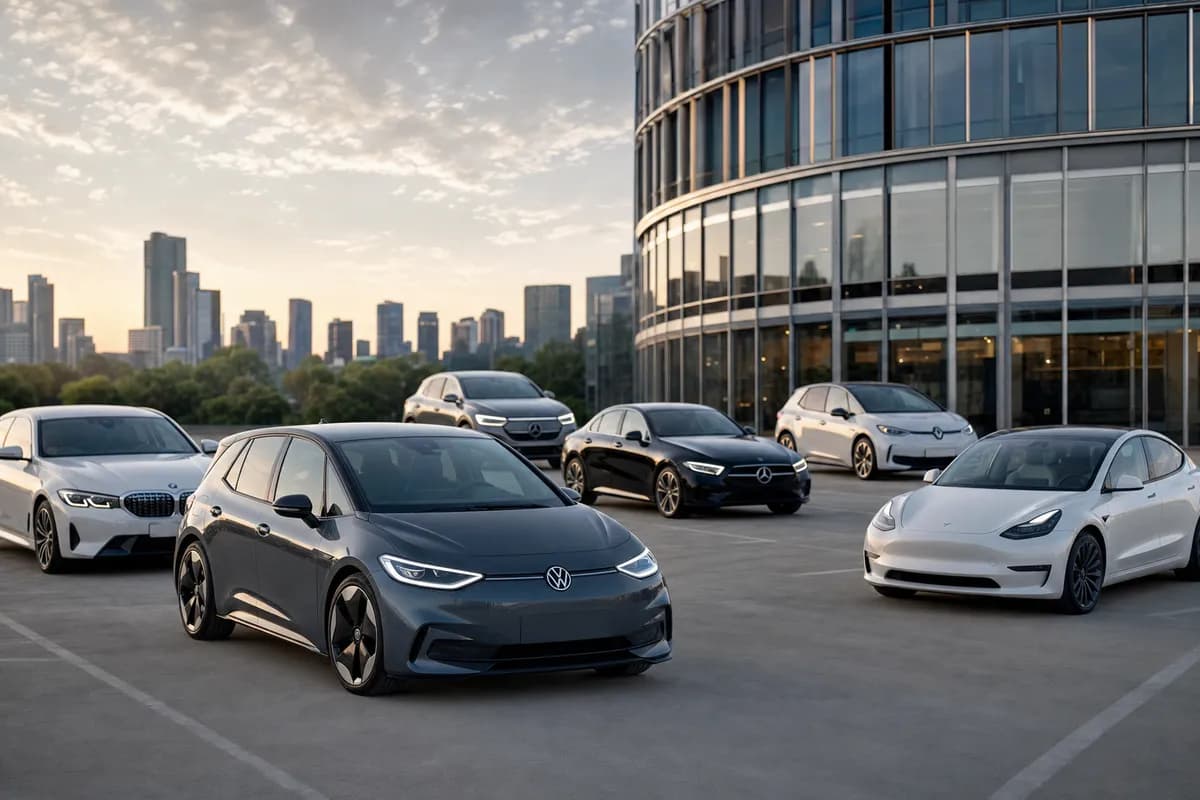
In June 2026, uneven EU company-car tax rules are holding back EV fleet demand, impacting 2026–2027 Volkswagen, BMW, Mercedes, Tesla, Renault, and BYD sales.
Europe’s company-car market still sets the pace for new-car demand, and in June 2026 the policy picture remains badly uneven. That matters because weak tax incentives are still slowing EV uptake in fleets, even as automakers from Volkswagen to BYD count on corporate buyers to hit 2026 and 2027 volume targets.
The latest cross-Europe policy reviews show a familiar problem: a handful of countries strongly favor battery-electric company cars through benefit-in-kind and deductibility rules, while many others still leave plug-in hybrids, combustion models, or high-emission vehicles too competitive on after-tax cost. For buyers, leasing firms, and manufacturers, EU company car tax EV policy 2026 is no longer a niche tax issue. It is one of the clearest signals for where Europe fleet EV sales 2026 will rise fast and where they will stall.
Why company-car tax policy still matters so much in Europe
Company cars account for a large share of Europe’s new registrations, especially in markets such as Germany, France, Italy, Spain, Belgium, and the Netherlands. In several EU countries, fleets, business users, and salary-sacrifice style schemes shape residual values and the used-car pipeline just as much as direct retail demand does.
That makes tax treatment critical. If an employee pays a low monthly tax charge to drive a battery-electric car, and the employer can deduct more of the cost, EVs move quickly into fleets. If tax rules remain technology-neutral or still tolerate favorable treatment for plug-in hybrids with low real-world electric use, EV adoption slows.
The June 2026 picture is stark. Countries including Belgium, the Netherlands, and the Nordics continue to give strong tax signals toward full EVs, while much of the rest of the EU still offers mixed or weak incentives. In practice, that means automakers see very different demand curves for the same vehicle depending on national policy rather than product strength alone.
- Strong EV fleet markets: Belgium, Netherlands, Denmark, Sweden, Finland
- Mixed-transition markets: Germany, France, Austria, Portugal
- Lagging fleet-tax markets: Italy, Spain, much of Central and Eastern Europe
For 2026 and 2027, that split will shape volumes for electric executive cars, compact crossovers, and light commercial fleets more than many headline retail incentives will.
Where most EU nations are still falling short
The biggest failure is simple: too many tax systems still do not make battery-electric cars decisively cheaper than combustion alternatives for company-car users. In some markets, the monthly benefit-in-kind gap is too small. In others, employer deductibility remains incomplete, inconsistent, or clouded by transitional rules.
Plug-in hybrids are another drag. Several countries have tightened treatment, but many still leave PHEVs close enough in total tax cost to battery EVs that fleets continue choosing them as a lower-risk option. That undermines corporate fleet electrification Europe is supposed to accelerate over this decade.
There is also a timing problem. Fleet buyers plan 24 to 48 months out, yet some governments still rely on temporary rates, phased thresholds, or annual revisions. Leasing companies and large employers want stable tax treatment over a contract life, not policy uncertainty every budget cycle.
What weak incentives look like in practice
- Small benefit-in-kind advantage: Employees do not save enough each month to switch from diesel or gasoline models.
- Incomplete business deductions: Employers see a weaker total-cost-of-ownership case for EVs.
- PHEV loopholes: Plug-in hybrids keep winning tenders despite lower real-world emissions benefits.
- Unstable policy horizons: Fleet managers delay orders because tax assumptions may change mid-cycle.
- Charging mismatch: Tax support exists, but depot or home charging rules remain weak.
The result is a more fragmented 2026 market than many expected. Europe is still growing EV volumes, but not at the pace needed for smooth compliance and manufacturing scale across all major brands.
What this means for Volkswagen, BMW, Mercedes, Tesla, Renault, and BYD
For automakers, the fleet market is where policy quickly turns into registrations. Strong tax support helps move high-volume EVs into corporate channels, protects residual values, and seeds the used market. Weak support forces brands into steeper discounts, tactical registrations, or slower production ramp-ups.
Volkswagen Group
Volkswagen remains heavily exposed to European fleet demand, especially with the ID.7, ID.4, ID.5, ID.3, Audi Q4 e-tron, Skoda Enyaq, and Cupra Tavascan. Where tax rules strongly favor BEVs, the group is well positioned because it covers company-car staples from compact hatchbacks to executive liftbacks.
But in weak-incentive markets, VW Group faces a margin problem. Fleet managers may still prefer diesel Passat, Tiguan, Octavia, or PHEV alternatives if tax gaps are narrow. That limits how quickly the company can push higher electric mix in 2026 and 2027.
BMW and Mercedes-Benz
BMW and Mercedes stand to benefit most where benefit-in-kind taxes heavily reward premium EVs. Models such as the BMW i4, i5, iX1, and Mercedes EQE, EQA, and EQB fit classic executive and upper-management fleet profiles across Germany, Belgium, the Netherlands, and Scandinavia.
The problem is that their average transaction prices are high. In countries without strong company-car tax relief, many employers will keep choosing 3 Series, 5 Series, C-Class, and GLC plug-in hybrids or efficient diesels. For both German premium brands, 2027 electric company cars growth depends as much on tax design as on product launches.
Tesla
Tesla still has one of the strongest fleet propositions on paper with the Model Y and Model 3, thanks to charging access, efficiency, and relatively low operating costs. In favorable tax markets, those advantages remain potent, especially for user-chooser fleets where employees can select their own car within a budget band.
Still, Tesla is more vulnerable than before to policy-neutral markets because competition has intensified. If tax systems do not clearly reward full EVs, buyers can more easily cross-shop BMW i4s, Volkswagen ID.7s, Renault Scenic E-Techs, Hyundai Ioniq 5s, or even cheaper combustion fleet models.
Renault
Renault’s opportunity is strongest in mainstream fleet electrification. The Megane E-Tech, Scenic E-Tech, Renault 5, and electric light commercial vans give it strong coverage where employers want lower monthly cost rather than premium-brand status.
That should help in France and neighboring markets if fleet tax policy keeps tightening against combustion and PHEVs. But if southern European markets continue with weak incentives, Renault’s EV fleet growth may skew heavily to a few supportive countries rather than broad regional expansion.
BYD
BYD is one of the clearest wild cards in the Volkswagen BMW Mercedes Tesla BYD Europe competitive set. With models such as the Seal, Seal U, Dolphin, and Atto 3, it can compete aggressively on equipment and monthly lease cost, which matters in salary-car and fleet tenders.
Yet BYD needs the same policy tailwind as everyone else. In markets where company-car tax policy strongly favors BEVs, a lower-priced EV entrant can gain fast. In markets where tax treatment remains soft, brand familiarity and incumbent fleet relationships still favor European legacy brands.
How fleet EV sales in 2026 are likely to split by market
The central lesson for Europe fleet EV sales 2026 is that growth will not be evenly distributed. Countries with clear and durable EV tax advantages should keep pulling demand forward. Others will likely remain stuck in a slower transition marked by PHEVs, delayed renewals, and selective electrification.
Likely winners in 2026–2027
- Belgium: Still one of the clearest examples of tax policy driving rapid business EV adoption.
- Netherlands: Mature EV fleet behavior and strong policy alignment continue to support volume.
- Nordic markets: High EV acceptance and strong fleet economics remain favorable.
- Large-company van fleets: Electric LCV adoption should keep rising where urban access rules tighten.
Likely laggards
- Italy and Spain: Large potential, but weaker fleet tax signals keep combustion and PHEVs competitive.
- Parts of Central Europe: Policy inconsistency and charging gaps continue to hold back uptake.
- Premium segments in mixed-policy markets: Employers delay BEV adoption when tax savings are modest.
That unevenness matters beyond 2026. Fleet cars become used cars, and used EV supply is essential for mass-market adoption. Weak company-car tax policy today means a weaker second-hand EV market in 2028 and 2029.
Verdict: Europe’s fleet EV transition is still being slowed by tax policy, not by lack of vehicles
The market now has enough credible electric company cars for most major fleet roles. Volkswagen has the ID range and its group brands. BMW and Mercedes have strong premium EV lineups. Tesla remains a core fleet player. Renault is competitive in mainstream and vans. BYD is increasingly relevant on price and equipment.
The real bottleneck in June 2026 is policy design. Most EU nations still fail to make battery-electric company cars the obvious tax-efficient choice for both employers and drivers. That will cap EV fleet growth, distort competition, and leave 2026–2027 demand concentrated in a small group of supportive countries.
For buyers and fleet operators, the takeaway is practical. The strongest EV business case in Europe is still found where tax rules clearly reward zero-emission vehicles over every alternative. Until more governments align company-car taxation with climate targets, the continent’s fleet transition will remain slower, patchier, and more expensive than it needs to be.
Affiliate disclosure: This article contains affiliate links. RevvedUpCars may earn a small commission on qualifying purchases at no extra cost to you.