Audi’s E-Tron GT has always carried an unusual brief: it must feel like a proper Audi grand tourer, deliver the acceleration expected of a modern performance EV, and justify its close technical relationship with the Porsche Taycan without becoming a rebadged Porsche.
Audi’s E-Tron GT has always carried an unusual brief: it must feel like a proper Audi grand tourer, deliver the acceleration expected of a modern performance EV, and justify its close technical relationship with the Porsche Taycan without becoming a rebadged Porsche. With the latest updates bringing more power, faster charging, and a larger battery, the E-Tron GT has moved from being a stylish electric flagship to one of the clearest benchmarks for what a high-performance EV should be.
A Flagship EV With Real Performance Credentials
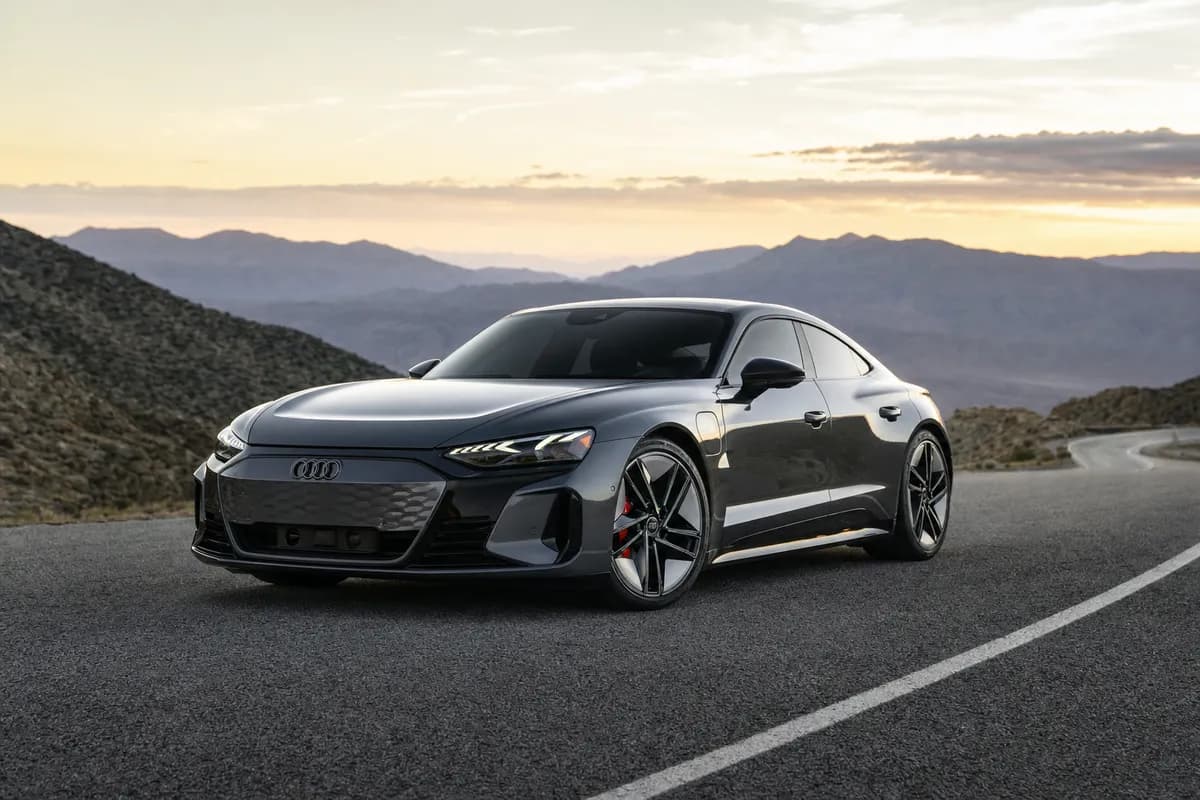
The Audi E-Tron GT arrived as Audi’s most dramatic electric car to date, positioned above the Q8 E-Tron SUV and built around a low-slung four-door coupe format. It uses the Volkswagen Group’s J1 performance EV platform, shared with the Porsche Taycan, but Audi has tuned the car around a different personality: quieter, more polished, and more grand-tourer than track weapon.
That distinction matters. The high-performance EV market is no longer defined only by straight-line acceleration. Tesla proved years ago that electric motors could produce shocking launch numbers. Lucid has pushed the range and power conversation further. Porsche has shown that an EV can withstand repeated hard driving. Audi’s task with the E-Tron GT is to combine those ingredients into a car that feels usable, premium, and emotionally convincing every day.
In its latest form, the E-Tron GT range has become significantly more serious. Depending on market, the updated line-up includes the S E-Tron GT, RS E-Tron GT, and RS E-Tron GT Performance. The numbers are no longer merely competitive; they are among the strongest in the segment.
- Audi S E-Tron GT: up to around 670 hp in boost mode, depending on market specification.
- Audi RS E-Tron GT: up to around 845 hp in boost mode.
- Audi RS E-Tron GT Performance: up to around 912 hp, making it the most powerful production Audi to date.
- 0-62 mph: as quick as about 2.5 seconds for the top Performance model.
- Battery: updated versions use a larger battery pack of roughly 105 kWh gross, with about 97 kWh usable capacity.
- DC fast charging: up to 320 kW, with a 10-80 percent charge possible in about 18 minutes under ideal conditions.
Those figures put the E-Tron GT directly in the conversation with the Porsche Taycan, Tesla Model S Plaid, Lucid Air Sapphire, and Mercedes-AMG EQE and EQS models. But Audi’s advantage is not only the headline power figure. It is the way the car packages performance into a more restrained, design-led, luxury-focused product.
Why the E-Tron GT’s Hardware Matters
The E-Tron GT’s most important technical asset is its 800-volt electrical architecture. That system allows the car to accept very high DC charging rates and operate more efficiently under heavy load than many 400-volt EVs. In practical terms, it means less time waiting at a high-power charger and more consistent performance when the car is driven hard.
Audi’s earlier E-Tron GT models already supported up to 270 kW charging, which was strong when the car launched. The updated car’s increase to as much as 320 kW keeps it near the front of the class. Charging speed is often misunderstood because peak rate is only part of the story. What matters is the charging curve: how long the car can hold a high rate before tapering. Audi and Porsche have both made this one of the J1 platform’s defining strengths.
For owners who use an E-Tron GT as intended, that makes a difference. This is not a city-only EV. It is a grand tourer, and a grand tourer needs to handle long-distance travel without turning every charging stop into a major interruption. A 10-80 percent charge in around 18 minutes, assuming a compatible charger and suitable battery temperature, gives the E-Tron GT genuine cross-country credibility.
The other key hardware element is the two-speed transmission on the rear axle. Most EVs use a single-speed reduction gear because electric motors produce broad, instant torque. Audi’s two-speed setup allows rapid low-speed acceleration in first gear and more efficient high-speed cruising in second. It is one of the reasons the E-Tron GT feels so forceful from a standstill while remaining relaxed at motorway speeds.
Dual-motor all-wheel drive is standard, with precise torque distribution between the axles. In the RS versions, that system is tuned for a more rear-biased and dynamic feel, but the car never becomes unruly. Audi’s performance identity has long been built around quattro traction, and the E-Tron GT translates that philosophy into the electric era with little drama and a great deal of grip.
The chassis specification also supports the car’s positioning. Depending on trim and market, the E-Tron GT can be equipped with adaptive air suspension, rear-wheel steering, an electronic rear differential lock, carbon-ceramic brakes, and active suspension technology. These systems are not decorative. They are essential in a car that weighs well over two tonnes and is capable of supercar-level acceleration.
Performance Without the Usual EV One-Trick Problem
The biggest criticism of many fast EVs is that they can feel one-dimensional. They accelerate brutally, then quickly reveal limitations in steering feel, brake consistency, thermal management, or driver engagement. The E-Tron GT is not immune to physics, but it is more complete than most.
Acceleration is immediate, as expected. Even the non-RS versions deliver more pace than most drivers can responsibly use on public roads. The RS E-Tron GT Performance pushes the car into territory that was once reserved for exotic supercars. But the Audi’s more impressive quality is how composed it remains after the launch-control moment is over.
The steering is accurate rather than hyperactive. The ride is firm but controlled, especially with the air suspension in its more relaxed settings. The body stays settled through fast directional changes, and the low battery placement gives the car a planted center of gravity. Compared with a Tesla Model S Plaid, the Audi feels more cohesive as a performance car, even if the Tesla still has a strong claim on value and straight-line shock factor. Compared with a Porsche Taycan, the Audi is slightly less sharp but more serene, which is exactly the point.
That difference in character is central to the E-Tron GT’s appeal. The Taycan is the more driver-focused car. The E-Tron GT is the more elegant long-distance machine. It does not try to hide its weight with artificial aggression. Instead, it uses its suspension, torque control, and body structure to make that weight feel well managed.
The E-Tron GT is at its best when it is not trying to be a silent supercar. It is most convincing as a high-speed electric grand tourer: fast, stable, refined, and visually distinctive.
Braking remains an important part of the experience. Audi blends regenerative braking with friction braking, and the system is designed to recover energy without making the pedal feel strange or inconsistent. Some EVs use aggressive one-pedal driving as a defining trait. Audi takes a more conventional approach, closer to a performance sedan or GT car. That may disappoint drivers who like maximum regen at all times, but it suits the E-Tron GT’s character.
Design and Cabin: Audi’s Strongest Argument
The E-Tron GT’s styling remains one of its strongest advantages. It is low, wide, and clearly electric, but it avoids the over-smoothed look that can make some EVs appear anonymous. The proportions are classic grand tourer: long wheelbase, short overhangs, muscular rear haunches, and a roofline that trades some rear headroom for visual drama.
Audi has also avoided making the cabin feel like a technology showroom at the expense of usability. The dashboard is digital, but it still includes physical controls where they matter. The Virtual Cockpit display remains one of the clearer driver interfaces in the industry, and the central infotainment system is integrated without overwhelming the cabin.
Material quality is strong, as expected at this price point. Audi offers leather-free interior options using recycled and synthetic materials, which fits the car’s broader sustainability message without making the cabin feel compromised. That is important because luxury EV buyers increasingly expect environmental credibility, but they rarely accept a downgrade in perceived quality.
The packaging is not perfect. Rear-seat space is acceptable rather than generous, particularly for taller passengers. The sloping roofline and low seating position can make entry and exit less graceful than in an electric SUV. Cargo space is also more limited than in some rivals, with a conventional rear trunk and a small front storage area. Buyers looking for maximum practicality will be better served by something like an Audi Q8 E-Tron, BMW i5 Touring in applicable markets, or a larger luxury EV sedan.
But that is not the E-Tron GT’s mission. It is a style-led performance flagship, and on that measure it succeeds. Unlike some EVs that rely on novelty, the Audi feels like it was designed to age well. The shape still looks expensive, the stance still looks purposeful, and the interior still feels recognizably Audi rather than trend-chasing.
How It Compares With Taycan, Tesla, Lucid and Mercedes
No performance EV exists in isolation anymore. The E-Tron GT competes in one of the fastest-moving parts of the premium market, and each major rival has a different strength.
The Porsche Taycan is the most obvious comparison because it shares the same basic platform. Porsche’s latest Taycan updates have pushed power, efficiency, and charging performance forward, with Turbo and Turbo GT variants delivering extreme capability. The Taycan remains the sharper driver’s car, especially in its more focused specifications. The Audi counters with a more understated design language, a calmer cabin, and a grand-touring feel that some buyers will prefer.
The Tesla Model S Plaid remains the acceleration and software-value benchmark. It is brutally quick, spacious, and supported by Tesla’s charging ecosystem, which remains a major ownership advantage in many markets. However, the Audi delivers a more premium cabin, more polished chassis tuning, and a stronger sense of craftsmanship. For buyers who prioritize build quality, design, and road feel over app integration and drag-strip numbers, the E-Tron GT makes a compelling case.
The Lucid Air is the range and efficiency standout. In its longest-range versions, it can travel farther on a charge than the Audi, and the Air Sapphire delivers extraordinary performance. Lucid’s engineering is deeply impressive, but the brand is still building its global retail and service footprint. Audi’s established dealer network and brand familiarity give the E-Tron GT an advantage for buyers who want a more conventional ownership experience.
The Mercedes-AMG EQE and EQS models approach performance luxury from a different direction. They are more comfort-biased, more spacious in the case of the EQS, and heavily focused on screen technology and isolation. The Audi is lower, sportier, and more visually athletic. It feels less like a luxury lounge and more like a true GT car.
That positioning is why the E-Tron GT matters. It does not win every category. It is not the cheapest, the longest-range, the lightest, or the most practical. But it is one of the most balanced high-performance EVs on sale because it understands what kind of car it is supposed to be.
Verdict: The E-Tron GT Sets a Standard by Staying Focused
The Audi E-Tron GT sets the standard for high-performance EVs not because it dominates every spreadsheet, but because it brings together the elements that matter in a real luxury performance car: pace, charging capability, design, refinement, and confidence at speed. It proves that an electric flagship can be more than a collection of battery and motor statistics.
The latest updates strengthen the case. More power gives the RS models genuine supercar acceleration. Faster charging makes long-distance use easier. The larger battery improves usability. Chassis improvements help manage the weight and performance without making the car feel harsh or artificial.
There are caveats. The E-Tron GT is expensive, rear-seat space is limited, and buyers who want maximum range or maximum practicality will find better options elsewhere. The Porsche Taycan remains the more precise driver’s tool, while the Tesla Model S Plaid and Lucid Air offer formidable alternatives in performance, range, or technology.
But Audi’s achievement is different. The E-Tron GT turns the high-performance EV into something mature and desirable rather than merely fast. It feels engineered for drivers who want speed without spectacle, technology without gimmickry, and sustainability without abandoning the emotional appeal of a premium grand tourer.
That is why the E-Tron GT remains one of the most important electric cars in Audi’s line-up. It shows where the brand is heading and, more importantly, shows that the future of performance does not have to be loud to be memorable.
Affiliate disclosure: This article contains affiliate links. RevvedUpCars may earn a small commission on qualifying purchases at no extra cost to you.