Kia’s smallest electric crossover aims to be calm, clever, and genuinely useful—does the EV2 top the Volvo EX30 and BYD Dolphin on daily living?
Small EVs usually feel like compromise boxes with touchscreens. The 2026 Kia EV2 doesn’t. After a first drive, this thing looks like Kia has figured out how to shrink the EV3 and EV6 formula without shrinking the sense of calm, cleverness, or value.
That matters, because the EV2 is walking straight into the busiest knife fight in the market. Buyers hunting the best small electric crossover 2026 now have serious options, from the punchy Volvo EX30 to the cheeky Mini Aceman and the aggressively priced BYD Dolphin.
A grown-up small EV, not a budget special
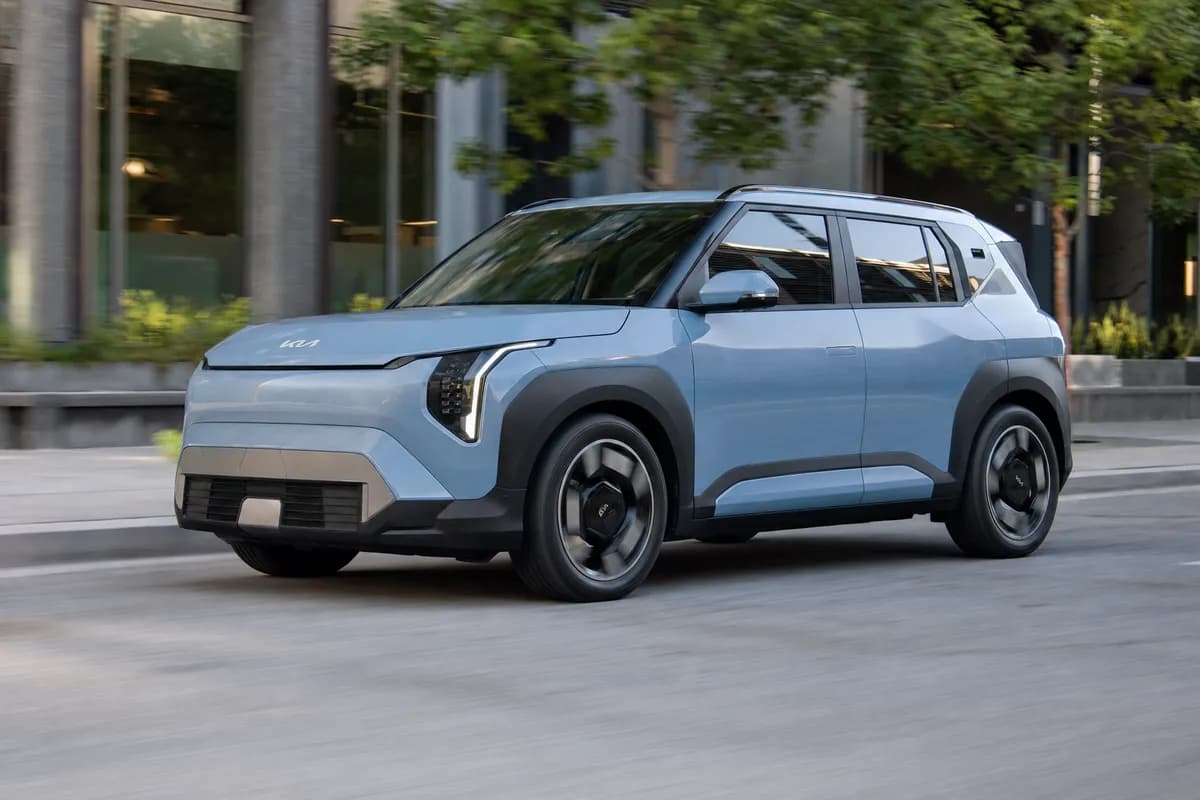
The basic pitch is simple: the EV2 is Kia’s smallest electric crossover, sitting below the EV3 and aimed at urban families, downsizers, and anyone who wants EV running costs without hauling around two tons of battery. In person, it avoids the toy-car trap. The design is upright, crisp, and surprisingly substantial, with Kia’s now-familiar pixel lighting signatures and squared-off surfacing that make it look more expensive than it likely needs to be.
Kia is targeting a starting price in Europe of roughly €30,000, depending on market and incentives, which puts this car in the thick of the affordable EV comparison conversation. That means direct pressure on the Volvo EX30, which starts higher in most markets, and on cars like the BYD Dolphin, which has built its case almost entirely on value. The Mini Aceman, meanwhile, comes at the segment from the style-and-brand side, usually with less generosity on space per euro.
Underneath, the EV2 uses Hyundai Motor Group’s smaller-car EV architecture rather than the full-fat 800-volt setup of the EV6 and EV9. No surprise there. What matters is that Kia has tuned the fundamentals well enough that it doesn’t feel like a cut-price engineering exercise.
Expected key specs
- Battery options: around 43 kWh and 58 kWh usable-capacity packs expected
- Drive layout: single-motor, front-wheel drive at launch
- Power output: roughly 113 hp to 150 hp depending on version
- WLTP range: approximately 186 to 273 miles
- DC fast charging: about 10-80% in 25 to 30 minutes on the larger battery
Those figures won’t terrify a Tesla Model 3 owner, but that’s not the mission. The EV2 is built for the school run, the city ring road, and the kind of suburban life where efficiency, visibility, and parking ease matter more than drag-strip bragging rights.
Urban range and charging: enough, and then some
The headline question for any 2026 Kia EV2 first drive is whether it can deliver useful range without becoming heavy, expensive, or both. On that front, Kia has judged the brief well. In mixed urban and secondary-road driving, the EV2’s projected real-world efficiency looks competitive, with consumption likely to land around 4.5 to 5.2 miles per kWh in gentle city use.
That gives the bigger-battery version a realistic urban range of around 220 to 250 miles, which is exactly where a small crossover needs to be. It won’t smash the segment, but it doesn’t need to. It just needs to avoid being the car that makes you think about chargers every time the weather gets cold, and on first impression, it does.
Against rivals, the EV2’s battery and charging strategy makes sense rather than chasing spec-sheet theater:
- Kia EV2: likely 43 kWh and 58 kWh packs, up to about 273 miles WLTP
- Volvo EX30: 51 kWh or 69 kWh battery, up to 295 miles WLTP in Single Motor Extended Range form
- BYD Dolphin: typically 45 kWh or 60.4 kWh battery, up to around 265 miles WLTP depending on trim
- Mini Aceman: around 42.5 kWh and 54.2 kWh usable battery options, up to roughly 252 miles WLTP
The Volvo still leads on outright performance and top-end range in the right version. The catch is price, and a cabin that feels more design manifesto than family toolkit. The BYD remains a value hammer, but its dynamics and software polish still lag the best European and Korean efforts. The Mini has character, but character does not create rear kneeroom or a bigger boot.
Cabin packaging: this is where the EV2 gets dangerous for rivals
Small on the outside, cleverly arranged inside: that’s the EV2’s killer app. Kia has used the tall roofline, flat floor, and upright seating position to create a cabin that feels one size up. This is not a miracle of physics, but it is very good packaging.
Front-seat space is generous, with excellent visibility and a low-stress driving position that suits the car’s urban mission. Rear-seat accommodation is the bigger surprise. Adults fit back there without performing yoga, and the square rear door apertures make child-seat duty less of a back-breaking insult.
Boot space is expected to land around the 400-liter mark, give or take final market spec, which would put the EV2 right near the top of this class. That matters more than a 0-62 mph sprint time in a small family EV, no matter what the internet tells you at 2 a.m.
Compared with the competition, Kia has focused on the stuff owners actually notice every day:
- More practical rear space than Mini Aceman
- Less claustrophobic cabin design than Volvo EX30
- More polished material and storage execution than BYD Dolphin
- Better balance of digital features and physical usability than most rivals
The dashboard layout is clean and modern, with a twin-screen setup that looks familiar if you’ve sat in the EV3. Mercifully, Kia still understands that burying climate functions in a touchscreen is an act of hostility. There are enough proper controls here to preserve your sanity in traffic.
How it drives: composed, quiet, and refreshingly unshowy
If you were hoping the EV2 would be a secretly rabid hot hatch on stilts, lower your expectations. This is not that car. What it is, though, is impressively refined for something at this end of the market.
The steering is light but accurate, body control is tidy, and the suspension has the kind of calm, mature damping that cheap EVs almost never manage. Over broken city surfaces, the EV2 keeps its composure better than the BYD Dolphin and feels less brittle than some larger-wheeled Mini products tend to. That alone will win it fans.
Performance from the likely 150-hp version is brisk enough, with 0-62 mph taking somewhere in the high-7-second to low-8-second range depending on final curb weight. That puts it comfortably ahead of slower entry-level EVs, even if it won’t match the absurd 3.6-second dual-motor Volvo EX30 Twin Motor Performance. Then again, neither will your insurance premium.
Noise suppression is another strong point. Wind and tire noise are well contained at urban and suburban speeds, and the car has that expensive-seeming hush that buyers increasingly expect from EVs. This is where the Kia EV2 review story gets interesting, because refinement is often the first thing sacrificed to hit a low price.
Driving strengths and weaknesses
- Strength: supple ride for the class
- Strength: easy one-pedal calibration and smooth regen blending
- Strength: excellent visibility and maneuverability
- Weakness: not especially quick in base form
- Weakness: front-wheel-drive layout means less playful balance than rear-drive EX30 versions
Kia EV2 vs Volvo EX30, BYD Dolphin, and Mini Aceman
This is where the EV2 makes its case. The Kia EV2 vs Volvo EX30 debate comes down to priorities. If you want the coolest badge, the quickest acceleration, and a more premium image, the Volvo still has real appeal. But if you want more intuitive usability, better packaging for the footprint, and a lower likely price, the Kia is the smarter buy.
Against the BYD Dolphin, the EV2 should justify a modest premium with better ride tuning, cleaner ergonomics, and a more upscale feel. BYD still wins if your spreadsheet is the only thing with a heartbeat. Most buyers, however, want a car that feels sorted as well as cheap.
The Mini Aceman remains the style-led choice. It is charming, distinctive, and likely to be more fun to look at than the Kia every single morning. It is also tighter inside and usually less generous on equipment for the money. Cute only gets you so far when the rear seats are occupied by actual humans.
The EV2’s talent is not that it dominates any single metric. Its talent is that it has no obvious weak spot, which in this class is far rarer and more valuable.
Verdict: one of 2026’s most convincing affordable EVs
The 2026 EV2 doesn’t arrive as a segment grenade. It arrives as something more dangerous: a deeply competent, intelligently packaged, realistically priced electric crossover with almost no nonsense baked in. Kia has not reinvented the small EV. It has simply done one properly.
That may be enough to make it the default recommendation for a huge number of buyers. The Volvo EX30 is quicker and flashier. The BYD Dolphin may undercut it on price. The Mini Aceman has more design swagger. But the EV2 looks set to be the one that best balances range, space, refinement, and everyday value.
If you’re shopping for the best small electric crossover 2026, put this near the top of the list. On first drive evidence, the EV2 feels like the affordable EV comparison winner for people who use their cars in the real world, not on social media.
Affiliate disclosure: This article contains affiliate links. RevvedUpCars may earn a small commission on qualifying purchases at no extra cost to you.