Discover the 2026 Ferrari 296 Challenge Stradale, a road-legal race car and hybrid supercar. Read Alex Torque's full review and explore its track-ready power.
In this article
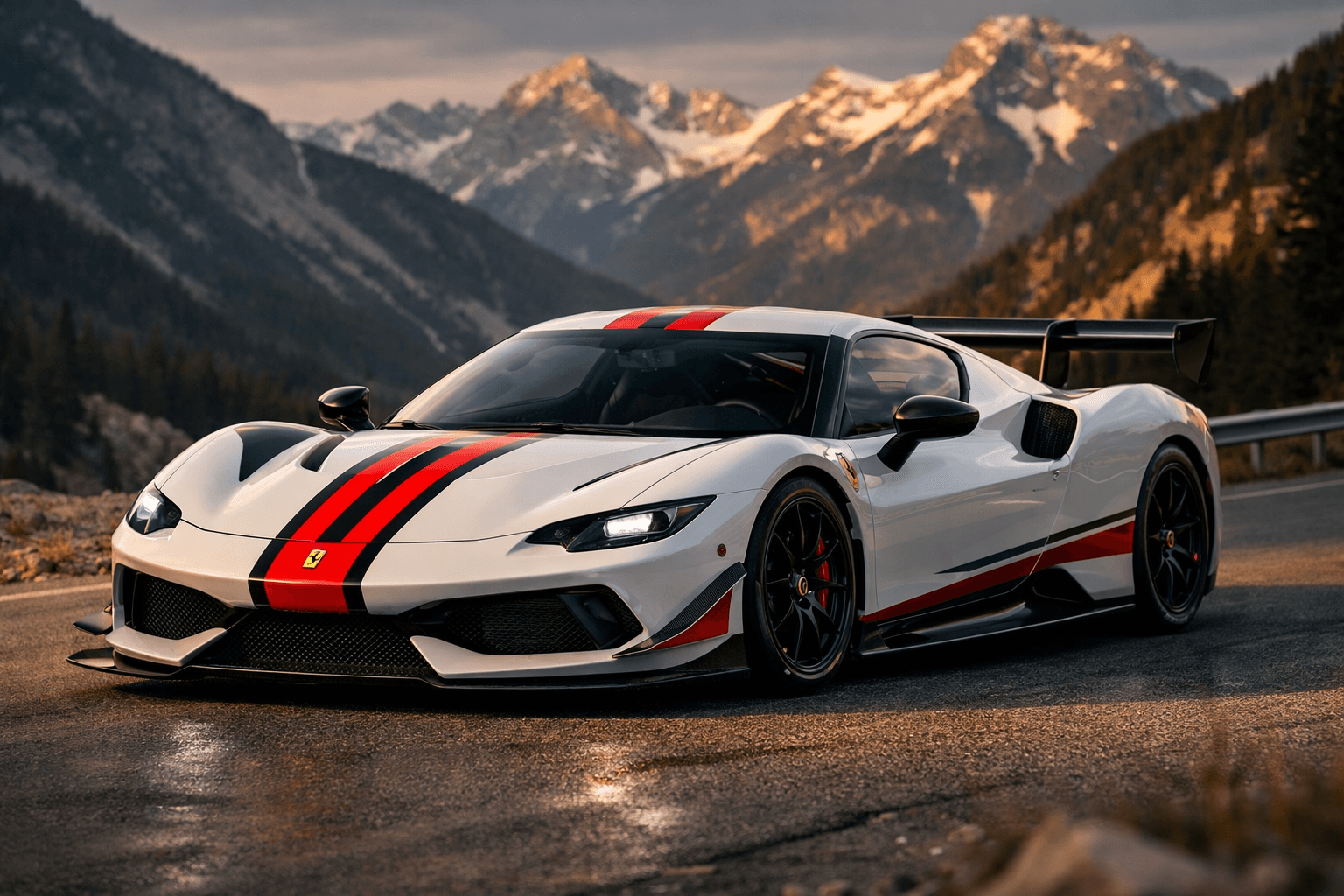
The first time I saw it sitting in pit lane at Fiorano, heat shimmering off its carbon fiber fenders, I actually laughed. Not because it’s funny—but because it’s absurd. This thing wears a license plate, yet it looks like it escaped from the Ferrari Challenge grid five minutes ago. The 2026 Ferrari 296 Challenge Stradale doesn’t whisper intent. It screams it through titanium exhaust tips and a rear wing that could double as patio furniture.
However, here’s the real question: is this just another “hardcore” Ferrari with a big wing and a big price, or is it genuinely the most focused hybrid supercar Maranello has ever built? After a day chasing apexes and chewing through Pirelli Trofeo Rs, I can tell you this—**this is the sharpest road-legal Ferrari I’ve driven since the 458 Speciale.** And yes, that includes the 488 Pista.
Furthermore, if you’ve been waiting for a Ferrari track car that blends electrified torque with old-school, high-revving drama, this is it. But it’s not for everyone—and Ferrari didn’t intend it to be.
Key Specs
Starting Price: Around $380,000 (check manufacturer website for latest pricing)
As-Tested Price: Around $420,000
Engine: 3.0L Twin-Turbo V6 + Electric Motor
Power: 868 hp / 546 lb-ft (combined)
0-60 mph: 2.6 seconds
Fuel Economy: 47-mile electric range (est.)
Transmission: 8-speed dual-clutch
Drivetrain: RWD
Curb Weight: Approx. 3,100 lbs
Cargo Space: 5.3 cu ft (front trunk)
Design & First Impressions
In the metal, the 296 Challenge Stradale looks less like a 296 GTB and more like a GT3 car that accidentally drove onto the Autostrada. The front splitter juts forward aggressively, the hood wears deep aero channels, and the rear wing is fully adjustable. Moreover, Ferrari claims significant downforce gains over the standard 296—think well north of 800 pounds at high speed.
In contrast to the already wild 296 GTB, this Ferrari 296 hardcore variant strips out pretense. Thinner glass, more exposed carbon, and vents carved everywhere like a sculptor went mad with a wind tunnel. The stance is lower, wider, angrier. Park it next to a McLaren 750S and the McLaren suddenly looks polite.
Notably, colors matter here. Rosso Corsa is classic, but the matte Grigio Nürburgring with exposed carbon aero bits makes it look like a stealth fighter. Additionally, Ferrari’s livery options—echoing its one-make Challenge series—turn this into rolling motorsport theater.
Interior & Technology
Open the featherweight door and you’re greeted by Alcantara, exposed carbon fiber, and less insulation than your average tent. The seats are fixed-back buckets that clamp your ribs like a racing harness. However, they’re surprisingly tolerable for an hour-long drive—any longer and you’ll start negotiating with your chiropractor.
Furthermore, Ferrari has simplified the cabin compared to the standard 296. There’s still a digital instrument cluster and central display, but menus are stripped back. Apple CarPlay remains, because even Ferrari knows you need Spotify on the way to the track. Meanwhile, physical controls on the steering wheel feel tactile and purposeful—no gimmicky capacitive nonsense. If you’ve read our take on why physical controls are making a comeback, you’ll appreciate this setup.
In fact, the cabin feels closer to the race-bred ethos we saw teased in the 2026 Ferrari Luce first look, but here everything serves lap time. Sound deadening is minimal. You hear pebbles pinging off the undertray. It’s glorious.
Behind the Wheel: Driving Experience
Advertisement
Fire it up and the twin-turbo V6 barks to life with a metallic snarl. However, it’s the electric motor that hits you first. Instant torque fills any hint of turbo lag, punching you out of slow corners like you’ve been rear-ended by a freight train. Then, at 8,500 rpm, the V6 takes over with a shriek that sounds more F1 than road car.
Moreover, throttle response is telepathic. The 8-speed dual-clutch snaps off shifts so violently in Race mode that your helmet would smack the headrest—if you’re smart enough to wear one. This is a Ferrari track car in every sense; it rotates eagerly on entry and claws out of corners with mechanical grip that borders on supernatural.
Steering? Razor sharp. There’s actual feedback through the wheel—tiny vibrations as the front tires load up. I’ve driven 40-plus performance hybrids, and most numb the experience. This doesn’t. It feels alive, like a 458 Speciale that discovered electricity and hit the gym.
Additionally, the brake modulation deserves applause. Carbon-ceramics bite hard but remain progressive, letting you trail-brake deep into corners without drama. At Laguna Seca’s Turn 2, I could feel the rear just begin to rotate under braking—controllable, predictable, addicting.
However, here’s the hot take: I’d take this over the SF90 on a technical track. The SF90 is faster in a straight line, yes. But the 296 Challenge Stradale feels lighter on its feet and more cohesive. It’s a scalpel compared to the SF90’s sledgehammer.
Let’s be honest—if you’re shopping here, you’re not cross-shopping a Prius. Still, the hybrid system allows for roughly 47 miles of electric-only range under gentle use. Check official efficiency data at FuelEconomy.gov as numbers are finalized.
However, once you start driving it as intended, fuel economy plummets into the teens. It requires premium fuel, obviously. Additionally, consumables—tires, carbon-ceramic pads—will vanish quickly if you drive it hard.
Insurance? Astronomical. Maintenance? Ferrari-level. For official specs and updates, see Ferrari’s official website. This is not a budget-friendly hybrid supercar; it’s a thoroughbred with thoroughbred costs.
Practicality & Daily Living
Technically, there’s a 5.3-cubic-foot frunk. You can fit a duffel bag and maybe a helmet. That’s it. In contrast to something like a Porsche 911 Turbo S, which offers actual rear seats and usable storage, this Ferrari barely tolerates groceries.
Visibility is decent forward, compromised rearward thanks to that wing. Meanwhile, the ride in its softest setting is firm but not punishing—think Cayman GT4 RS levels of compliance. However, potholes will make you wince.
As a road trip machine, it’s viable for two people packing light. But this car’s natural habitat is a racetrack, not a cross-country cruise. It’s the automotive equivalent of a marathon runner forced to walk the mall.
How It Stacks Up: Competitive Comparison
The obvious rivals? Porsche 911 GT3 RS, McLaren 750S, and Lamborghini Huracán STO. Each brings a different flavor of insanity.
Compared to the 911 GT3 RS, the Ferrari offers more outright power and electrified punch. However, the Porsche still delivers the purest naturally aspirated engine experience and arguably better steering feel. The GT3 RS remains the benchmark for track precision.
Against the McLaren 750S, the Ferrari feels more visceral and special inside. The McLaren rides better and is slightly more approachable at the limit. Meanwhile, the Huracán STO counters with theatrical V10 noise—but it can’t match the hybrid torque fill or efficiency.
Spec
296 Challenge Stradale
911 GT3 RS
McLaren 750S
Starting Price
$380,000
$241,300
$329,500
Power
868 hp
518 hp
740 hp
0-60 mph
2.6s
3.0s
2.7s
MPG/Range
47 mi EV
15 mpg
15 mpg
Cargo Space
5.3 cu ft
4.6 cu ft
5.3 cu ft
Warranty
3 yr/unlimited mi
4 yr/50,000 mi
3 yr/unlimited mi
Therefore, if you want the most emotionally intense hybrid supercar experience, the Ferrari wins. If you want lap-time consistency and value, the Porsche is hard to beat.
The Good
Explosive hybrid power with minimal turbo lag
Exceptional steering feedback and chassis balance
Serious aerodynamic grip for track use
Raw, race-inspired cabin atmosphere
More cohesive than the SF90 on tight circuits
The Bad
Eye-watering price and running costs
Minimal practicality and cargo space
Firm ride on rough roads
Will intimidate inexperienced drivers
Alex Torque's Verdict: 9.3/10
Best for: Track-obsessed drivers who want race-car intensity with a license plate.
Look elsewhere if: You want comfort, subtlety, or anything resembling practicality.
The 2026 Ferrari 296 Challenge Stradale isn’t just another special edition—it’s Maranello doubling down on what makes a Ferrari special: noise, nerves, and nuance at the limit. In a world drifting toward numb electric speed, this Ferrari 296 hardcore masterpiece proves you can have electrons and emotion in the same breath.
Would I daily it? Probably not. Would I sell a kidney for a few more laps? Don’t tempt me. Because the 2026 Ferrari 296 Challenge Stradale isn’t about commuting—it’s about chasing apexes until the sun sets and your brakes glow like embers.
Disclosure: This article may contain affiliate links. If you make a purchase through these links, we may earn a small commission at no extra cost to you. This helps support RevvedUpCars.com. Learn more.
Affiliate disclosure: some links on this page earn us a commission at no extra cost to you.
Alex Torque is a lifelong gearhead who grew up in Detroit with motor oil in his veins. After a decade as a performance driving instructor at Laguna Seca and the Nurburgring, he traded his racing helmet for a keyboard—though he still logs track days whenever possible. Alex specializes in sports cars, supercars, and anything with forced induction. His reviews blend technical precision with the visceral thrill of pushing machines to their limits. When he’s not testing the latest performance machines, you’ll find him restoring his 1973 Datsun 240Z or arguing about optimal tire pressures. Alex believes that driving should be an event, not a commute.
Get the latest car reviews in your inbox
Join thousands of car enthusiasts. No spam, unsubscribe any time.



Comments
Leave a comment