Jaguar’s 2027 electric rebrand is crystallizing in July 2026—now the big question is whether the first GT can win back Range Rover-era buyers.
Jaguar’s reset no longer looks theoretical. In July 2026, the brand’s stark new electric design direction is coming into focus at exactly the wrong—and potentially right—moment for the global luxury EV market.
The wrong moment, because premium EV demand has cooled from its early spike and buyers have become less forgiving. The right moment, because luxury customers are now looking for clearer identity, better execution, and something more distinctive than another anonymous electric crossover.
Jaguar’s electric reboot is finally becoming real
The central fact behind the Jaguar electric rebrand 2026 story is simple: Jaguar is no longer trying to evolve gently from its old lineup. It is attempting a hard break. The company has already wound down much of its legacy range, and its first next-generation production EV is expected to be a high-riding four-door GT positioned well above the outgoing I-Pace and far from the old XE, XF, and F-Type formula.
That is a huge gamble for a brand that spent years losing volume, relevance, and pricing power. Jaguar sold roughly 180,000 vehicles globally in 2018, but by the middle of this decade its volumes had fallen dramatically as the brand prepared for an all-electric relaunch. This is not a normal model-cycle transition. It is a near-total reinvention of product, price, design, and customer base.
The first new car, widely referred to as the Jaguar GT EV, is expected to sit on JLR’s new electric architecture and target a very different buyer from the old Jaguar norm. Pricing has been widely discussed in six-figure territory, putting it into the same conversation as upper-trim Porsche Taycan variants, Audi e-tron GT buyers, Mercedes EQS customers, and affluent Range Rover households that may be open to something more emotional.
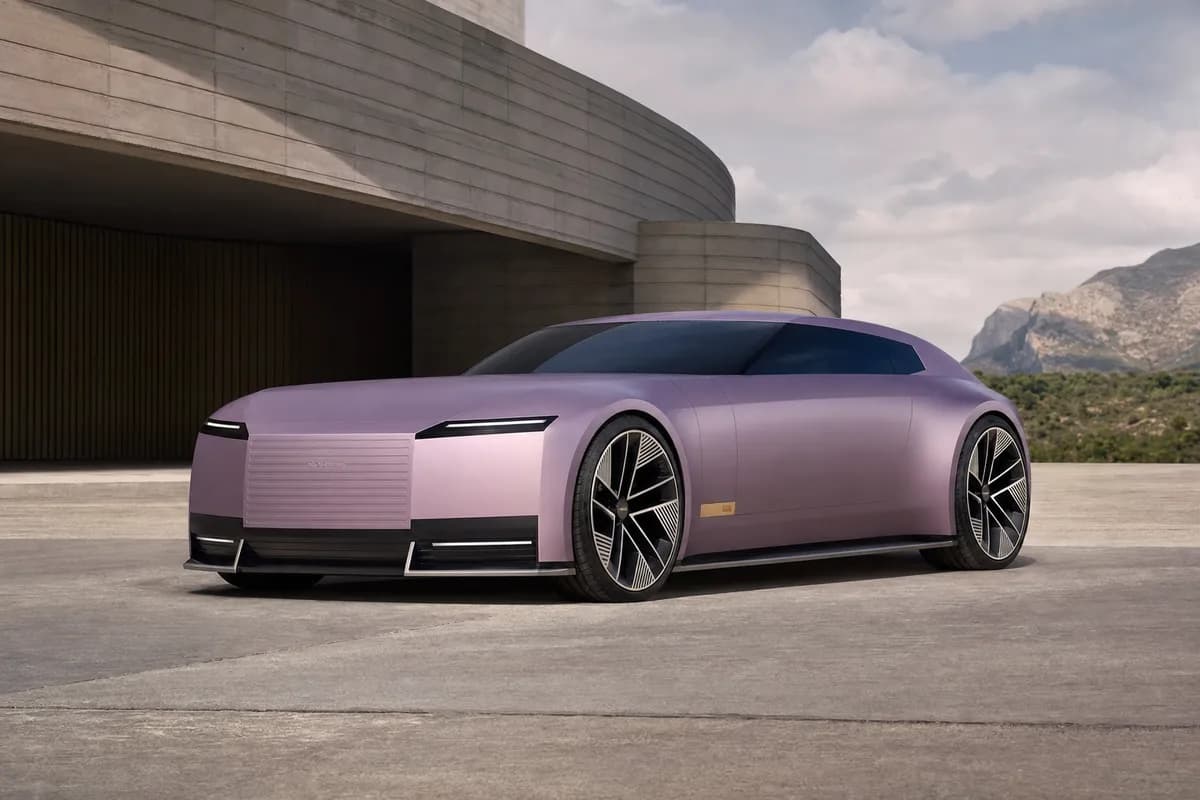
That new design language matters because Jaguar cannot win by being merely competent. The market already has competent luxury EVs. Jaguar needs to look expensive, feel rare, and project a stronger point of view than the conservative German default.
What the new design direction says about the 2027 Jaguar EV strategy
Jaguar’s emerging aesthetic is blunt, geometric, and intentionally divisive. The proportions appear set to emphasize a long wheelbase, cab-rearward stance, and a cleaner, more architectural surface treatment than the curves and vents that defined many recent Jags. That is not nostalgia. It is a bid to make Jaguar instantly recognizable again.
For the Jaguar 2027 EV plan, this is more than styling. It is brand triage. Jaguar spent too long caught between BMW’s sports-sedan discipline, Mercedes luxury cues, and Land Rover’s in-house gravitational pull. The new design direction tries to fix that by moving Jaguar upmarket and away from direct price-war territory.
There are several reasons this approach could work:
- Visual separation: Most premium EVs still look cautious. A bolder Jaguar has a chance to stand out in a crowded showroom and on the road.
- Margin over volume: Jaguar is unlikely to return to old sales numbers soon, so higher transaction prices matter more than chasing share.
- Internal differentiation: JLR needs Jaguar to be something other than a softer, less profitable cousin to Range Rover.
But there is also a clear risk. Polarizing design only helps if the rest of the car delivers. Buyers spending well into six figures will expect excellent software, fast charging, strong real-world range, top-tier cabin quality, and flawless dealer treatment. Distinctive design can open the door. It cannot excuse weak fundamentals.
That is especially true in a market where Porsche has continued refining the Taycan, Mercedes has expanded its EQ portfolio, BMW has improved its Neue Klasse messaging, and Lucid has shown that range and packaging still matter at the top end. Jaguar’s reboot will be judged as a complete luxury product, not as a brave design experiment.
Can Jaguar pull buyers away from Range Rover and other established luxury names?
One of the most interesting questions in this relaunch is whether Jaguar can win over customers who already trust JLR—but currently spend their money on Range Rover. For many affluent households, Range Rover has become the default premium choice inside the group. It carries stronger resale confidence, broader cultural cachet, and clearer product positioning than Jaguar has had for years.
That makes “Range Rover-era buyers considering a switch” a real audience, not a hypothetical one. If Jaguar’s new GT EV offers dramatic styling, strong performance, and a more driver-focused identity than a large luxury SUV, some buyers may see it as a second-car indulgence or even a primary statement vehicle. The appeal is not practicality. It is exclusivity and character.
Jaguar’s opportunity with those buyers rests on a few points:
- Design-led differentiation: Customers bored by familiar SUV silhouettes may want something lower, sleeker, and less expected.
- Brand heritage: Jaguar still has emotional capital tied to grand touring, style, and performance.
- EV timing: Some luxury buyers skipped first-wave EVs and may now be ready for a second-wave product that feels more special.
The challenge is that the same buyers also have little patience for compromise. Range Rover customers accept high prices because the badge has retained desirability and status through constant reinvestment. Jaguar, by contrast, must rebuild trust while asking for similarly serious money.
That means the first production GT cannot feel like a design-led halo with unfinished execution. If rear-seat space is compromised, software is inconsistent, or charging performance trails rivals, many buyers will simply stay in a Range Rover, move to Porsche, or wait for newer electric offerings from Bentley and Mercedes-Maybach.
The luxury EV market in 2026 is no longer forgiving
The broader luxury EV market 2026 backdrop makes Jaguar’s timing unusually difficult. EV growth has not stopped, but it has matured. Incentive wars, softer residual values in some segments, charging concerns, and buyer fatigue around overly screen-driven cabins have changed the mood from novelty to scrutiny.
In the premium space, that means three things. First, the easy conquest customers are mostly gone. Second, affluent buyers now compare EVs against excellent hybrids, plug-in hybrids, and combustion luxury models rather than treating battery power as an automatic upgrade. Third, brands with weak execution are exposed much faster.
Jaguar is entering that environment with both an advantage and a handicap:
- Advantage: It can relaunch with a clean-sheet identity rather than carrying over compromised legacy products.
- Handicap: It lacks the current market momentum, installed EV base, and buyer confidence of stronger premium rivals.
The old playbook of flooding dealers with inventory and relying on discounts would be fatal here. A low-volume, high-image EV strategy is the only sensible path. But that path requires Jaguar to hold pricing discipline and preserve scarcity without frustrating early adopters or alienating retail partners.
Why dealer risk may be the biggest near-term problem
The least glamorous part of the relaunch may prove the most important: Jaguar dealer strategy. Repositioning a struggling brand upmarket is not just a design and engineering problem. It is a retail-network problem. Dealers have endured shrinking Jaguar volumes for years, and many have depended far more heavily on Land Rover sales to justify their operations.
If Jaguar transitions to lower-volume, higher-priced EVs, some retailers could benefit from stronger per-unit economics. Others may see too little throughput to justify dedicated showroom space, staff training, charging investment, and customer-service upgrades. The risk is not abstract. Thin dealer commitment can quickly undermine a premium relaunch.
The main dealer challenges are clear:
- Lower volume: Fewer units mean less room for retail mistakes and weaker service absorption.
- Training demands: High-end EV buyers expect product experts, charging support, and software competence.
- Brand separation: Jaguar must feel distinct in mixed JLR retail environments dominated by Range Rover traffic.
- Residual-value pressure: Dealers will be cautious if early used values look unstable.
Jaguar likely knows this, which is why a more selective retail approach would make sense. Fewer, better-prepared outlets could support a premium positioning better than a broad network that still sells Jaguar as an afterthought. The danger is that shrinking access too much can also reduce visibility and service confidence, especially in North America.
Verdict: Jaguar can survive the reset, but only if the first GT is exceptional
Jaguar still has a path through this reset. The brand does not need old mass-market volume to survive, and it does not need to outsell German rivals in the EV era. It does need to become unmistakable again, command real pricing power, and deliver a first product good enough to reset expectations overnight.
That is why the first Jaguar GT EV matters so much. It has to prove that Jaguar’s radical new design language is backed by serious engineering, polished software, strong range and charging performance, and a retail experience worthy of six-figure money. If it does, Jaguar can carve out a credible niche as a lower-volume electric luxury brand with real identity.
If it misses, the market will be brutal. In the 2026 premium EV landscape, buyers have options, patience is thin, and prestige alone no longer covers execution gaps. Jaguar’s electric rebrand is bold enough to get attention. Survival depends on turning that attention into confidence.
Affiliate disclosure: This article contains affiliate links. RevvedUpCars may earn a small commission on qualifying purchases at no extra cost to you.