Global electric-vehicle demand picked up again in May 2026, extending a rebound that has looked increasingly durable in China and parts of Europe but still uneven in the United States.
Global electric-vehicle demand picked up again in May 2026, extending a rebound that has looked increasingly durable in China and parts of Europe but still uneven in the United States. For buyers, that headline matters less as a broad industry talking point than as a practical question: which automakers are actually converting stronger demand into momentum for real 2026 and 2027 models? The answer is not the same in every region. BYD continues to widen its advantage in China and other export markets, Hyundai is holding onto a strong position with efficient mainstream crossovers, GM is finally getting more volume from its Ultium-based lineup, and Tesla remains a global force even as its growth story has become more regionally dependent. Ford, meanwhile, is still fighting through the hardest problem in the current EV market: finding profitable volume in segments that mainstream buyers actually want at today’s prices.
Global EV demand in May 2026: the rebound is real, but it is not evenly shared
The big picture in global EV demand May 2026 is straightforward: battery-electric and plug-in hybrid sales continued to rise year over year, with China doing most of the heavy lifting, Europe stabilizing after a choppy incentive reset period, and the U.S. remaining the slowest of the three major regions. That pattern has defined the latest phase of the market.
China is still the center of gravity for EV growth because it combines lower-cost domestic supply, intense competition, strong charging buildout, and a buyer base now accustomed to EVs as mainstream products rather than early-adopter purchases. Europe is growing again, but more selectively. Demand is strongest where incentives remain supportive, charging is credible, and automakers have introduced newer, more affordable compact EVs. The U.S. is expanding too, just at a meaningfully slower pace.
That makes today’s 2026 EV sales trends less about whether EVs are growing at all and more about where each company is exposed. An automaker with strong China volume, a broad European lineup, or lower-cost compact EVs is positioned very differently from one still relying on larger, higher-priced U.S.-centric vehicles.
For consumers, the rebound also says something important about product fit. The models still gaining momentum tend to share a few characteristics:
- Competitive real-world pricing, not just attractive headline MSRPs
- Efficient packaging in crossover, hatchback, and compact sedan formats
- Fast charging that works consistently enough to reduce ownership anxiety
- Software and infotainment that feel current without becoming a distraction
- Strong value relative to internal-combustion alternatives, not just other EVs
That is one reason the current sales rebound is not lifting every brand equally. The market is rewarding automakers with products that are easier to justify as everyday purchases, while punishing those still asking buyers to pay a premium for vehicles that feel like compromises.
Which brands and 2026–2027 models are still gaining momentum
BYD remains the clearest winner in the current cycle. Its strength is not tied to one halo vehicle but to a deep bench of models across multiple price bands. The Seagull/Dolphin family, Atto 3, Seal, Seal U, and Song lineup continue to give BYD a scale advantage that rivals are struggling to match. In markets where it has a dealer and service foothold, BYD’s formula is simple and effective: modern packaging, acceptable to strong charging performance, aggressive pricing, and rapid product cadence. For the 2027 electric car outlook, BYD looks especially well placed because it can keep refreshing volume models faster than most legacy competitors.
Tesla is still one of the most important companies in the global EV market, but its momentum now looks more concentrated around price discipline, software familiarity, and charging convenience than sheer novelty. The Model Y remains a volume anchor in many regions because it still hits the practical sweet spot of crossover packaging, efficiency, and access to an excellent charging network. The refreshed Model 3 also remains competitive where pricing is rational. The question for Tesla in 2026 and 2027 is not whether it remains relevant; it clearly does. The bigger issue is whether it can return to broader growth without leaning so heavily on incentives, financing deals, and periodic price adjustments.
GM is in a better position than it was a year earlier because its EV rollout finally looks more tangible to regular shoppers. The Chevrolet Equinox EV is arguably the most important vehicle in GM’s current portfolio because it targets the heart of the U.S. crossover market rather than the edges. The Blazer EV has also become more competitive as software issues have been addressed. Cadillac’s Lyriq continues to give GM a credible premium offering, while the Silverado EV and GMC Sierra EV serve a more limited but strategically useful role in proving out the truck side of the business. If there is one GM model that best reflects where demand is heading, it is the Equinox EV: attainable size, familiar brand, and pricing that can attract buyers trading out of gas-powered compact SUVs.
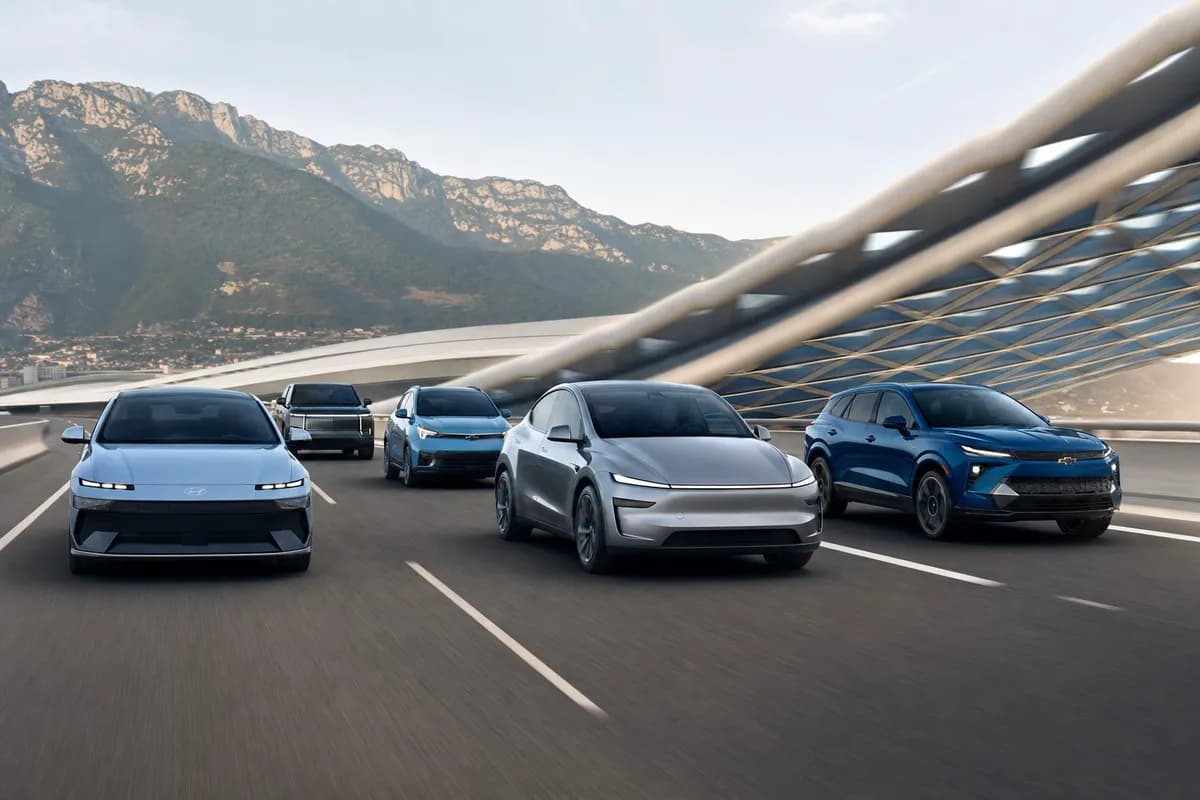
Hyundai Motor Group, including Hyundai and Kia, still has one of the strongest EV portfolios outside China. The Hyundai Ioniq 5, Ioniq 6, Kia EV6, and EV9 have all helped establish the group as a serious global player, and newer lower-cost entries are increasingly important to sustaining that momentum. Hyundai’s advantage is not just styling or technology. It is the company’s ability to combine good efficiency, competitive charging speeds on its E-GMP platform, and mainstream usability. Buyers notice when a vehicle charges quickly and drives normally without asking them to adapt around it. That continues to matter.
Ford is more mixed. The Mustang Mach-E remains its strongest EV product because it speaks the language of the market: it is a crossover, it is recognizable, and it is easier to live with than a battery-electric full-size pickup for most households. The F-150 Lightning still matters for Ford strategically, but the market for expensive electric trucks remains narrower than some early forecasts suggested. The E-Transit is important in fleet terms, though less visible to retail buyers. Ford’s problem is not lack of EV credibility; it is that its most expensive EV bets have landed in the market before battery costs and charging coverage have made those segments easy to scale profitably.
Among the specific models with the best momentum heading into 2027, several stand out:
- Tesla Model Y for global practicality and charging access
- Chevrolet Equinox EV for U.S. mass-market relevance
- Hyundai Ioniq 5 and Kia EV6 for charging speed and everyday usability
- BYD Dolphin, Atto 3, and Seal for value and broad international potential
- Ford Mustang Mach-E for staying power in a crowded crossover field
Why the U.S. EV market is still lagging Europe and China
The story of the U.S. EV market lagging is not about consumer resistance in the abstract. It is about market structure. U.S. buyers still face a tougher set of trade-offs than buyers in China and many parts of Europe.
First, affordability remains the biggest barrier. The U.S. market is still too reliant on larger vehicles, and electrifying larger vehicles generally means more battery cost. That pushes transaction prices up. Even when tax credits apply, many buyers are looking at monthly payments that remain too close to premium-car territory.
Second, charging is improving but still inconsistent. Tesla owners continue to benefit from the most mature fast-charging experience, and the opening of more North American Charging Standard access is a long-term positive. But for many non-Tesla buyers, public charging remains less predictable than it should be. In Europe, denser urban layouts and broader policy support have helped EV adoption, while China has built charging scale at a pace the U.S. has not matched.
Third, policy support in the U.S. is more fragmented. Tax-credit rules tied to sourcing and assembly have encouraged domestic investment, which is strategically important, but they have also made the market more confusing. Europe may have had its own policy disruptions, but many countries still present a clearer ownership case to buyers. China goes further, with industrial policy, local competition, and infrastructure all aligned around EV expansion.
Fourth, the U.S. product mix is still not ideal. The market needs more compact and midsize EVs at lower prices, but automakers historically made more money on bigger trucks and SUVs. That has slowed the arrival of truly mass-market EVs. GM is starting to address that with the Equinox EV. Hyundai and Kia have done it better than many rivals. Tesla’s lower-price strategy has helped. But the gap remains.
The U.S. is not failing to adopt EVs. It is trying to scale EVs through a vehicle mix and retail environment that make affordability harder than in China and less policy-coordinated than in Europe.
That is the central reason sales growth in the U.S. continues to trail. It is not one problem. It is several medium-sized problems landing on buyers at once.
What this means for Tesla, GM, Hyundai, Ford, and BYD
For Tesla, the rebound confirms that it is still structurally strong, especially where charging confidence matters most. But it also underlines that Tesla is no longer operating in a market where product age and narrower lineups can be ignored forever. The company remains highly competitive on efficiency, software integration, and charging, yet it now faces more pressure to keep its mainstream lineup fresh and broaden its appeal beyond the same core models.
For GM, this is the kind of market environment it needed. If EV demand is rising gradually rather than spiking irrationally, execution matters more than hype. That favors companies that can put genuinely mainstream products in front of buyers. GM’s task now is straightforward but difficult: make sure Equinox EV and Blazer EV availability, quality, and pricing stay strong enough to convert curiosity into repeatable volume.
For Hyundai, the current market validates its strategy. The company has spent years proving that EVs can be efficient, well packaged, and relatively easy to own. Its challenge heading into 2027 is preserving that edge as rivals improve and as lower-cost Chinese brands expand in more export markets. Hyundai has strong products; the next test is margin resilience and sustained share.
For Ford, the sales rebound is less automatically helpful. If the market is rewarding affordable, efficient, everyday EVs, Ford needs more of them. The Mach-E still works. The Lightning still has strategic value. But Ford’s path to stronger EV momentum likely depends on broadening its lineup below the full-size truck price band and controlling losses more tightly as it does so.
For BYD, the message is the most positive. Rising global demand in 2026 plays directly into BYD’s strengths: vertical integration, deep model coverage, and the ability to compete aggressively on price. The biggest constraint on BYD’s growth is less about product readiness than market access, brand building, and the political trade environment in North America and Europe.
Verdict: the winners in 2026 and 2027 will be the brands selling usable EVs, not just impressive ones
The latest rebound in global EV demand May 2026 is encouraging for the industry, but it is even more revealing for buyers. The market is telling automakers that the next phase of EV growth will not be won mainly by spectacle, extreme performance, or oversized batteries. It will be won by companies that deliver convincing everyday transportation at prices more people can absorb.
That is why BYD continues to gain. It is why Hyundai remains one of the most credible non-Chinese EV players. It is why GM’s Equinox EV matters more than almost any concept car. It is why Tesla’s Model Y is still such a force. And it is why Ford, despite strong brand recognition, still has more work to do to align its EV business with the widest part of the market.
For shoppers, the practical takeaway is clear:
- Expect the best value to remain in compact and midsize EV crossovers rather than large trucks.
- Watch charging access and real transaction prices more closely than headline range numbers.
- Assume China and Europe will keep moving faster than the U.S. unless affordability and charging improve materially.
- Look to the 2027 model pipeline for more refined, lower-cost EVs rather than dramatic one-off breakthroughs.
The 2027 electric car outlook is therefore less about a sudden transformation than a sorting process. The brands gaining momentum now are the ones building EVs that feel normal, useful, and financially plausible. In this phase of the market, that is what wins.
Affiliate disclosure: This article contains affiliate links. RevvedUpCars may earn a small commission on qualifying purchases at no extra cost to you.