Explore the BMW X7 vs Escalade showdown and see if BMW's flagship SUV meets dealer demands in the full-size luxury SUV market. Read more now!
Here’s a spicy truth bomb: the BMW X7 has been cosplaying as a “big SUV” for years, but park it next to a Cadillac Escalade and it suddenly looks like it skipped leg day. That’s why the BMW X7 vs Escalade debate matters right now, especially as buyers with $100k to burn are asking whether BMW is finally ready to go properly American-sized. I’ve driven dozens of full-size luxury SUVs, and this matchup isn’t just Germany versus Detroit—it’s philosophy versus sheer audacity.
The Escalade has become a rolling status symbol, like a Swiss watch inflated with steroids, while BMW insists its flagship SUV is about “precision” and “dynamic excellence,” even when it weighs nearly three tons. Dealers will happily tell you both are sold out, both are exclusive, and both justify eye-watering markups. But if you actually care about how these beasts drive, feel, and age in your garage, the BMW X7 vs Escalade question deserves more than showroom hype.
This isn’t about which badge impresses your neighbors; it’s about whether BMW’s biggest SUV is big enough—in size, presence, and attitude—to steal buyers from America’s luxury land yacht king. Spoiler: one of these feels engineered by people who love Nürburgring lap times, and the other by people who understand Texas.
Quick Specs
- Starting Price: BMW X7 approximately $82,000; Cadillac Escalade starting around $85,000 (check manufacturer website for latest pricing)
- Engine: X7 3.0L turbo inline-six / 4.4L twin-turbo V8; Escalade 6.2L V8 or 3.0L diesel
- Power: X7 up to 523 hp; Escalade 420 hp (682 hp in Escalade-V)
- 0-60 mph: X7 M60i about 4.5 seconds; Escalade about 5.9 seconds
- Fuel Economy: X7 approx. 21 mpg combined; Escalade approx. 16 mpg combined
The Contenders: German Precision vs American Excess
The BMW X7 is Munich’s idea of a flagship SUV: sharp creases, tech-forward cabin, and marketing buzzwords like “athletic poise” sprinkled everywhere. The Cadillac Escalade is subtler in its messaging—it just shows up enormous, chrome-heavy, and confident, like it owns the parking lot. Rivals like the Lincoln Navigator, Mercedes-Benz GLS, and Lexus LX exist, but let’s be honest, these two dominate the conversation.
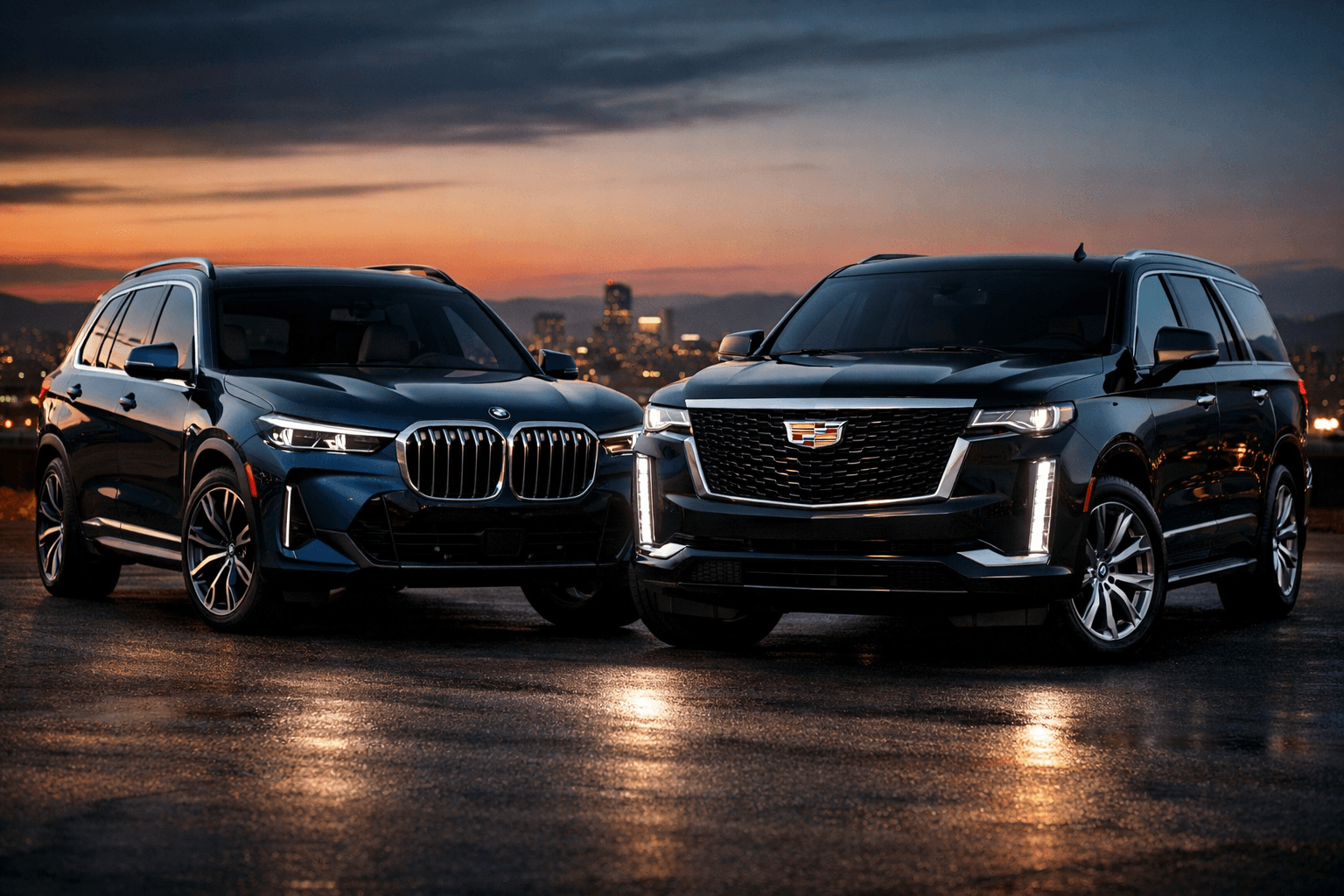
BMW claims the X7 is “full-size,” but dimensionally it’s closer to the GLS than a true Escalade rival. The Escalade is longer, wider, and offers cargo space that makes Home Depot runs feel like child’s play. Hot take: BMW doesn’t actually want to build an Escalade rival because that would mean admitting Americans were right about big SUVs all along.
Design Face-Off: Presence Matters
Park an Escalade outside a steakhouse and people assume you’re important or at least pretending convincingly. Its vertical LED lights and slab sides scream confidence, even if subtlety died somewhere around the wheelbase measurement. The X7 looks handsome and expensive, but next to the Cadillac it feels like it’s apologizing for taking up space.
BMW’s design team clearly focused on aerodynamics and “sportiness,” which is admirable, but buyers in this segment want drama. The Escalade delivers that in spades, especially in Sport Platinum trim with 22-inch wheels. If design were a YouTube thumbnail, the Escalade gets clicked every time.
Interior & Tech: Screens, Leather, and Ego
Inside, the X7 is beautifully assembled, with tight panel gaps and materials that feel like they’ll survive a decade of abuse. BMW’s curved display looks slick, though the touch-heavy iDrive controls can be fiddly—throttle response isn’t the only thing that can feel lazier than a cat in a sunbeam here. The Escalade counters with a 38-inch OLED display that looks like it was stolen from a Vegas casino.
Cadillac’s Super Cruise remains a genuine party trick, offering hands-free driving on thousands of miles of mapped highways, and it works brilliantly. BMW’s driver assists are competent but less confidence-inspiring. If you care about UX philosophy, you’ll enjoy our deep dive on why screen overload can ruin good design.
This is where the BMW X7 punches above its weight. The M60i’s 523 hp V8 hustles this brick to 60 mph in about 4.5 seconds, which is frankly ridiculous. It corners flatter than it has any right to, channeling a bit of Chris Harris-approved lunacy.
The standard Escalade is no slouch, but it’s tuned for wafting, not hunting apexes. Yes, the Escalade-V exists with 682 hp and a supercharger soundtrack that could wake the dead, but it also drinks fuel like it’s free. Most buyers will never exploit the BMW’s dynamic edge, which leads to my controversial take: BMW over-engineered the X7 for an audience that mostly wants comfort.
Value Breakdown: Where the Money Goes
On paper, pricing is closer than you’d expect, but dealer demands change everything. Escalades often command premiums because demand is relentless, something we’ve discussed in our analysis of BMW’s struggle to rival Escalade dominance. BMW dealers are more willing to negotiate, especially on higher trims.
Running costs favor the X7 slightly, thanks to better fuel economy and smaller dimensions. For official efficiency figures, FuelEconomy.gov remains the best source. Reliability is a toss-up, though Cadillac’s simpler powertrains may age more gracefully.
BMW X7 vs Escalade: The Reality Check
This is the heart of the BMW X7 vs Escalade debate: BMW built a brilliant large SUV, but Cadillac built a cultural icon. The X7 excels if you actually drive your SUV like a car, tackling twisty roads and caring about steering feel. The Escalade excels if you want space, presence, and tech that impresses every passenger.
If you’re still cross-shopping, our guide on how to choose three-row SUVs like Escalade & BMW is worth a read before you sign anything. Also, check safety ratings directly from NHTSA for peace of mind.
| Spec | BMW X7 | Cadillac Escalade |
|---|
| Starting Price | Approx. $82,000 | Approx. $85,000 |
| Power | Up to 523 hp | 420 hp (682 hp Escalade-V) |
| 0-60 mph | 4.5s | 5.9s |
| MPG/Range | ~21 mpg | ~16 mpg |
| Cargo Space | 90.4 cu ft | 121 cu ft |
| Warranty | 4 yr/50,000 mi | 4 yr/50,000 mi |
Pros
- BMW X7 drives far better than its size suggests
- Escalade offers unmatched interior space
- Both deliver serious luxury and tech
- Strong resale demand in this segment
Cons
- X7 lacks true full-size presence
- Escalade fuel economy is brutal
- Dealer markups can sour the experience
RevvedUpCars Rating: 8.5/10
Best for: Buyers torn between driving enjoyment and unapologetic luxury presence.
So, is BMW ready to go bigger? In the BMW X7 vs Escalade showdown, the answer is “almost.” BMW built the better driver’s SUV, but Cadillac still owns the room, the road, and the reputation—until Munich decides to stop pretending and build something truly colossal.
Get the latest car reviews in your inbox
Join thousands of car enthusiasts. No spam, unsubscribe any time.



Comments
Leave a comment