Bidirectional charging is shifting from pilots to real options. Here’s which 2026–2027 EVs can power homes and enable utility V2G programs.
Bidirectional charging is moving from pilot-project jargon to a real buying factor in 2026. For a growing list of EV owners, the question is no longer just how fast a car charges, but whether it can keep the lights on during an outage or earn money from a utility program.
That shift matters because bidirectional charging 2026 is finally lining up on three fronts at once: more capable vehicles, more home hardware, and more utility support. The result is a market where Ford, GM, Hyundai, Kia, Tesla, and Nissan owners are starting to see practical value beyond miles of range.
Why bidirectional charging is becoming a mainstream EV feature
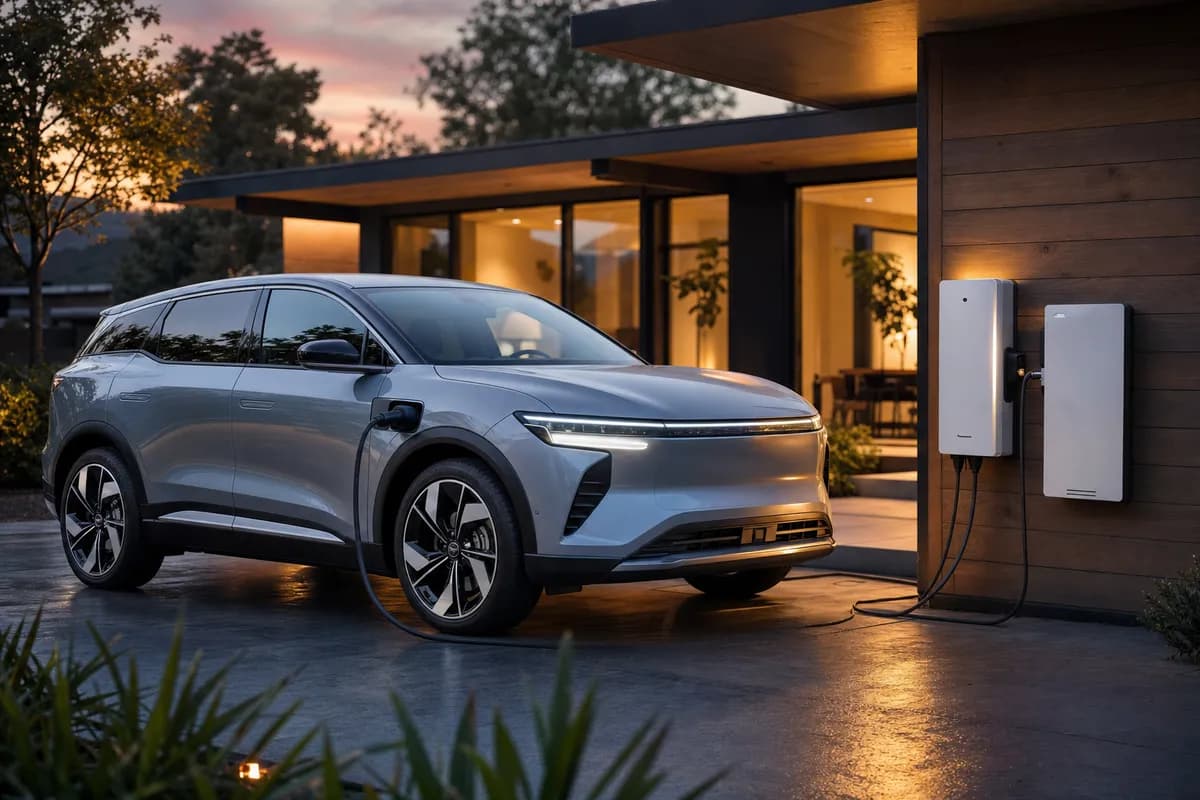
Bidirectional charging lets electricity flow both ways. In plain terms, an EV can charge from the grid, but it can also send power back out to a home, a building, or the grid itself.
There are two main use cases. Vehicle-to-home, or V2H, means the car acts as a home backup battery. Vehicle-to-grid, or V2G, means the vehicle can export power to the utility network, usually through a managed program.
That difference matters. A lot of vehicles now support some form of power export, but not all of them support full home integration, and even fewer are enrolled in true vehicle to grid utilities programs at scale.
What changed by May 2026 is that the pieces are finally connecting. More EVs are shipping with native bidirectional capability, charger makers have brought UL-listed home energy systems to market, and utilities are under pressure to find flexible capacity as power demand rises from data centers, heat pumps, and EV charging itself.
Which 2026-2027 EVs can power your home, and which ones still have limits
The list of V2H V2G EVs is longer than it was even a year ago, but capability still varies by platform, battery architecture, and region. Some vehicles can run appliances directly from onboard outlets. Others can support whole-home backup through dedicated equipment.
- Ford F-150 Lightning: Still the most established mainstream home-backup EV in the U.S. with the Intelligent Backup Power system. With the extended-range battery, usable capacity is roughly 131 kWh, enough to cover many homes for several days depending on load.
- Chevrolet Silverado EV and GMC Sierra EV: GM’s Ultium-based trucks support bidirectional hardware through the GM Energy ecosystem. Real-world capability depends on trim, charger installation, and utility interconnection, but these are now core GM entries in the 2026 EV home backup conversation.
- Chevrolet Equinox EV, Blazer EV, Cadillac Lyriq: GM has expanded bidirectional compatibility beyond pickups, though rollout remains more fragmented than Ford’s. Buyers need to verify both vehicle firmware and home hardware support.
- Hyundai Ioniq 5, Ioniq 6, Kia EV6, EV9: These E-GMP models popularized vehicle-to-load, or V2L, with export power for tools, appliances, and emergency use. Newer North American rollout plans are pushing further toward integrated home backup, especially with the EV9 and updated charging hardware.
- Tesla Cybertruck: Tesla’s Powershare system brought bidirectional capability into Tesla’s lineup in a more formal way. Cybertruck can support home backup when paired with approved gateway and power equipment.
- Nissan Leaf: The old pioneer still matters. Leaf has long supported CHAdeMO-based bidirectional charging and remains one of the clearest examples of V2G readiness, though its aging platform and charging standard limit mass-market momentum.
- Nissan Ariya: Ariya has been expected to play a larger role in Nissan’s next-phase bidirectional strategy, but market availability of full home and grid functions still depends heavily on region and program partners.
The key caveat is simple: not every EV with an outlet can power your house. Vehicle-to-load is useful, but it is not the same as a transfer-switch-equipped, utility-approved V2H setup. That distinction will shape owner satisfaction more than marketing language.
What the latest rollouts mean for Ford, GM, Hyundai, Kia, Tesla, and Nissan owners
Ford still has the strongest consumer-facing message. The F-150 Lightning remains the easiest bidirectional vehicle for mainstream buyers to understand because Ford tied the truck, the home integration system, and the backup use case together early. The downside is cost: installation for full-home backup can still run into several thousand dollars beyond the vehicle itself.
GM is now the broadest legacy automaker in this space. GM Energy has expanded from a truck story to a portfolio play, linking Ultium vehicles with chargers, stationary storage, and home energy management. That gives GM owners a larger long-term ecosystem, even if the experience remains more complex than Ford’s in practice.
Hyundai and Kia have an edge in consumer awareness because V2L has been visible and useful from day one. Owners of the Ioniq 5, Ioniq 6, EV6, and EV9 already understand the idea of using the car as a power source. The challenge for both brands is bridging that portable-power reputation into fully approved home-backup and eventual grid-service programs in North America.
Tesla’s position is unusual. For years, Tesla focused on Powerwall and avoided broad bidirectional support in its passenger cars. Cybertruck changed that. For Tesla owners, the significance is not just product capability, but the possibility that Tesla could eventually link vehicle backup, solar, and home energy software into one tightly controlled system.
Nissan deserves credit for being early, but early is not the same as dominant. Leaf proved that electric cars power your house is not a futuristic concept. In 2026, though, Nissan’s challenge is to convert that technical legacy into broader, easier, CCS- and NACS-era relevance.
Why utilities are finally paying attention to EV batteries
Utilities have talked about EVs as grid assets for years. What changed is economics. A single EV battery can store far more energy than a typical home battery system, and aggregating thousands of parked vehicles creates a flexible resource that can help shave peak demand or support local reliability.
That is why vehicle to grid utilities programs are expanding from pilots into limited commercial offerings. Utilities in California, Texas, New York, and parts of the Southeast are increasingly testing managed charging, backup-power incentives, and export programs that pay customers for availability or delivered energy.
Compensation still varies widely. Some programs offer bill credits for enrolling a compatible charger and vehicle. Others pay event-based incentives during peak periods. A few are moving toward capacity-style payments, where owners are compensated for making battery energy available, not just for the electricity actually discharged.
- Backup resilience: Utilities like V2H because it reduces outage pressure and improves customer resilience without building new local storage everywhere.
- Peak shaving: EV fleets can discharge during the most expensive demand windows.
- Renewable balancing: Midday solar oversupply can be absorbed by vehicles and later exported when demand rises.
- Deferred grid upgrades: Managed charging and V2G can reduce strain on transformers and distribution circuits in some neighborhoods.
There are still barriers. Interconnection rules differ by state and utility. Bidirectional chargers remain expensive. Battery warranty language is not always clear about frequent export use. And standards are still split across CCS, NACS, ISO 15118, and utility-specific communications layers.
What buyers should actually look for in 2026
The smart question is not just whether a vehicle supports bidirectional charging. Buyers should ask what kind of bidirectional charging it supports, what hardware is required, and whether a local utility program exists.
- Check the power type: V2L, V2H, and V2G are not interchangeable.
- Confirm home hardware: Many systems require a specific charger, inverter, gateway, and transfer equipment.
- Verify utility approval: A technically capable EV may still be unusable for export in your service territory.
- Read the warranty: Export cycling policies differ by automaker.
- Look at battery size: A 100-plus-kWh truck battery offers very different backup value than a smaller crossover pack.
The bottom line is that bidirectional charging 2026 is no longer niche. Ford remains the most mature in consumer home backup, GM has the broadest ecosystem ambitions, Hyundai and Kia are well positioned to scale up from V2L to full V2H, Tesla has finally entered the category in a serious way, and Nissan still has real technical credibility despite losing momentum.
The next phase will be shaped less by flashy launch claims and more by utility integration, installation cost, and standardization. If those pieces keep improving, the EV parked in the driveway will increasingly be sold not just as transportation, but as part of the house and part of the grid.
Affiliate disclosure: This article contains affiliate links. RevvedUpCars may earn a small commission on qualifying purchases at no extra cost to you.