Jeep brings the Cherokee back to the two-row fight. We drive it for everyday comfort, trail capability, and hybrid-era value versus key rivals.
Jeep killed the Cherokee, waited while the market got even hotter, then brought it back into a crossover knife fight. The 2026 model lands in the heart of America’s favorite battlefield: rugged-looking, family-friendly two-row SUVs that promise campsite vibes and Costco competence in the same breath.
That makes this 2026 Jeep Cherokee first drive more than a nostalgia exercise. The real question is whether Jeep has finally built a Cherokee that can outsmart a Subaru Outback, out-style a Toyota RAV4, and out-authenticate the soft-road set without becoming miserable on the morning commute.
A Cherokee That Looks Like a Jeep Again
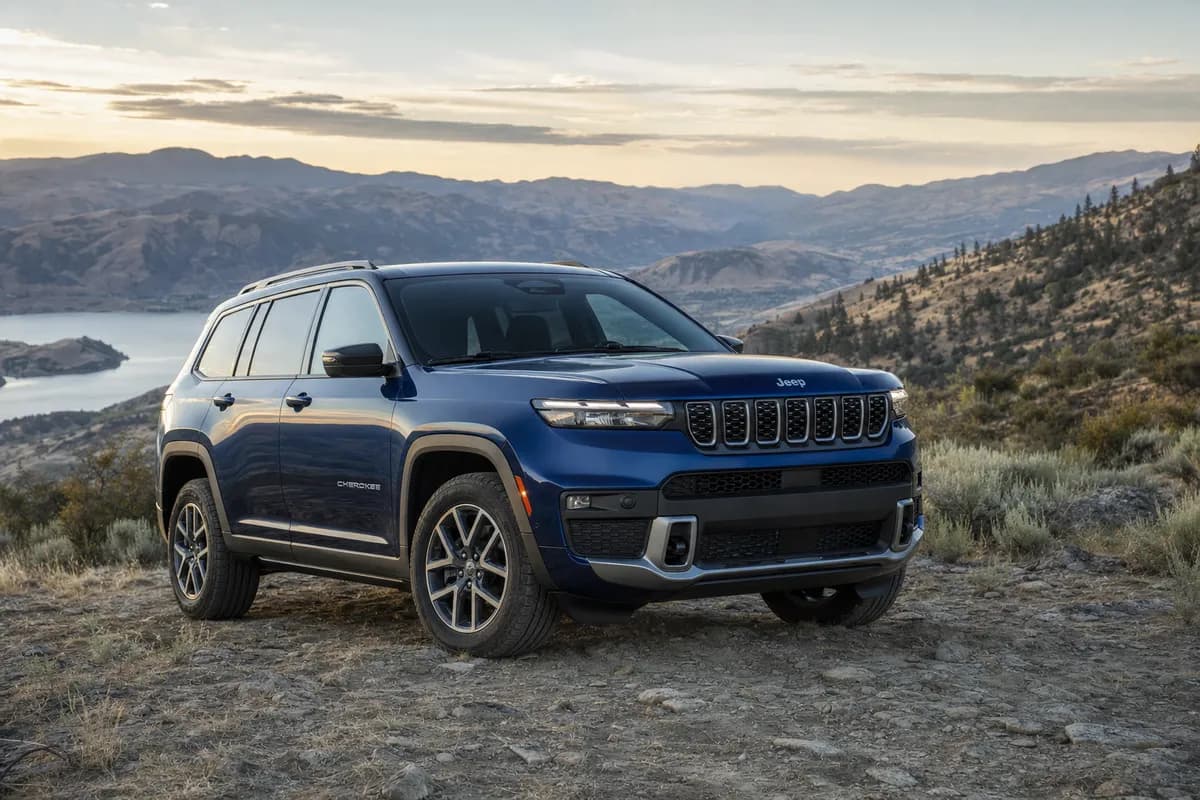
The old Cherokee always carried a bit of identity confusion. This new one does not. The 2026 Cherokee leans hard into squared-off Jeep design cues, with a bluff nose, upright greenhouse, short overhangs, and just enough visual toughness to remind the parking lot that this brand still knows what a trail looks like.
Underneath, the Cherokee rides on Stellantis’ STLA Large-derived architecture tailored for midsize and compact applications, which gives Jeep room for gas, hybrid, and eventually plug-in variants. At launch, the lineup centers on a turbocharged four-cylinder and a hybrid setup, with front-wheel drive standard on lower trims and all-wheel drive available broadly. Jeep says the hybrid will be the volume play, and that is exactly where it should put its chips.
Dimensionally, the Cherokee lands right where it needs to. It is a two-row SUV aimed squarely at the Subaru Outback, Ford Bronco Sport, Honda CR-V, and Toyota RAV4, with a footprint larger than a Compass but tidier than a Grand Cherokee. Translation: family-friendly without feeling like you need a commercial driver’s license to park it.
On-Road Manners: Better Than a Jeep Has Any Right to Be
The surprise of this 2026 Jeep Cherokee review is not that it can handle dirt. It is that it feels properly sorted on pavement. Ride quality is supple without turning floaty, and the body control over broken back roads is tighter than what you get in a Subaru Outback, which still tends to heave and bob when pushed.
Steering is light but not numb, and that matters because too many “adventure” crossovers feel like they were tuned by accountants. The Cherokee is not sporty in a Mazda CX-50 sense, but it tracks cleanly, settles quickly after impacts, and stays quieter at 70 mph than a Ford Bronco Sport. Wind noise is well managed, and tire roar is lower than expected on all-terrain-leaning trim packages.
The turbocharged gas model is competent rather than charismatic. Expect output in the neighborhood of 250 horsepower, enough to move the Cherokee with authority but not enough to make you invent errands. The hybrid is the smarter drivetrain, with stronger low-speed response, smoother stop-start operation, and the kind of real-world efficiency this class now demands.
Jeep is targeting roughly 35 mpg combined for the hybrid, which would put it in the fight with the Toyota RAV4 Hybrid at 39 mpg combined and ahead of the Ford Bronco Sport, which tops out at 29 mpg combined with the 1.5-liter turbo. The Subaru Outback remains roomy and likable, but even the base 2.5-liter version manages just 28 mpg combined, and it feels slower doing it.
How the key rivals stack up on paper
- 2026 Jeep Cherokee Hybrid: about 35 mpg combined, available AWD, higher trail capability
- Toyota RAV4 Hybrid: 219 hp, 39 mpg combined, excellent resale, less personality
- Subaru Outback 2.5: 182 hp, 28 mpg combined, wagon practicality, softer responses
- Ford Bronco Sport Badlands: 250 hp, 26 mpg combined, real off-road hardware, noisier ride
Cabin, Tech, and Everyday Use: Finally Competitive
If you have been inside recent Jeeps, the Cherokee’s cabin will feel familiar in a good way. Materials are improved, switchgear feels sturdier than the old model’s, and the layout favors actual usability over touchscreen cosplay. Jeep has learned that buyers in this class want rugged looks, yes, but they also want someplace to put a coffee, a phone, and a week’s worth of family clutter.
The seating position is upright and commanding, which sounds trivial until you hop back into a RAV4 and remember how many mainstream SUVs still make you feel slightly perched rather than properly planted. Front seats are supportive over long stints, and rear-seat legroom is competitive. Cargo space trails the boxiest rivals slightly, but the area is square and easy to load.
Infotainment should be one of the Cherokee’s strengths. Expect a large central touchscreen running Jeep’s latest Uconnect system, still one of the better interfaces in the business because it does not make basic tasks feel like a software engineering exam. Wireless Apple CarPlay, Android Auto, over-the-air updates, and a full suite of driver assists are all here, as they must be in any candidate for best compact SUV 2026.
One caveat: some upper trims edge into price territory where expectations rise sharply. Once you stack premium audio, panoramic glass, hybrid hardware, and trail packages, the Cherokee can drift into the mid-$40,000 range. That is not insane in 2026, but it does put Jeep dangerously close to better-finished alternatives and its own larger siblings.
Trail Cred: More Real Than Most, Less Compromised Than a Bronco Sport
Here is where the Jeep badge has to cash the check its grille keeps writing. The good news is that the Cherokee actually backs it up. Available all-wheel-drive systems, useful ground clearance, selectable terrain modes, and Jeep’s off-road calibration give it more genuine dirt-road and moderate-trail confidence than a RAV4 or CR-V.
In Trailhawk-style specification, the Cherokee is the one mainstream hybrid-leaning crossover that still feels engineered by people who occasionally leave pavement on purpose. Approach and departure angles are meaningfully better than what you get in the Subaru Outback, and wheel articulation is decent for the segment. No, it is not a Wrangler. Thank God. Wranglers are fun in the wild and annoying on the interstate.
The closest philosophical rival is the Ford Bronco Sport Badlands. That Ford is a legitimate little bruiser, with twin-clutch rear-drive hardware and an eagerness to scramble up ugly terrain. But the Bronco Sport pays for that attitude every day with a choppier ride, more cabin noise, and less polish. The Cherokee feels like the grown-up’s choice.
Why the Cherokee has an edge in the rough
- Better off-road hardware than most compact crossovers, not just cosmetic cladding
- More comfortable daily ride than a Bronco Sport Badlands
- More authentic Jeep character than a Compass without Grand Cherokee bulk
- Hybrid efficiency potential that helps justify the adventure branding
Jeep Cherokee vs Subaru Outback, RAV4, and Bronco Sport: Who Should Buy What?
The Jeep Cherokee vs Subaru Outback debate comes down to personality versus packaging. The Outback still wins for sheer cargo flexibility, low load height, and proven road-trip comfort. But the Jeep feels more substantial, more modern inside, and more capable when the route gets sloppy.
Against the Toyota RAV4, the Cherokee trades Toyota’s unbeatable appliance brilliance for something with actual flavor. The RAV4 Hybrid is still the rational benchmark because it is efficient, dependable, and easy to resell. It is also about as emotionally stirring as laminated instructions. The Jeep does not quite beat Toyota on value, but it makes the case that buyers do not have to drive a kitchen gadget to get good mileage.
Versus the Ford Bronco Sport, the Cherokee is the better all-rounder. The Ford looks cool and punches above its weight off-road, but it feels narrower in mission. The Jeep is quieter, calmer, and more refined without surrendering too much trail talent.
Verdict: A Strong Return, and Jeep’s Best Shot at the Mainstream in Years
The revived Cherokee gets the fundamentals right. It looks like a Jeep, drives better than expected, offers a hybrid people will actually want, and delivers enough legitimate trail ability to separate itself from the endless parade of black-cladded soft-roaders.
It is not the cheapest option, and the Toyota RAV4 Hybrid still owns the pure math argument. But if you want a Jeep Cherokee hybrid SUV that feels authentic without punishing you for having a commute, this is the most convincing Cherokee in a long time.
So, can it beat the Subaru Outback, Ford Bronco Sport, and Toyota RAV4 on everyday comfort, trail cred, and hybrid-era value? Mostly, yes. The Outback remains a practicality champ, and the RAV4 Hybrid still wins the accountant’s trophy. But the 2026 Cherokee is the one I would choose if I wanted one vehicle to do everything reasonably well and still make me glance back at it in the driveway.
Affiliate disclosure: This article contains affiliate links. RevvedUpCars may earn a small commission on qualifying purchases at no extra cost to you.