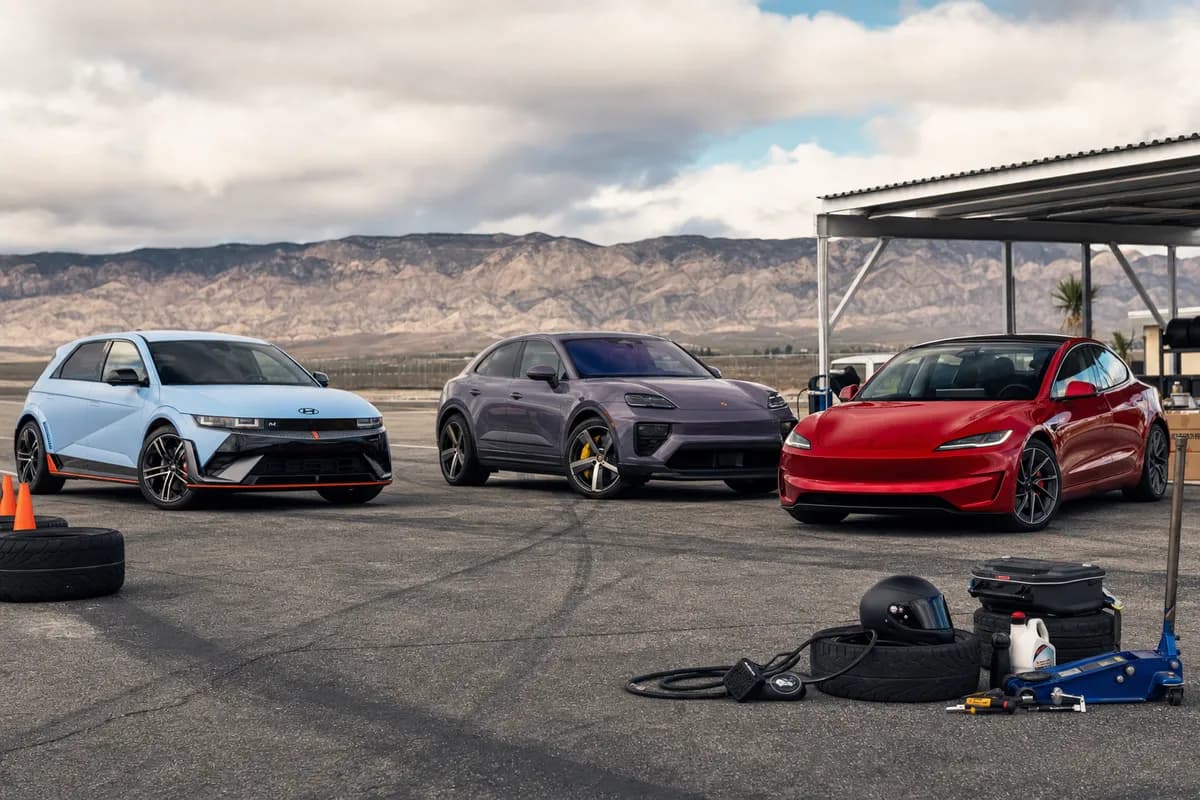
Performance EV owners are turning autocross days into DIY tech clinics—mastering brake fluid, tire heat, 12-volt reliability, and charging logistics.
Walk any autocross paddock or novice track day in 2026 and you will see something that felt niche just a few years ago: rows of performance EVs on sticky tires, brake ducts off, apps open, and owners swapping notes about temperatures instead of tailpipes. The new DIY scene around the 2026 Porsche Macan Electric, 2027 Hyundai Ioniq 5 N track prep, and Tesla Model 3 Performance autocross mods is less about theater and more about making heavy, very fast EVs repeatable, reliable, and easy to run.
Why performance EV owners are building a different kind of grassroots scene
The old tuner formula does not fully fit these cars. A 2026 Porsche Macan Electric can weigh well over 5,000 pounds depending on trim, a Hyundai Ioniq 5 N lands around the 4,800-pound mark, and a Tesla Model 3 Performance is lighter but still no featherweight compared with older ICE track toys. That mass changes everything, especially brakes, tires, and heat.
It also changes the social side of the hobby. Instead of chasing louder exhausts or fake shift maps, owners are comparing brake fluid boiling points, front tire pyrometer readings, DC fast charging curves, and the best way to keep a 12-volt system happy between sessions. The culture feels closer to endurance paddock problem-solving than to parking-lot car-show posturing.
That is a big reason this community is growing fast. These cars are brutally quick out of the box, but they reward smart prep more than flashy parts. The most respected builds are often the subtle ones: better fluid, smarter alignment, track-friendly pads, lightweight reversible wheels, and charging plans that keep the day moving.
Brake fluid and tire heat management are the real first mods
Ask experienced EV track-day drivers where to spend money first, and you will hear the same answer over and over: consumables. Regenerative braking reduces pad wear in some scenarios, but on repeated high-speed laps a heavy EV still asks a lot from its friction brakes. Once battery state of charge, motor temperature, or regen limits shift, the mechanical system has to do real work.
That makes EV brake fluid and tire heat management the foundation of any serious prep. The stock fluid in many street cars is fine for commuting, but repeated 100-plus-mph stops in a two-and-a-half-ton EV can cook it quickly. A high-temp DOT 4 fluid with a strong dry boiling point is cheap insurance, and a full flush before event season is often smarter than buying shiny hardware first.
- Brake fluid: High-temp DOT 4 from proven brands is the go-to move for track days and aggressive autocross use.
- Pads: Street-performance pads may survive autocross, but novice and intermediate track drivers often step up to a true dual-purpose compound.
- Tires: Heavy EVs can overheat outer shoulders fast, especially on factory all-seasons or staggered street setups.
- Alignment: More front negative camber is often the biggest single improvement in tire life and consistency.
The 2027 Hyundai Ioniq 5 N track prep crowd has been especially vocal about tire strategy. The car is astonishingly capable, but it can work the front outside shoulder hard if driven aggressively on a conservative street alignment. Owners are finding that careful pressure tuning, a square wheel-and-tire package where practical, and modest alignment changes can transform the car from “hero lap machine” to “repeatable all-day tool.”
The Tesla Model 3 Performance community has years of autocross experience to draw from, and that knowledge now helps newer EV owners. One recurring lesson is simple: do not chase ultra-low hot pressures because the car “feels softer.” Heavy EVs need sidewall support, and greasy front tires cost more time than a slightly harsher ride ever will. Start conservative, log hot pressures immediately after runs, and adjust in small steps.
The overlooked weak point: 12-volt reliability and event-day electrical prep
One of the funniest and most frustrating truths of modern EV ownership is that the tiny 12-volt system can sideline a car with a battery pack the size of a studio apartment floor. Contactors, computers, pumps, and access systems still depend on that low-voltage battery. When it gets weak, weird things happen.
Track use can expose that weakness because the car spends long hours cycling systems, cooling itself, waking up repeatedly, and running accessories in the paddock. Owners in the new DIY community are treating 12-volt health as basic maintenance, not a random afterthought. That is especially wise for cars used in mixed duty: commuting all week, then charging hard and lapping on weekends.
- Test the 12-volt battery before event season, especially if the car is more than two or three years old.
- Update software and confirm any battery-management or charging recalls are complete.
- Bring a compact jump pack that supports low-voltage recovery procedures for modern vehicles.
- Watch parasitic loads in the paddock, including sentry-style features, HVAC use, and constant accessory charging.
For the 2026 Porsche Macan Electric DIY crowd, this fits the broader Porsche ownership mindset perfectly. Track prep starts with system health, not with social-media mods. If the cooling systems, low-voltage battery, software, and brake hydraulics are all sorted, the car can do what Porsche engineered it to do.
Charging logistics are now part of performance prep
The biggest difference between an ICE track day and an EV one is not speed. It is planning. Performance EV charging logistics now sit right next to tire pressures and helmet checks on the pre-event checklist.
At autocross, the math is usually easy. A Tesla Model 3 Performance or Hyundai Ioniq 5 N can often run a full local event, drive home, and never touch a charger if the site is nearby. Track days are different, especially at faster circuits where repeated high-speed sessions drain battery faster and heat-soak can affect charging speed between runs.
The experienced owners are converging on a few practical rules. Arrive with a high state of charge, but not necessarily 100 percent if the car limits power or regen awkwardly at the very top of the pack. Know the charging options within 10 to 20 miles of the track, verify adapter compatibility, and have a backup if the nearest fast charger is busy or derated.
- Map the day before the event. Do not trust a single app.
- Know your car’s charging curve. Some cars recover time best from roughly 10 to 60 percent, not 80 to 100.
- Use session pacing. Two hard sessions and one cool-down-oriented session may be faster over a whole day than going flat-out every time.
- Pack your charging kit. Adapters, mobile EVSE, extension solutions approved by the manufacturer, and membership cards still matter.
The Ioniq 5 N has one obvious advantage here: its 800-volt architecture can recover quickly on a healthy high-power DC charger. The Model 3 Performance counters with deep Supercharger integration and a huge support network. The Macan Electric, depending on route and infrastructure, benefits from Porsche’s route planning and broad CCS-based access, but owners still need to treat charging like fuel strategy, not an afterthought.
Reversible mods are winning because they make these cars better everywhere
The best thing about this emerging scene is how practical it is. Most owners are not gutting interiors or chasing one-lap dyno glory. They are choosing reversible changes that improve autocross response, track consistency, and daily livability at the same time.
Tesla Model 3 Performance autocross mods are a good example. The strongest setups are usually not dramatic: a second wheel-and-tire package, a more aggressive but streetable alignment, better brake fluid, track-capable pads, and maybe a front camber solution that can be returned to stock later. That formula has been winning local events for years because it works.
The same pattern now shows up with the Macan Electric and Ioniq 5 N. Owners want mods they can install in a garage, undo before lease turn-in, and live with on Monday morning. That means no hacked-up interiors, no fake engine-noise gimmicks, and no flashy aero that kills range without delivering measurable gains.
- Wheel and tire package: Often the most effective upgrade, especially if it reduces unsprung mass and broadens tire choices.
- Alignment hardware: Camber-friendly components can dramatically improve front-end bite and tire wear.
- Pads and fluid: Still the highest-value reliability upgrade.
- Seat and driver interface tweaks: Better seating position, removable harness solutions where legal, and clear data logging can improve consistency more than raw power.
- Cooling-minded details: Simple airflow management and disciplined cool-down routines beat cosmetic “performance” add-ons.
Verdict: the smartest EV enthusiasts are building a community around repeatability
This new generation of performance EV owners is creating one of the healthiest enthusiast subcultures in the hobby. They are not pretending a 2026 Porsche Macan Electric is a 2,700-pound Cayman, or that a 2027 Hyundai Ioniq 5 N track prep build needs cosplay noises to feel serious. They are working with the strengths of the platform: instant torque, stout factory power, sophisticated thermal management, and software-rich data.
More importantly, they are honest about the tradeoffs. Heavy EVs eat tires, stress brake fluid, and force drivers to think about charging and 12-volt reliability in ways older track toys did not. But with the right prep, these cars are fast, durable, and shockingly fun to hustle.
That is why this DIY community matters. It is grounded in real use, real maintenance, and real learning. And if the paddock in 2026 is any indication, the future of grassroots performance is not quieter because it is less exciting. It is quieter because everyone is busy checking pressures, plugging in, and getting ready for the next session.
Affiliate disclosure: This article contains affiliate links. RevvedUpCars may earn a small commission on qualifying purchases at no extra cost to you.