China’s electric-vehicle market has spent the past few years proving it can move from premium experiments to mass-market scale at extraordinary speed.
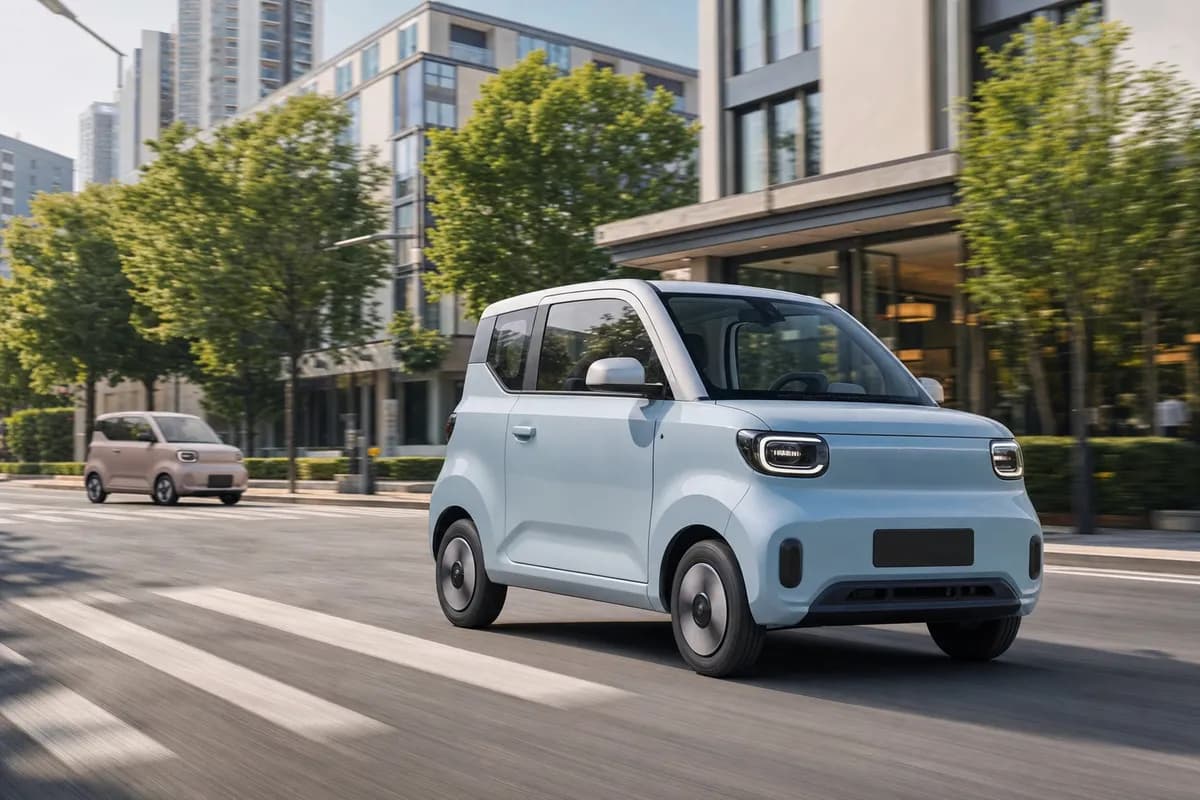
China’s electric-vehicle market has spent the past few years proving it can move from premium experiments to mass-market scale at extraordinary speed. Now, in May 2026, attention is shifting to an even smaller frontier: ultra-compact electric city cars that echo the role of Japan’s kei cars but are tailored to Chinese urban realities. The question is bigger than vehicle size. If China succeeds in building a credible category of China electric K-cars—tiny, low-cost EVs aimed at dense cities—it could pressure Japanese brands at home, reshape global thinking around low-cost electric city cars, and give automakers a practical blueprint for 2027 small EV trends in increasingly congested urban markets.
Why China Is Looking at Electric K-Cars Now
The timing makes sense. China’s EV market is no longer defined only by large crossovers, high-tech sedans, or price wars in the mainstream compact segment. It is also being shaped by saturation in some categories, slower consumer spending, and growing pressure on automakers to find profitable growth in smaller, more specialized vehicles. In that environment, ultra-small EVs are moving back into focus—not as novelty products, but as potentially serious urban transport tools.
China already has precedent. The Wuling Hongguang Mini EV demonstrated that there is real volume at the bottom end of the market when price, simplicity, and city usability line up. Since its 2020 launch, the model family has repeatedly ranked among China’s best-selling EVs, with cumulative sales running well above one million units across variants. It was never a direct equivalent to a Japanese kei car in regulatory terms, but it proved a key point: many urban buyers do not need a large battery, long highway range, or premium hardware.
What is different in 2026 urban EV news is that Chinese manufacturers and suppliers are increasingly discussing a more defined, higher-quality micro-EV class. Instead of treating tiny EVs as stripped-down mobility devices, the industry is exploring whether a standardized segment could emerge around better crash performance, smarter packaging, improved battery durability, and city-friendly connected features. In effect, China is asking whether it can create its own answer to the kei-car formula—without copying Japan’s regulations directly.
That matters because Chinese cities face a familiar mix of traffic, parking scarcity, emissions targets, and cost sensitivity. A vehicle around 3.0 to 3.4 meters long with a modest battery pack can make a lot of sense in that setting. Batteries remain the most expensive part of an EV, and a genuinely small city car can dramatically reduce battery size needs. That creates a path to lower sticker prices without relying entirely on aggressive subsidies.
There is also a strategic export dimension. Chinese brands know that many cities in Europe, Southeast Asia, and Latin America are looking for EVs that are easier to park, cheaper to buy, and less resource-intensive to build than today’s dominant compact crossovers. A Chinese micro-EV platform that is engineered properly could become more than a domestic niche. It could turn into a global city-car proposition.
How China’s Emerging Electric K-Car Concept Compares With Japanese Kei Cars
Japan’s kei-car category is one of the auto industry’s most successful examples of regulation shaping product strategy. Kei cars are tightly defined by size and engine-output rules, with maximum dimensions of 3.4 meters in length, 1.48 meters in width, and 2.0 meters in height. In return, they benefit from tax and ownership advantages in Japan. That framework produced an entire ecosystem of highly efficient, space-maximized small vehicles.
The EV version of that formula is already taking shape in Japan. The clearest current example is the Nissan Sakura, launched in 2022 and developed with Mitsubishi. It uses a 20 kWh battery, offers WLTC range of around 180 km, and has become one of Japan’s most important small EVs. Mitsubishi’s eK X EV is its close sibling. Both vehicles showed that a Japanese kei car EV can work when it delivers familiar kei practicality with lower running costs and quiet urban performance.
But Japan’s kei EV segment still faces constraints. Battery cost remains a challenge in a category where price sensitivity is extreme. Public charging access varies by region. And while models like the Sakura have sold well by niche EV standards, the segment is not yet large enough to transform the wider global market on its own.
China’s version would be different in at least four ways:
- Scale: China’s domestic EV supply chain is much larger, especially in batteries, motors, power electronics, and low-cost software integration.
- Price pressure: Chinese automakers are already accustomed to competing in brutally cost-sensitive EV segments.
- Platform flexibility: Chinese brands are more willing to experiment with fast product cycles and derivative body styles.
- Export ambition: A successful Chinese micro-EV is likely to be designed with foreign-market derivatives in mind from the outset.
That does not mean Chinese electric K-cars would automatically beat Japanese kei EVs. Japan’s automakers understand space efficiency better than almost anyone, and kei cars are deeply embedded in local consumer habits. But China could challenge the segment on cost and speed. If a Chinese-built city EV can offer acceptable safety, a 20 to 30 kWh battery, real-world urban range of roughly 150 to 250 km, and a sub-$10,000 to $12,000 equivalent price in its home market, it would force every small-car planner to pay attention.
There is an important caveat here: regulation is destiny in this class. Kei cars succeed in Japan partly because the rules support them. China does not have an exact regulatory counterpart. So for China electric K-cars to become a durable category rather than a passing marketing label, local governments may need to align parking policy, licensing, urban-access incentives, and safety standards in ways that reward genuinely compact EVs.
The Models and Market Signals Driving the Trend
The strongest evidence for this shift is not a single announced “Chinese kei” regulation. It is a cluster of market signals. On one side are proven low-end hits such as the Wuling Hongguang Mini EV and Geely Panda Mini, which showed demand for compact, affordable urban EVs. On the other are newer products moving slightly upmarket with better fit, finish, and technology, suggesting manufacturers believe buyers will pay more for a small EV that feels less compromised.
Among the key reference points in China’s current mini-EV and city-EV landscape:
- Wuling Hongguang Mini EV: The segment-defining low-price micro-EV, typically offering battery choices around the mid-teens to mid-20-kWh range depending on variant.
- Geely Panda Mini: A direct urban competitor positioned around affordability and short-distance practicality.
- Changan Lumin: Slightly more rounded in design and comfort, aimed at buyers wanting a small but friendlier daily EV.
- BYD Seagull: Not a micro-EV in the strictest sense, but a crucial benchmark because it proves Chinese brands can combine low pricing with more complete engineering in a small package.
The BYD Seagull is especially significant. At roughly 3.78 meters long, it sits above what most observers would call a kei-like size envelope. But it has become a benchmark for affordable EV packaging and cost discipline. It shows how much value Chinese automakers can deliver at the lower end of the market, and it creates pressure to see whether that efficiency can be pushed into even smaller formats.
What May 2026 adds is rising discussion around a category below the Seagull but above the most basic quadricycle-like products: proper small passenger EVs with doors, climate control, connected infotainment, decent materials, and improved structural integrity. That middle ground is where China’s electric K-car push could become truly disruptive.
From an engineering standpoint, the formula is straightforward:
- Keep the battery modest, likely around 17 to 30 kWh.
- Optimize interior packaging for four occupants over short trips.
- Focus on low-speed efficiency rather than high-speed range.
- Use simplified manufacturing and localized supply chains.
- Offer enough digital features to feel modern without adding major hardware cost.
If manufacturers can do that while keeping weight down, energy consumption in city use can be exceptionally low. That helps both customers and fleet operators. It also makes these vehicles attractive for car sharing, urban delivery, and municipal mobility programs.
Why This Matters for Global Automakers and 2027 City-Car Planning
Small cars have been in retreat in many markets because the economics became difficult. Safety requirements, emissions compliance, software costs, and customer expectations all pushed vehicle prices up. Automakers found it easier to make money on larger crossovers than on basic hatchbacks. EVs intensified that problem because batteries added cost precisely where buyers are least willing to absorb it.
That is why the emergence of competitive low-cost electric city cars from China matters beyond China. If Chinese brands can prove there is a sustainable business case for tiny EVs with acceptable quality and safety, they will reopen a strategic debate that many established automakers had effectively postponed.
For Japanese automakers, the pressure is immediate. Brands such as Nissan, Mitsubishi, Suzuki, Honda, and Daihatsu understand small vehicles deeply, but they have not all moved at the same speed in affordable EVs. Nissan and Mitsubishi have a visible foothold through the Sakura and eK X EV. Honda has experimented with compact urban EV ideas, but scaling an affordable global city EV remains a challenge. Suzuki has strong small-car credentials but has been more cautious in pure EV rollouts.
If Chinese makers begin to define a quasi-kei electric segment with faster cost reduction, Japanese manufacturers could face a dual threat:
- At home: Chinese ideas could influence consumer expectations around digital features and pricing in the smallest EV classes.
- Abroad: Chinese exports could capture city-EV demand in markets where Japanese brands once had an advantage in practical small cars.
European automakers are also watching closely. Renault, Stellantis, Volkswagen, and Hyundai have all talked about more affordable EVs, especially for urban buyers. But truly inexpensive small EVs remain difficult to deliver at scale. If China shows a repeatable formula in 2026, it could influence 2027 small EV trends across Europe, where city access rules, emissions zones, and parking constraints increasingly favor compact zero-emission vehicles.
There is also a policy angle. Cities worldwide are under pressure to cut congestion and emissions, but replacing every internal-combustion car with a like-sized electric SUV does not solve space inefficiency. Tiny EVs are not the full answer—public transit, cycling, and walking remain essential—but they fit better into a mixed urban-mobility ecosystem than oversized vehicles do.
That is where China’s push could have real influence. It may encourage automakers and policymakers to think less about “entry EVs” as downsized versions of mainstream cars and more about city-specific vehicles optimized for dense environments.
The Limits, Risks, and the Likely Outcome
The bullish case for China’s electric K-car movement is clear, but so are the risks. The first is safety perception. Ultra-small vehicles face obvious scrutiny in any collision discussion, especially in markets where larger vehicles dominate the road. If Chinese automakers want these products to succeed beyond price-driven niches, they will need to demonstrate credible crash performance and structural engineering, not just low purchase costs.
The second risk is margin. Cheap cars are hard to build profitably, and cheap EVs can be even harder. China’s industry is already dealing with heavy competition and persistent pricing pressure. A race to the bottom in micro-EVs could create sales volume without healthy returns.
Third, there is the regulatory mismatch problem. Japan’s kei ecosystem works because tax and ownership rules reinforce the segment. In Europe, homologation and safety expectations are different. In North America, consumer tastes and speed profiles make true kei-like EVs a tougher proposition outside dense urban pockets. So there is no guarantee that a successful Chinese city EV would travel globally in identical form.
Still, the core idea is likely to stick. The industry needs smaller, lighter, cheaper EVs if electrification is going to broaden beyond early adopters and higher-income households. China is unusually well positioned to test that proposition quickly.
Verdict: China’s May 2026 push toward an electric K-car-like segment looks less like a fad than an early signal of where urban EV design could be heading. It will not replace conventional hatchbacks or compact crossovers overnight, and it will not simply copy Japan’s kei-car model. But it could establish a new class of practical, affordable city EVs that pushes Japanese automakers to respond, gives global planners a fresh template for 2027, and reminds the industry that the future of urban mobility may depend as much on doing less car better as on adding more technology.
In that sense, the significance of 2026 urban EV news around China’s compact-car experimentation is not just about one country or one niche segment. It is about whether the next phase of electrification can become smaller, cheaper, and more city-appropriate. If China can make that work at scale, the ripple effects will extend far beyond its own streets.
Affiliate disclosure: This article contains affiliate links. RevvedUpCars may earn a small commission on qualifying purchases at no extra cost to you.