China’s May 2026 EV and AI standards blueprint may dictate 2027 global car design, software, batteries, and driver-assist features for top brands.
China’s latest automotive standards blueprint is more than a domestic policy update. It is an early design brief for the next wave of electric cars, software stacks, batteries, and driver-assist systems that global brands plan to sell in 2027.
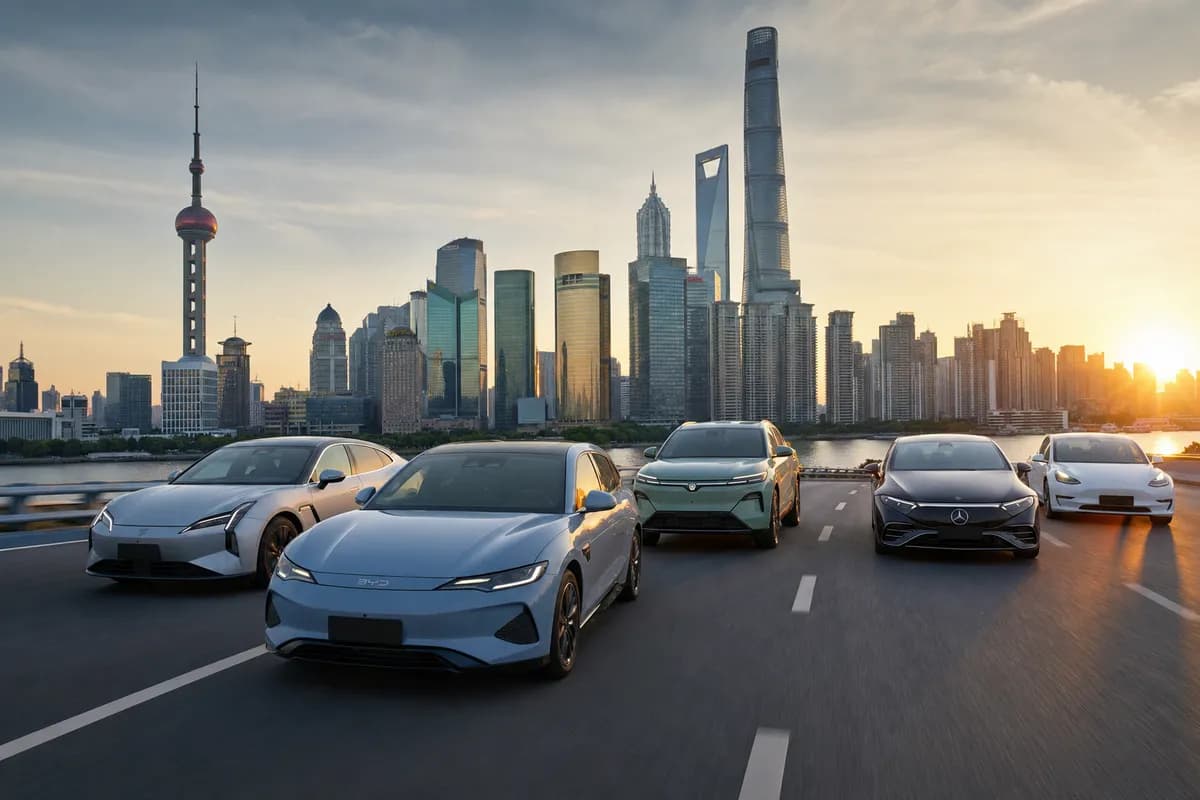
That matters because China is now the world’s largest EV market, the biggest battery market, and the toughest proving ground for connected-car technology. When Beijing rewrites the rules, BYD, Geely, Volkswagen, Mercedes-Benz, and Tesla usually have to respond far beyond China.
China’s 2026 standards push is really a roadmap for 2027 vehicles
In May 2026, Chinese regulators and standards bodies outlined a fresh blueprint covering EV safety, intelligent connected vehicles, battery performance, software updates, cybersecurity, data handling, and advanced driver-assistance functions. The broad message was clear: future vehicles sold in China will need to be safer, more software-defined, more transparent in how driver-assist systems are marketed, and more tightly governed in how they collect and process data.
China has used this playbook before. Once a standard is formalized in the country’s vast domestic market, automakers often redesign hardware and software once and then spread those changes across global programs to save cost and complexity.
That is why China EV standards 2026 could shape not just local-market sedans and SUVs, but also the architecture of 2027 electric cars sold in Europe, Southeast Asia, the Middle East, and potentially other export regions. For multinational automakers, China is too big to treat as a niche compliance exercise.
Why this blueprint matters more than past rulemaking
- Scale: China remains the world’s largest market for battery-electric and plug-in hybrid vehicles.
- Speed: Chinese brands launch software and hardware updates faster than most legacy rivals.
- Export reach: Vehicles engineered for China increasingly become export vehicles for Europe and emerging markets.
- Technology depth: The new rules touch batteries, AI, OTA software, sensor suites, and marketing claims.
Software-defined cars face tougher AI, data, and OTA requirements
The most immediate impact will likely be on vehicle software. China’s emerging framework points toward stricter controls on over-the-air updates, in-car data flows, cybersecurity validation, and the use of AI in decision-making and driver-assist functions.
For automakers, that means software can no longer be treated as a lightly regulated feature layer sitting on top of the car. In 2027 vehicles, it will increasingly be a compliance-critical system, with traceability, validation records, and clearer limits on what can be changed remotely after delivery.
This is where automotive AI regulations become practical rather than theoretical. A carmaker may need to show not just that an AI-assisted feature works, but also how it was trained, how edge cases are handled, when a human driver must intervene, and whether system naming exaggerates capability.
Tesla is an obvious example. Its Full Self-Driving branding has already faced scrutiny in multiple markets, and China’s tighter language around driver-assist communication could force still more conservative naming, warnings, and feature gating. That pressure would not stop with Tesla. Mercedes-Benz, Volkswagen, BYD, and Geely all increasingly sell cars on software promise.
Likely software and AI compliance changes for 2027 models
- Stricter OTA oversight: More validation before safety-related software can be updated remotely.
- Data localization pressure: Sensitive mapping, camera, and vehicle-operating data may need local storage or controlled transfer.
- Driver-assist naming rules: Less room for marketing terms that imply hands-free or autonomous capability beyond the system’s actual limits.
- Cybersecurity audits: Broader testing of connected systems, cloud links, and supplier software.
- AI accountability: Better documentation of decision logic, failure modes, and driver handover protocols.
Volkswagen and Mercedes-Benz may feel that especially sharply because both are trying to accelerate software execution after years of delays and platform resets. China’s rules could force them to standardize software governance earlier in the product cycle, not after vehicles are already on the road.
Battery standards could influence chemistry choices, pack design, and thermal safety
Battery regulation is the second major pressure point. China has already pushed hard on thermal runaway testing, durability, charging safety, and battery traceability. The 2026 blueprint suggests that these themes will expand, with more detailed requirements around pack resilience, diagnostics, and lifecycle management.
That could affect cell chemistry strategies for 2027 models. BYD, already deeply invested in LFP through its Blade Battery, may be better positioned than rivals if tougher safety-led rules favor pack structures with stronger thermal stability and lower fire risk. Tesla, which uses both LFP and nickel-based chemistries depending on model and plant, may need more China-specific calibration in battery management and charging behavior.
Geely, through brands including Zeekr and Volvo-linked operations, is also likely to lean into battery architecture that can satisfy both performance and traceability demands. Premium brands such as Mercedes-Benz may face a harder balancing act if China’s rules reward durability, abuse resistance, and transparent battery health data over maximum headline range.
What battery rules could change in real vehicles
- More robust pack enclosures to improve crash and puncture protection.
- Tighter thermal monitoring with more sensors and earlier fault detection.
- Battery health reporting for regulators, service networks, and used-car buyers.
- New pack software limits on fast charging, preconditioning, and peak discharge under certain conditions.
- Easier materials tracing across the supply chain.
There is also a cost angle. If compliance pushes more testing, more sensors, and more detailed pack management, entry-level EVs could become slightly more expensive to engineer. But stronger standards may also reduce recall risk and improve residual values, especially as used EV buyers grow more sensitive to battery condition.
ADAS rules may force automakers to redraw the line between assistance and autonomy
China has become one of the most aggressive markets for urban navigation assist, highway pilot functions, automated parking, and AI-driven cockpit systems. It is also a market where regulators increasingly want tighter control over how these features are deployed and described.
The likely result is a tougher distinction between Level 2 assistance and anything marketed as more than that. For 2027 vehicles, expect more driver monitoring, clearer takeover prompts, wider geofencing, and less tolerance for systems that allow drivers to overestimate capability.
This could reshape product planning for BYD Geely Volkswagen Mercedes Tesla in different ways. BYD and Geely move quickly and can iterate fast in-house, but they may need to slow feature rollouts if validation standards rise. Volkswagen and Mercedes-Benz may benefit if stricter rules narrow the gap between Chinese software speed and German validation culture.
Tesla, again, sits in the middle of the debate. Its camera-heavy approach and centralized software architecture are well suited to rapid updates, but that same speed can conflict with tighter approval expectations for ADAS feature changes. China may demand more fixed boundaries around what the system can do and where it can do it.
Expected ADAS impacts by brand
- BYD: Strong domestic supply chain and software pace are advantages, but marketing claims may face closer scrutiny.
- Geely: Zeekr and other premium efforts could gain if regulators reward high-end sensor redundancy and better validation.
- Volkswagen: Needs cleaner software execution, but stricter rulebooks may help reduce competitive chaos.
- Mercedes-Benz: Premium trust and safety positioning align well with more conservative ADAS regulation.
- Tesla: Likely to face the most attention on naming, feature scope, data handling, and software update controls.
Why global automakers may redesign once for China, then export the solution
The biggest strategic question is whether automakers build China-only compliance packages or redesign global architectures around China’s new baseline. In many cases, the second option is cheaper.
A single battery pack design, one OTA governance model, one ADAS warning strategy, and one cybersecurity stack can be expensive upfront but easier to scale across millions of vehicles. That is how global EV software rules often emerge in practice: not through one global law, but through the gravitational pull of the largest market.
This has already happened with battery sourcing, infotainment localization, and connected-car ecosystems. It could now happen with AI documentation, software release controls, and the way brands communicate assisted-driving functions to customers.
There are limits. Europe has its own safety and data rules, and the United States remains politically complex for China-linked technology decisions. Still, for automakers that depend on Chinese volume or Chinese engineering resources, it makes little sense to develop a cutting-edge 2027 EV platform that cannot satisfy Beijing’s standards logic from day one.
Verdict: China’s blueprint could become the de facto template for next-generation EVs
China’s May 2026 standards blueprint looks like regulation, but for the industry it functions more like a product mandate. It tells carmakers what a credible 2027 electric car must be: battery-safe, software-controlled, data-governed, AI-limited, and honest about what driver-assist systems can actually do.
BYD and Geely may adapt fastest because they already build at China’s pace. Volkswagen and Mercedes-Benz may use the reset to impose more discipline on troubled software programs. Tesla may remain technically agile, but face some of the hardest questions on compliance boundaries.
The broader takeaway is simple. The cars launched in 2027 will not be shaped only by consumer demand or engineering ambition. They will also be shaped by the rulebooks of the markets that matter most, and right now no rulebook matters more than China’s.
Affiliate disclosure: This article contains affiliate links. RevvedUpCars may earn a small commission on qualifying purchases at no extra cost to you.