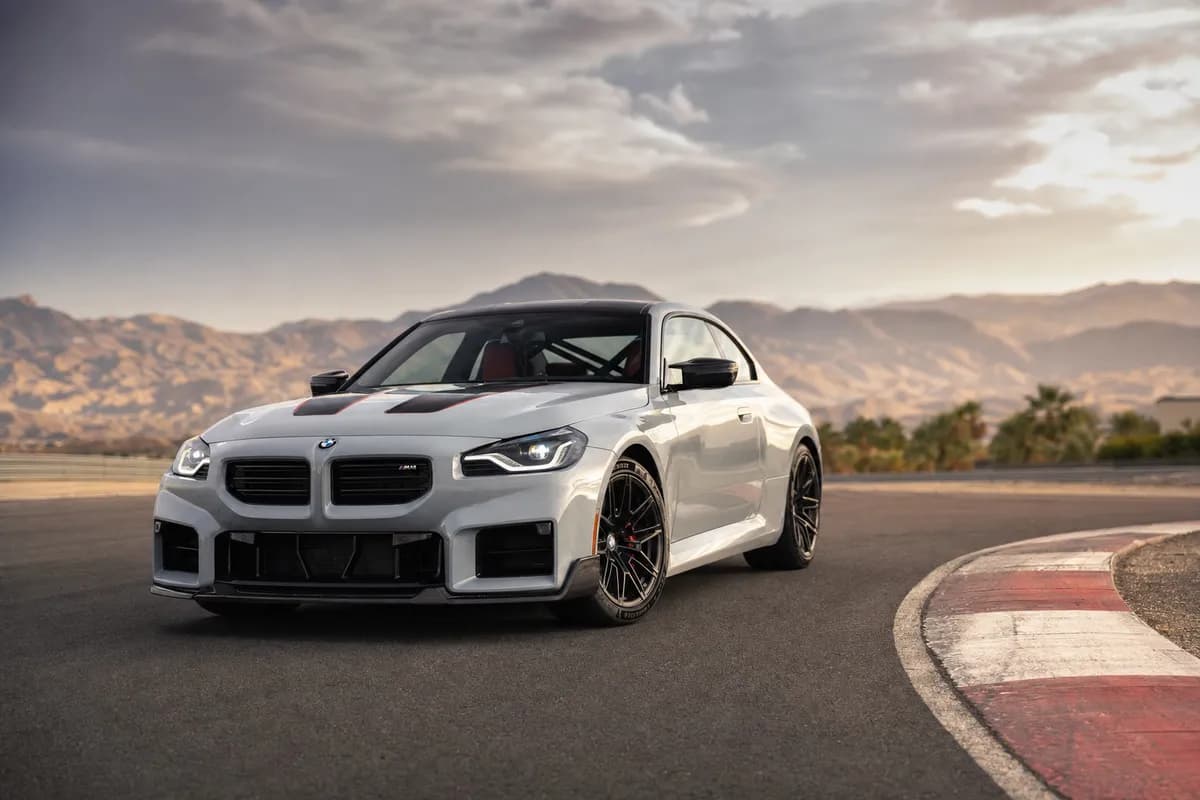
The 2026 BMW M2 CS feels lean, sharp, and uncompromising, but can it match the Porsche 718 Cayman GTS 4.0 and Audi RS 3 on track?
The 2026 BMW M2 CS is the sort of car that makes modern performance machinery look a bit bloated and overcomplicated. It is smaller, angrier, and more honest than most 500-hp toys now wearing premium badges. The real question is whether BMW has built a genuine driver’s car, or just a louder M2 with carbon-fiber garnish.
A sharper M2, not just a sticker package
The good news is that the 2026 BMW M2 CS first drive answers that question quickly. This is not a cosmetic special. BMW has taken the regular G87 M2 and attacked the parts that matter: power, weight, chassis tuning, brake stamina, and front-end bite.
Under the hood sits a twin-turbocharged 3.0-liter inline-six, now rated at 523 horsepower and 479 lb-ft of torque. That is a huge jump over the standard M2’s 473 hp, and it puts the CS much closer to M3 Competition territory than old-school compact-coupe tradition. Power goes to the rear wheels through an eight-speed automatic only, which will annoy manual purists, but it is brutally effective on a circuit.
BMW also trimmed mass with a carbon-fiber roof, carbon bucket seats, forged wheels, and lighter trim pieces. Officially, the reduction is modest rather than miraculous, but every kilo matters when the base car already lives north of 3,800 pounds. Expect a curb weight around 3,770 pounds, which still is not featherweight, but it is enough to sharpen the M2’s reflexes.
- Engine: 3.0-liter twin-turbo inline-six
- Output: 523 hp / 479 lb-ft
- Transmission: 8-speed automatic
- Drivetrain: Rear-wheel drive
- 0-60 mph: about 3.7 seconds
- Top speed: roughly 188 mph with M Driver’s package
Those numbers matter because the M2 CS is entering a vicious part of the market. The Porsche 718 Cayman GTS 4.0 has less power at 394 hp, but it is far lighter and sweeter balanced. The Audi RS 3 gives you 401 hp, all-wheel-drive traction, and giant real-world pace with much less drama.
On track, the M2 CS finally feels worthy of the badge
Push the CS hard and it makes a far better case for itself than the standard M2 does. The nose keys into apexes with more conviction, body motions are better tied down, and the car feels less like a compact muscle coupe and more like a serious circuit tool. That matters, because some recent M cars have confused speed with delicacy. This one mostly remembers both.
The front axle is the star. BMW’s revised spring and damper tuning, stiffer engine mounts, and sharper alignment settings give the M2 CS more immediate turn-in and better mid-corner composure. You can trail brake into a corner, load the outside front, and trust the chassis to rotate progressively instead of simply bullying the front tires.
Then the engine takes over and starts being rude. The S58 six punches out of slower corners with far more violence than the Cayman GTS 4.0 can match, and it does so with less lag and more top-end shove than the RS 3’s charismatic five-cylinder. On a fast track, that power advantage is not academic. It is the difference between “nicely balanced” and “where did that BMW go?”
Brake consistency is also strong, especially with the optional carbon-ceramics. Steel brakes will likely be the smarter road-car choice, but either setup feels more track-resilient than what most owners will ever demand. The automatic transmission is similarly ruthless: rapid, obedient, and always in the right gear when you call for it. Yes, a manual would be more romantic. No, it would not be faster.
The M2 CS is not light in the Lotus sense or delicate in the Porsche sense. But it is fast in a way that feels engineered, not merely inflated.
M2 CS vs Porsche 718 Cayman GTS 4.0: feel versus force
This is the comparison enthusiasts really care about. The M2 CS vs Porsche 718 Cayman GTS 4.0 battle is not just a numbers game. It is a philosophical fight between brute-force front-engine BMW theater and the Cayman’s mid-engine precision.
The Porsche still wins on steering purity, seating position, and transparency. Few cars at any price talk to the driver as clearly as a 718 Cayman GTS 4.0, and its naturally aspirated 4.0-liter flat-six remains one of the last truly great engines you can buy. At around 3,200 pounds, it also changes direction with less effort and less inertia than the BMW can ever fully escape.
But the Cayman is no longer the default answer if track pace is the first priority. The BMW’s extra 129 hp and giant torque edge give it serious straight-line superiority, and on larger circuits that advantage adds up quickly. If the Porsche is the better dance partner, the BMW is the one kicking the door down and posting the lap time.
- BMW M2 CS advantage: power, torque, braking punch, rear-seat practicality
- Porsche 718 Cayman GTS 4.0 advantage: steering feel, chassis balance, lower weight, engine character
- Track pace winner: likely BMW on faster circuits
- Road feel winner: definitely Porsche
That last point matters. On a great road, the Cayman still feels more intimate and more special. The M2 CS is thrilling, but its feedback comes with a layer of modern M-car insulation that Porsche has not entirely surrendered.
M2 CS vs Audi RS 3: the BMW’s biggest real-world problem
The M2 CS vs Audi RS 3 comparison is less romantic and probably more relevant. The RS 3 is the assassin in this class: compact, usable, hilariously quick, and easier to exploit in lousy weather or on broken roads. Its turbocharged 2.5-liter five-cylinder makes 401 hp and 369 lb-ft, and the quattro system lets average drivers access nearly all of it, nearly all the time.
On a smooth dry track, the BMW is the better driver’s car. It has richer steering, better brake feel, cleaner rear-drive adjustability, and a chassis that rewards commitment rather than simply deleting mistakes. The Audi is grippy and devastatingly effective, but it can feel like it is solving the corner for you.
On the road, though, the RS 3 lands a few painful punches. It is easier to place in traffic, easier to drive quickly in the wet, and easier to live with every day thanks to four doors and a more compact footprint. It also undercuts what the M2 CS will almost certainly cost by a wide margin, with the Audi starting in the low-$60,000 range while the BMW should land closer to $95,000 once options and reality collide.
- BMW M2 CS: more involving, more powerful, more serious on track
- Audi RS 3: cheaper, more usable, all-weather traction, four-door practicality
- Value winner: RS 3
- Driver’s car winner: M2 CS
Can you actually live with it?
Surprisingly, yes. The M2 CS rides firmly, as it should, but it is not the dental punishment some hardcore specials become. Adaptive dampers help, road noise is acceptable for the class, and visibility remains decent by modern coupe standards.
You also get genuine day-to-day advantages over the Cayman. There are rear seats, a usable trunk, and an interior layout that feels familiar rather than exotic. BMW’s latest infotainment still asks too much of the touchscreen for climate tasks, but at least the cabin feels expensive and well screwed together.
The bigger issue is not comfort. It is identity. At nearly six figures, the M2 CS is playing dangerously close to cars with stronger badges, lighter structures, or more memorable engines. That makes it a harder emotional sell than older CS models, which felt like mischievous overachievers rather than junior super-coupes with a finance plan.
Verdict: one of the best compact performance cars of 2026, but not the purest
The BMW M2 CS review verdict is simple: BMW has built a properly exciting compact coupe again. The 2026 M2 CS is quicker, sharper, and more coherent than the standard M2, and on track it has enough grip, braking stamina, and power to trouble much more expensive machinery. It feels like a car developed by people who still occasionally enjoy corner entry.
Still, this is not the purest answer in the segment. The Porsche 718 Cayman GTS 4.0 remains the better tool for drivers who value feedback, delicacy, and the sort of connection that survives after the stopwatch is put away. The Audi RS 3 is the rational choice for buyers who want giant pace with fewer compromises and fewer financial bruises.
But if your shortlist starts with lap times, rear-drive adjustability, and a six-cylinder that hits like a sledgehammer, the M2 CS makes a very convincing case. It may not be the last word in tactile nuance, but it absolutely belongs in the conversation for the best compact performance car 2026. And unlike too many modern fast cars, it still feels like it wants you involved.
Affiliate disclosure: This article contains affiliate links. RevvedUpCars may earn a small commission on qualifying purchases at no extra cost to you.