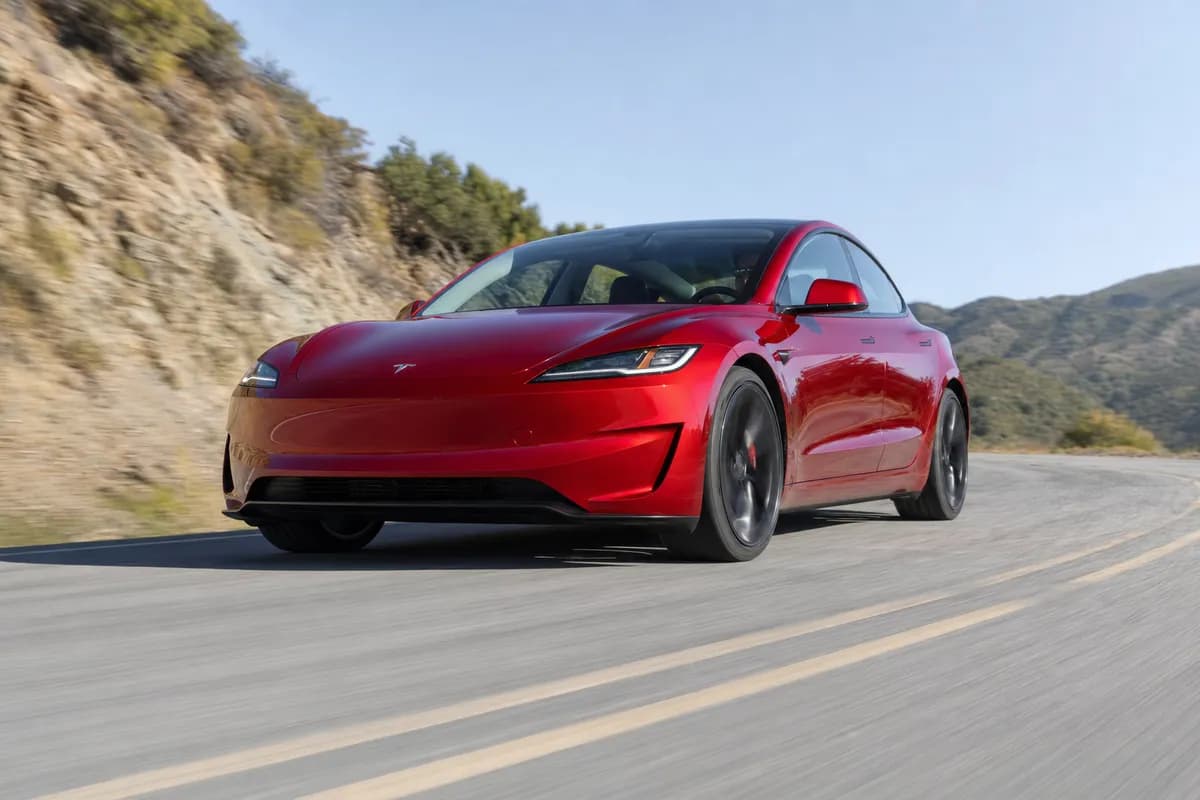
The updated 2026 Tesla Model 3 Performance proves quick EV fun can stay classy. Here’s how it stacks up on speed, handling, range, and value.
The 2026 Tesla Model 3 Performance arrives with a simple mission: remind everyone that the quickest way to have fun in an EV still doesn’t need fake engine noises, arcade gimmicks, or a six-figure sticker. It’s faster, sharper, and more grown-up than before. The real question is whether that’s enough to fend off the riotous Hyundai Ioniq 5 N and the polished BMW i4 M50.
A Faster, Smarter Model 3 Performance
This 2026 Tesla Model 3 Performance review starts with the obvious bit: the numbers still matter, and Tesla knows it. The updated dual-motor sedan makes a claimed 510 horsepower and 554 lb-ft of torque, enough for a 0-60 mph time of 2.9 seconds with rollout subtracted. Top speed is 163 mph, which remains properly absurd for something you can use for the school run.
Unlike the old Model 3 Performance, this one feels engineered rather than merely overpowered. Adaptive dampers, revised springs, stiffer bushings, stronger brakes, and stickier summer rubber transform the car from “fast appliance” into something that actually talks back on a road. The steering is still light on feel, but the chassis is now composed enough that you stop caring after the second corner.
Tesla has also cleaned up the visual package. The deeper front fascia, rear diffuser, carbon-fiber lip spoiler, and 20-inch forged wheels give it some menace without turning it into a cosplay race car. It still looks understated next to an Ioniq 5 N, but that’s part of the appeal: this is a missile in office clothes.
How It Drives: Finally More Than a Straight-Line Trick
On a tight back road, the Model 3 Performance is the best-driving Tesla short of a Model S Plaid on a very good day and a very short road. Turn-in is sharper, body control is tighter, and the car now resists the floaty rebound that used to plague hard driving. It feels lighter on its feet than its roughly 4,050-pound curb weight suggests.
The adaptive dampers are the headline act. In their firmer settings, they keep the body flat without ruining ride quality, and in daily driving they relax enough to make this an easy commuter. That split personality matters, because the BMW i4 M50 still wins on steering polish, while the Hyundai Ioniq 5 N remains the more playful hooligan.
Braking is stronger, too, with improved pedal consistency under repeated hard stops. That said, the Hyundai still has the broader track-day toolkit, including superior thermal management and a chassis that invites trail-braking mischief. The Tesla is devastatingly effective, but the Hyundai is the one that eggs you on.
What the Tesla now does especially well
- Launches hard without drama or axle hop
- Controls body movement far better than the previous Model 3 Performance
- Balances comfort and aggression better than the Ioniq 5 N
- Feels smaller and more precise than the BMW i4 M50
Tesla Model 3 Performance vs Hyundai Ioniq 5 N
The Tesla Model 3 Performance vs Hyundai Ioniq 5 N showdown is really a battle of philosophies. Tesla delivers clinical speed, cleaner packaging, and stronger efficiency. Hyundai responds with character, track stamina, and enough synthesized nonsense to either delight you or make you roll your eyes clean out of your skull.
The Ioniq 5 N produces up to 641 hp with N Grin Boost and hits 0-60 mph in about 3.3 seconds. It’s heavier at around 4,850 pounds, but it hides that mass brilliantly thanks to a superbly tuned chassis, aggressive torque distribution, and brake regen calibration that feels genuinely adjustable. It is also physically larger, which helps practicality but dulls some of the intimacy you get in the Tesla.
Where Tesla claws back points is efficiency and range. Expect the Model 3 Performance to return an EPA estimate around 290 to 300 miles, depending on wheel and tire configuration. The Ioniq 5 N sits closer to 221 miles EPA, which is the price you pay for all that fun and those massive tires.
Charging complicates the story. Hyundai’s 800-volt architecture can rip from 10 to 80 percent in about 18 minutes on a suitable DC fast charger, which is still magic when conditions line up. Tesla’s charging curve is less headline-grabbing, but the Supercharger network remains the more dependable real-world advantage in North America. Fast charging is only useful if the charger actually works, and Tesla still wins that boring but vital battle.
Tesla vs Hyundai: key differences
- Faster to 60: Tesla Model 3 Performance
- More engaging chassis: Hyundai Ioniq 5 N
- Better range: Tesla Model 3 Performance
- Better road-trip charging experience: Tesla Model 3 Performance
- More practical cargo space and rear room: Hyundai Ioniq 5 N
- Better track toy: Hyundai Ioniq 5 N
Tesla Model 3 Performance vs BMW i4 M50
The Tesla Model 3 Performance vs BMW i4 M50 comparison is closer in spirit. Both are electric sport sedans with serious pace, understated styling, and everyday usability. The difference is that the BMW feels like a luxury car first, performance EV second, while the Tesla now leans harder into the sports-sedan brief.
The i4 M50 makes 536 hp and reaches 60 mph in 3.7 seconds. It’s richly finished, quieter on the highway, and more substantial in the way BMW buyers expect. It’s also heavier at about 5,000 pounds, and you feel that mass when the road gets technical.
BMW still delivers the superior cabin experience. Material quality is miles ahead of Tesla’s minimalist, screen-dominated interior, and the driving position feels more tailored. But Tesla answers with cleaner ergonomics for core functions, lower operating costs, and a lighter, more eager chassis.
Range is another Tesla win. The i4 M50 typically lands around 267 miles EPA, which is decent but not class-leading. The Model 3 Performance stretches farther on a charge while undercutting the BMW on price by a meaningful margin.
Where the BMW still punches back
- Cabin quality is far richer than the Tesla’s
- Ride isolation is better at highway speeds
- Steering and brake blending feel more natural in normal driving
- Brand cachet still matters to luxury buyers, whether enthusiasts admit it or not
Range, Value, and Daily-Life Reality
If you’re shopping for the best performance EV 2026, raw speed alone is a teenager’s argument. The Tesla matters because it combines supercar-rattling acceleration with actual daily usability. That formula remains hard to beat.
Pricing is the dagger. The 2026 Model 3 Performance should land around $54,000 to $57,000 before incentives, depending on market and options. A Hyundai Ioniq 5 N starts closer to $67,000, and the BMW i4 M50 hovers around $71,000 before you even start clicking expensive boxes.
That gap is not small. It is the difference between “stretch purchase” and “rationally irresponsible.” Tesla also gives you competitive rear-seat space, a front trunk, low energy consumption, and access to the best charging ecosystem in the business.
There are caveats. Tesla’s cabin still feels sparse to the point of austerity, and build quality can vary more than it should at this price. The lack of physical controls remains annoying when you just want to adjust something simple without poking a screen like you’re ordering lunch at an airport kiosk.
Quick comparison: which one should you buy?
- Buy the Tesla Model 3 Performance if you want the best mix of speed, range, price, and daily ease.
- Buy the Hyundai Ioniq 5 N if you want the most entertaining, most track-ready performance EV under six figures.
- Buy the BMW i4 M50 if luxury, refinement, and badge appeal matter more than ultimate value.
Verdict
As a 2026 electric sports sedan comparison, this one lands a clear punchline: the updated Tesla Model 3 Performance is still the category’s most convincing all-rounder. It is quicker than the BMW, far more efficient than the Hyundai, and dramatically cheaper than both. More importantly, it no longer feels like a one-trick launch-control party favor.
The Hyundai Ioniq 5 N is still the enthusiast’s oddball hero. It has more personality, more adjustability, and the better sense of occasion when you’re out to misbehave. The BMW i4 M50 remains the classy, comfortable grown-up option, but it asks luxury-car money without delivering the sharpest driving experience or the best range.
So can the 2026 Tesla Model 3 Performance beat them on speed, handling, range, and everyday value? On balance, yes. The Hyundai is more fun. The BMW is more premium. But the Tesla is the one most buyers should actually bring home.
Affiliate disclosure: This article contains affiliate links. RevvedUpCars may earn a small commission on qualifying purchases at no extra cost to you.