
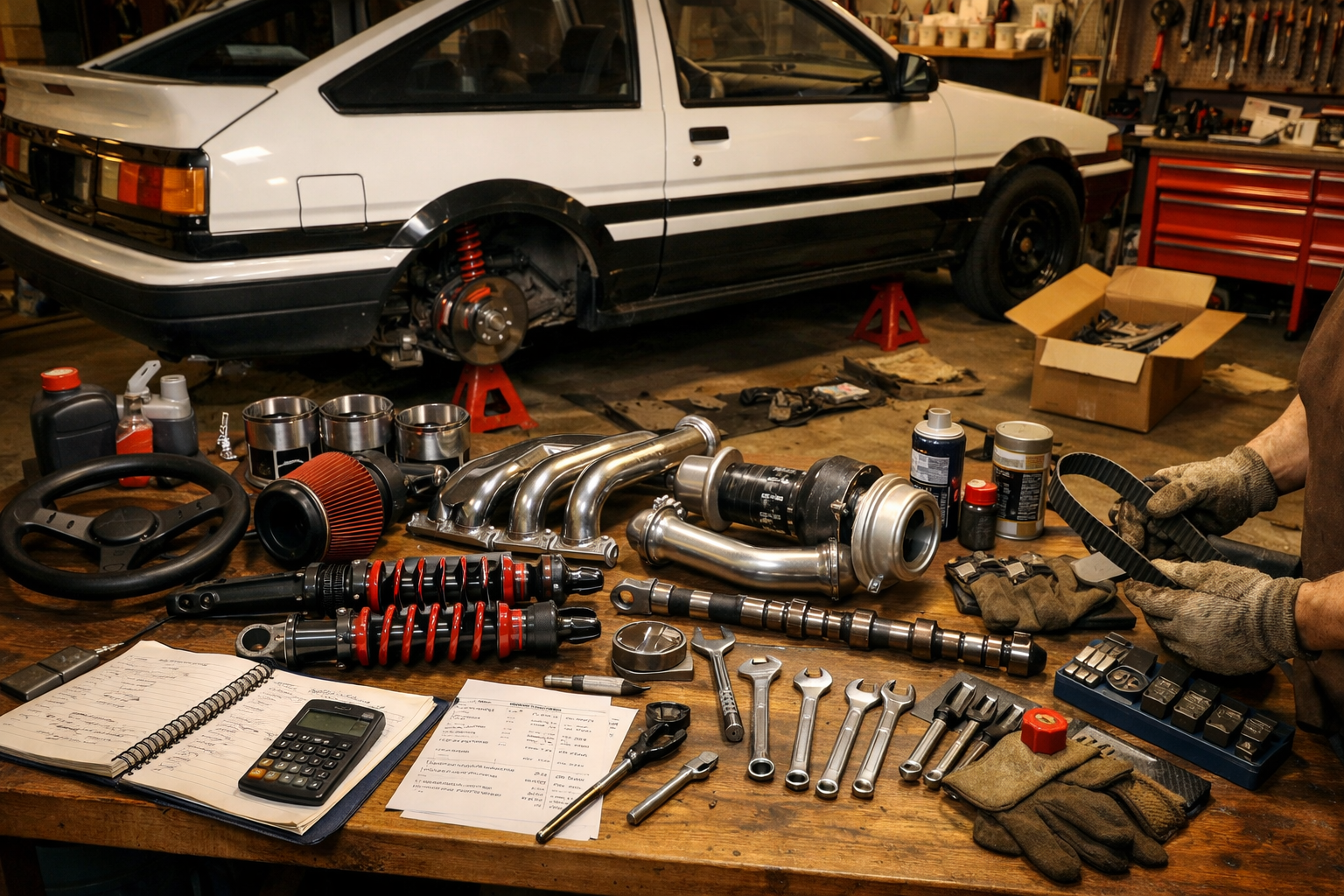
You just dragged home a dusty Corolla hatch with pop-up headlights and a blown rear shock, and now your buddies are asking, “You really gonna restore that thing?” Yeah. You are. This Toyota AE86 restoration guide is for the folks who see an ’80s econobox and picture mountain passes, Initial D vibes, and a screaming 4A-GE at 7,500 RPM.
The AE86 isn’t just another old Toyota. Clean examples are $20,000–$35,000 in 2025, and rough project cars still pull $6,000–$12,000. Do it right and you’ve got a appreciating classic. Do it wrong and you’ve got a money pit with mismatched body panels and a hacked wiring harness.
In this guide, I’ll walk you through budgeting, parts sourcing, and smart performance upgrades—from AE86 Tom’s Racing goodies to practical classic Toyota upgrades that won’t grenade your engine. Twenty years under the hood talking here. Let’s build it right.
What You’ll Need
- Tools: Metric socket set (8mm–19mm), 10mm deep socket (not a wrench—trust me), 1/2″ breaker bar, torque wrench, floor jack, jack stands, multimeter, compression tester
- Parts/Materials: Timing belt kit ($120–$250), full suspension refresh kit ($600–$1,200), brake overhaul parts ($400–$800), bushings ($200–$500), fluids & filters ($150)
- Time: 3–6 months part-time for a full restoration; 1–2 weekends per major system
- Difficulty: 🔧🔧🔧🔧 (4/5 – advanced DIY)
- Dealer Cost: $8,000–$15,000+ restoration labor vs DIY Cost: $3,000–$7,000 — You Save: $5,000+
Why This Matters
Skip the basics on an AE86 and you’ll pay for it. Old rubber bushings make the car wander like a shopping cart with a bad wheel. Neglect the timing belt and that high-revving 4A-GE can leave you stranded. In 20 years of wrenching, I’ve seen more classic Toyotas ruined by deferred maintenance than by hard driving.
Plan to refresh safety items immediately—brakes, suspension, fuel lines. Engine timing components every 60,000–90,000 miles (verify via Toyota’s original service data or Toyota Owners). Before you modify anything, restore it to baseline.
And if you’re buying one online, read our Bring a Trailer Bidding Tips: How to Evaluate Classics. Rust and “creative wiring” don’t show up well in filtered photos.
Before You Start
⚠️ WARNING: Always support the car with rated jack stands on solid ground. Never rely on a hydraulic jack alone. I’ve seen cars fall. It’s ugly.
⚠️ WARNING: Old fuel systems can leak. Work in a well-ventilated area and keep a fire extinguisher nearby when replacing fuel lines or cleaning tanks.
Check compression first. Warm engine, pull all four plugs, hold throttle wide open, crank it. You want consistent numbers across cylinders (generally 170–210 psi for a healthy 4A-GE, but verify spec). Big differences? Budget for a rebuild.
Run the VIN through NHTSA.gov for outstanding recalls and review our Car Recall Checklist: Protect Yourself Today. Even classics deserve safe brakes and seat belts.
Step-by-Step Guide
-
Start with a Full Inspection
Get it on stands. Check frame rails, rear shock towers, hatch area for rust. Tap suspicious spots with a screwdriver handle. Flaky metal means body shop time.
Pro Tip: Budget $2,000–$5,000 for proper rust repair. Cheap patch panels will haunt you. -
Baseline the Engine
Replace timing belt, tensioner, water pump. Use a 10mm, 12mm, 14mm sockets and a torque wrench. Torque specs vary—consult factory manual. Parts run $200–$400.
Change oil (4–4.5 quarts 10W-30), coolant (about 6–7 quarts total system capacity). -
Refresh the Fuel & Ignition
New fuel filter ($20), inspect tank, replace cracked rubber lines. Upgrade plugs (NGK BKR6E), wires, distributor cap/rotor. Rough idle often vanishes here. -
Rebuild Suspension & Brakes
Replace struts (KYB Excel-G $400 set or Tokico), control arm bushings, ball joints. Torque suspension bolts with weight on wheels.
Brake pads/rotors all around: $300–$600. Stainless brake lines if you’re tracking it. -
Electrical Cleanup
Fix hacked stereo wiring. Use a multimeter. Clean grounds. AE86s are simple, but 40-year-old wiring gets brittle. -
Performance Upgrades (After It’s Healthy)
Consider AE86 Tom’s Racing parts—period-correct wheels, suspension tuning, or intake components. Mild cam upgrade (256°) and headers can add 10–15 hp without killing drivability.
Bigger power? ITBs or 20V swap. Budget $3,000–$6,000. Do it right or don’t do it.
This Toyota AE86 restoration guide approach—restore first, modify second—keeps you from stacking problems on top of problems.
Common Mistakes to Avoid
- Ignoring Rust: I’ve seen this in the shop a hundred times. Pretty paint hiding rotted rails. Structural rust kills projects.
- Overbuilding the Engine: High-compression builds without proper tuning = blown head gaskets. Keep it streetable.
- Cheap Coilovers: $400 no-name kits ride like pogo sticks and leak in a year.
- Skipping Bushings: Old rubber makes new shocks pointless. Replace them all.
- Bad Wiring Mods: Twisted wires and electrical tape cause fires. Solder and heat-shrink only.
When to Call a Professional
If compression is low across multiple cylinders, expect machine shop work ($1,500–$3,000). Body rust near suspension pickup points? Get a restoration shop involved.
A fair engine rebuild labor price is $2,000–$4,000 plus parts. If a shop can’t explain clearances, machining steps, or provide a written estimate—walk away.
And check emissions laws. In California, Leno’s Law 2026 may ease some classic restrictions, but always verify with EPA.gov guidelines for your state.
Recommended Products
- KYB Excel-G Struts: Budget-friendly, OEM-like ride. About $400/set.
- Energy Suspension Bushing Kit: Polyurethane, tighter handling. $250–$350.
- NGK Ignition Components: Reliable spark. Don’t cheap out here.
- Factory Service Manual (FSM): $80–$150 used. Worth its weight in gold.
- Period-Correct Wheels (Watanabe/Tom’s Racing style): $1,200–$2,000. Completes the look.
What I use in my own garage? OEM where reliability matters, quality aftermarket where performance counts.
Why This Toyota AE86 Restoration Guide Approach Works
The AE86 is simple, lightweight, and honest. Treat it like a marathon, not a sprint. Budget realistically—$5,000 for a solid refresh, $10,000+ for show-level builds. With smart classic Toyota upgrades, you’ll have a car that’s more fun at 60 mph than most new cars are at 120.
Do This
- Restore safety systems first
- Replace all rubber components
- Use a torque wrench on everything critical
- Keep modifications period-correct
Don’t Do This
- Don’t modify before baseline maintenance
- Don’t trust rusty frame rails
- Don’t cheap out on suspension
- Don’t ignore local emissions laws
Restoring an AE86 isn’t just wrenching—it’s preserving a piece of Toyota history. Follow this Toyota AE86 restoration guide, take your time, and build it once the right way. You can do this. It’ll test your patience, but every time those pop-ups flip up, you’ll grin like a kid.
Drop your questions in the comments. Stay safe under there, and remember — a $20 repair manual saves a $2,000 repair bill.