
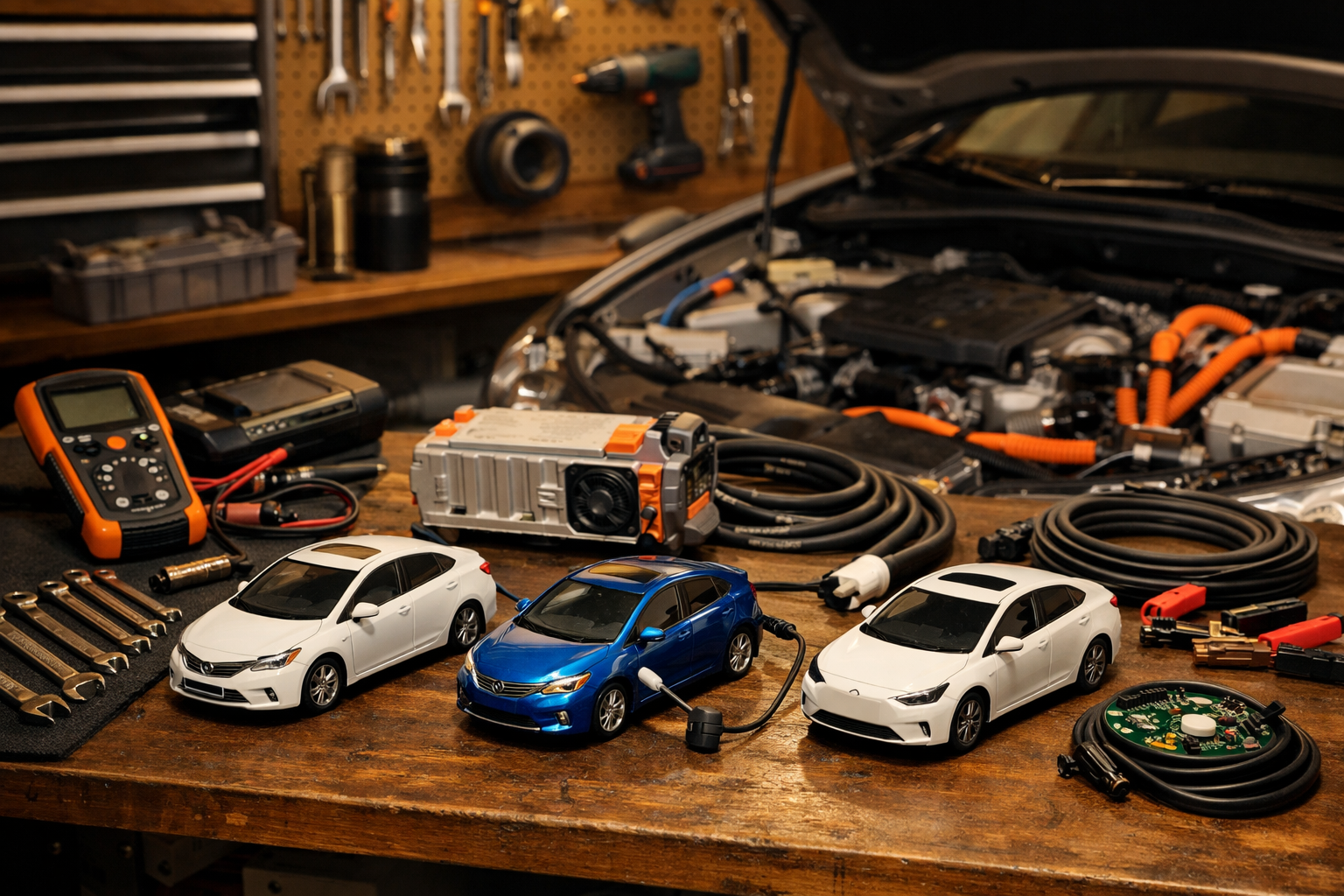
You’re standing on a dealership lot staring at three versions of the “same” car — hybrid, plug-in hybrid, and full EV — and the salesperson is throwing around words like kilowatt-hours and regenerative braking. Figuring out the hybrid vs plug-in hybrid vs EV debate in 2026 feels like choosing between a cordless drill, a corded drill, and an old-school hand crank.
Pick right, and you’ll save thousands in fuel and maintenance. Pick wrong, and you’ll be cursing charging stations or watching your gas savings disappear. I’ve been wrenching for 20 years, and I’ve seen folks buy the wrong electrified car for their lifestyle more times than I can count.
In this guide, I’ll break down real-world costs, fuel savings comparison numbers, charging realities, and what actually works depending on how you drive. No sales fluff. Just what I’d tell my brother before he signs a 72-month loan.
What You’ll Need
- Tools: Your last 12 months of driving habits (miles per day, road trips), calculator, utility rate info (¢/kWh)
- Parts/Materials: N/A — but budget for a Level 2 home charger ($500–$1,200 installed)
- Time: 30–60 minutes of honest research
- Difficulty: 🔧🔧 (mostly decision-making)
- Dealer Cost: Overpaying by choosing wrong = $3,000–$8,000 mistake vs DIY research cost: $0 — You Save: Potentially thousands
Why This Matters
The wrong electrified vehicle can cost you more than a thirsty V6. I’ve seen plug-in hybrid owners never plug in. That’s like buying a treadmill and using it to hang laundry.
In 2026, the price gap looks like this (average midsize crossover):
- Gas model: $28,000
- Hybrid: $30,000–$32,000
- Plug-in Hybrid (PHEV): $35,000–$40,000
- Full EV: $38,000–$50,000
According to the EPA, average annual fuel costs:
- Gas SUV (28 MPG, 12k miles): about $1,700/year
- Hybrid (45 MPG): about $1,050/year
- PHEV (mostly electric driving): $700–$900/year
- EV: $600–$800/year (depends heavily on your electric rate)
Over five years, that’s a potential $4,000–$5,000 difference in fuel savings comparison alone. That’s a transmission rebuild or a family vacation.
If you’re shopping smart, also check broader market trends like in our Q1 2026 Auto Sales: Winners and Losers breakdown — some brands are discounting EVs heavily right now.
Before You Start
Before deciding in the hybrid vs plug-in hybrid vs EV conversation, answer these three questions honestly:
- How far do you drive daily?
- Can you charge at home?
- Do you take long road trips monthly?
⚠️ WARNING: If you live in an apartment with no reliable charging access, a full EV can become a weekly headache. Public charging rates can double your “cheap electricity” advantage.
Check your utility rate. If you’re paying $0.25 per kWh in California, EV savings shrink. If you’re paying $0.11 in the Midwest, you’re golden.
Also, review recall history at NHTSA.gov. New tech means occasional growing pains.
Step-by-Step Guide
-
Calculate Your Daily Driving Distance
Average Americans drive about 37 miles per day. If you’re under 40 miles daily, a PHEV or EV likely covers 90% of your use on electricity alone.
Pro Tip: Look at your oil change receipts for mileage intervals — that tells the real story. -
Understand Each Type
Hybrid: Gas engine + small battery. No plugging in. Think Toyota Corolla Hybrid (45–50 MPG).
Plug-in Hybrid: Bigger battery (25–50 miles electric range). Gas backup. Like Toyota RAV4 Prime.
EV: No gas engine. 250–320 miles per charge typical in 2026 (Tesla Model 3, Hyundai Ioniq 6, BMW iX3 — which we covered in BMW iX3 World Car: 2026 Win Shakes EV Market). -
Compare Real Costs
Example over 5 years (12k miles/year):
Hybrid fuel savings vs gas: ~$3,250
PHEV savings (if plugged in daily): ~$4,500
EV savings: ~$5,000
But if you don’t plug in your PHEV? It performs like a heavier hybrid and loses most savings. -
Factor in Maintenance
Hybrids: Similar to gas cars, but brake pads last longer (regen braking).
PHEVs: Same as hybrids + charging components.
EVs: No oil changes, no spark plugs, fewer moving parts. In 20 years of wrenching, I’ve seen fewer catastrophic failures in EV drivetrains simply because there’s less to break. -
Consider Resale Value
EV tech evolves fast. A 5-year-old EV may feel outdated quicker than a hybrid. Hybrids currently hold value very well due to steady demand.
Common Mistakes to Avoid
- Buying a PHEV and never plugging it in. I’ve seen this a hundred times. You’re hauling around a heavy battery for nothing.
- Ignoring home charging installation costs. Level 2 install can run $800–$2,000 depending on panel upgrades.
- Overestimating road trip charging convenience. If you drive cross-country monthly, hybrid may be less stressful.
- Falling for dealer markups. Some dealers still add $3,000 “market adjustments” on EVs. Walk away.
- Skipping insurance quotes. EVs sometimes cost $200–$400 more per year to insure.
When to Call a Professional
This isn’t a wrenching job, but it is a financial decision. Talk to:
- Your tax advisor about federal/state credits
- Your utility company about off-peak charging rates
- Your insurance agent for premium comparisons
A fair dealer experience should include transparent battery warranty details (usually 8 years/100,000 miles minimum per federal mandate). Verify through manufacturer sites and ASE-certified resources if you’re unsure about service complexity.
Red flag: If a salesperson can’t clearly explain charging times or warranty coverage, they don’t understand the car.
Recommended Products
- Grizzl‑E Level 2 Charger ($399–$499): Rugged, reliable. What I’d install in my own garage.
- Emporia Level 2 Charger ($399): Budget-friendly with smart monitoring.
- Kill A Watt Meter ($30): Check real household power usage before committing.
- OBD2 Scanner ($60–$120): Even EVs and hybrids throw codes. Knowledge is power.
If you’re cross-shopping SUVs specifically, check our deeper dive here: How to Choose Hybrid vs Electric SUV 2026. It narrows this down by vehicle size.
Hybrid vs Plug-In Hybrid vs EV: Which One Wins?
Here’s my straight-garage answer to the hybrid vs plug-in hybrid vs EV question:
- Buy a Hybrid if you want simplicity, no charging stress, and proven reliability. Best all-around choice.
- Buy a Plug-In Hybrid if you drive under 40 miles daily and WILL plug in every night.
- Buy an EV if you have home charging and rarely drive over 250 miles in a day.
There’s no universal winner. The best EV buying guide 2026 advice I can give? Match the tool to the job. You wouldn’t use a torque wrench to hammer nails.
Do This
- Track your real driving habits
- Calculate 5-year total cost, not sticker price
- Check charging access before buying
- Test drive all three types back-to-back
Don’t Do This
- Assume EV always saves the most money
- Ignore electric rate costs
- Buy a PHEV without plugging in daily
- Pay dealer “market adjustment” fees
At the end of the day, the hybrid vs plug-in hybrid vs EV decision isn’t about hype — it’s about your driveway, your commute, and your budget. You can absolutely figure this out in an evening with a calculator and some honesty.
If you’ve got questions about a specific model, drop it in the comments. I’ll give you the straight answer — no sales pitch, no nonsense.
Stay smart in the showroom, and remember — a $20 repair manual saves a $2,000 repair bill.