

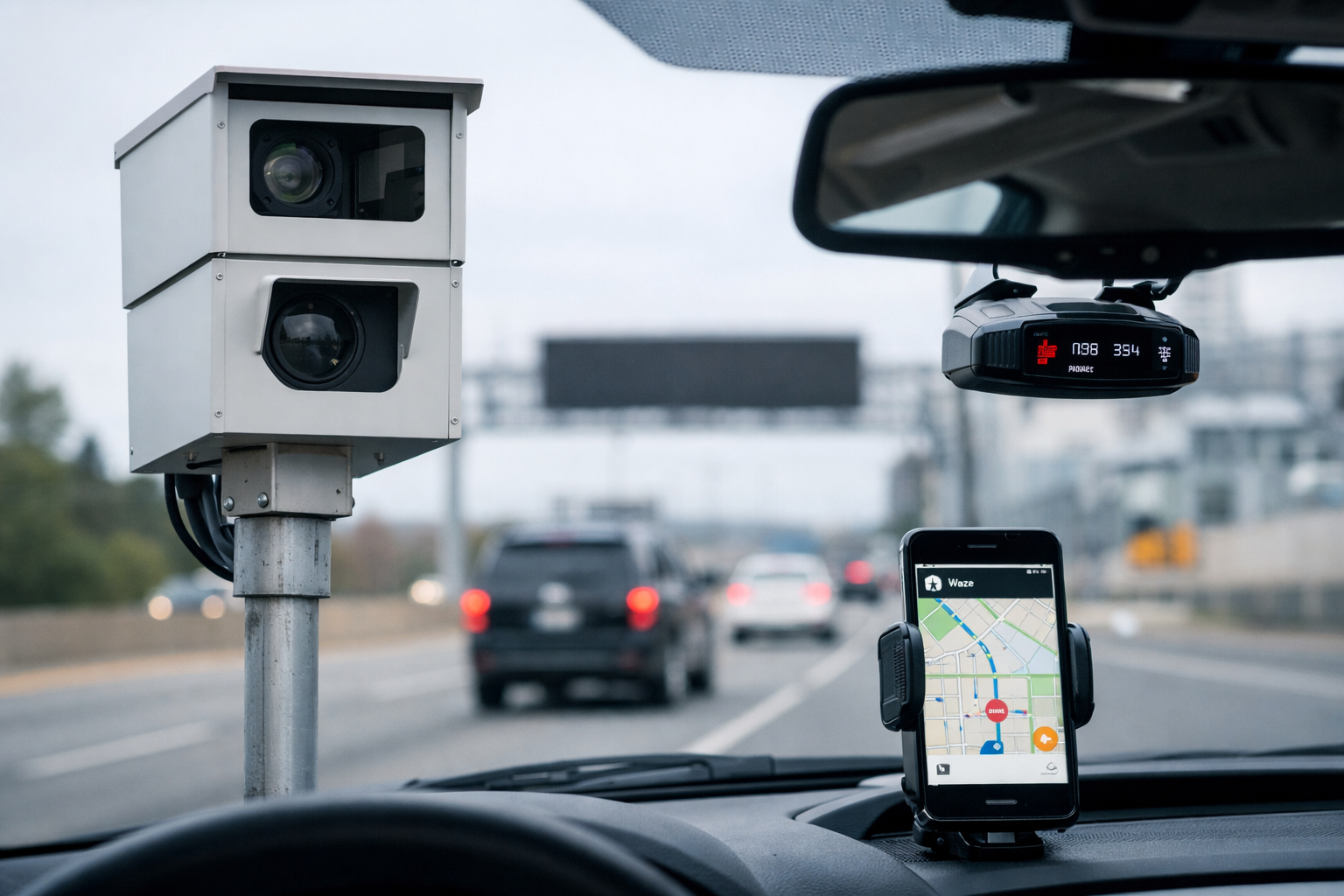
Colorado transportation officials confirmed this week that the first phase of Colorado speed cameras using corridor-based average speed enforcement will go live on May 1, 2026, along high-crash stretches of I-70 and U.S. 36. Unlike traditional radar traps, these systems calculate a driver’s speed over several miles—making the familiar “slow down at the detector, speed up after” strategy largely ineffective.
The Colorado Department of Transportation (CDOT) and the Colorado State Patrol announced the rollout on April 17, citing a 22% increase in speed-related fatalities statewide since 2019, according to preliminary state data. This isn’t just another ticketing program. It marks a technological shift that could render traditional radar detectors—and arguably Waze alerts—obsolete on some of the state’s busiest corridors.
For drivers who rely on dashboard detectors or crowd-sourced apps, this represents a fundamental change in how traffic law technology works. And Colorado is unlikely to be the last state to adopt it.
The Headlines
- What: Colorado launches average speed enforcement cameras on major highways
- Who: Colorado DOT and Colorado State Patrol
- When: First phase begins May 1, 2026
- Impact: Traditional radar detectors and Waze alerts may be ineffective on monitored corridors
- Key Number: 22% rise in speed-related fatalities since 2019 (state data)
What Happened
CDOT installed overhead camera gantries at the start and end points of three pilot corridors: a 12-mile stretch of I-70 west of Denver, a 9-mile segment of U.S. 36 toward Boulder, and a construction zone on I-25 south of Colorado Springs. The cameras capture license plates at entry and exit, then calculate average speed based on travel time.
Drivers exceeding the posted limit by 10 mph or more will receive citations by mail, according to state officials. Fines start at $75 for minor violations and escalate beyond $200 in active construction zones. However, officials say there will be a 30-day warning period before citations are issued.
“Point enforcement changes behavior for a few hundred yards. Average speed enforcement changes behavior for miles,” a CDOT spokesperson said during the April 17 press briefing.
Unlike traditional radar guns, these systems do not emit detectable signals. That means popular radar detectors from brands like Escort, Valentine One, and Uniden have nothing to “see.” Meanwhile, crowd-sourced apps like Waze can alert drivers to camera locations—but slowing only at a known point won’t prevent a ticket if your overall average speed remains high.
For a deeper technical breakdown of how this works, see our guide on average speed cameras explained, which details the timing algorithms and enforcement thresholds.
Why It Matters
This is about more than tickets. It’s about shifting the enforcement model from reactive to systemic. According to the National Highway Traffic Safety Administration, speeding contributed to 29% of U.S. traffic fatalities in 2024. States are under pressure to reduce roadway deaths, especially after pandemic-era spikes.
Additionally, average speed enforcement has shown measurable impact overseas. The U.K.’s Department for Transport reported crash reductions of up to 36% on corridors using similar systems, according to data cited by Reuters in prior coverage of European programs.
For drivers, the implications are immediate. The long-standing cat-and-mouse game—detector chirps, quick brake tap, accelerate again—doesn’t work when enforcement spans 10 miles. In fact, reports indicate insurance companies are watching automated enforcement data trends closely, though Colorado has not announced insurer data-sharing plans.
Moreover, this comes at a time when ownership costs are already climbing. As we’ve covered in New Car Prices 2026 May Rise Again, higher MSRPs and insurance premiums are squeezing budgets. Add automated citations, and the financial impact compounds.
The Bigger Picture
Colorado’s move fits into a national shift toward traffic law technology that prioritizes automation. New York City expanded its speed camera program in 2025. Meanwhile, Washington, D.C. now generates more than $300 million annually from automated traffic enforcement, according to city budget reports.
However, this isn’t purely about revenue. The U.S. Department of Transportation has pushed a “Safe System Approach,” emphasizing infrastructure and automated compliance tools, per Transportation.gov. Average speed enforcement aligns directly with that framework.
There’s also a privacy dimension. Civil liberties groups argue that continuous plate tracking—even if temporary—raises concerns. CDOT says non-violator data will be deleted within days, but independent audits will determine how that’s implemented.
Historically, enforcement tech evolves faster than driver countermeasures. We saw it with red-light cameras in the 2000s and with adaptive cruise control outpacing early detection systems. Having covered three product cycles of in-car tech, I can tell you this pattern is familiar: once enforcement becomes algorithmic, hardware-based avoidance tools struggle to keep up.
What the Competition Is Doing
Colorado isn’t alone. Pennsylvania expanded pilot average speed enforcement in work zones in 2025. California lawmakers are debating corridor-based systems in Los Angeles County. Meanwhile, Texas has resisted automated enforcement after banning red-light cameras in 2019.
Automakers, interestingly, are responding indirectly. BMW, Mercedes-Benz, and Ford increasingly integrate intelligent speed assistance (ISA) into 2025 and 2026 models, especially in Europe where it’s mandated. ISA uses GPS and camera-based sign recognition to warn—or even limit—speed.
In contrast, Tesla relies heavily on camera-based perception and over-the-air updates to refine speed limit detection. However, U.S. vehicles still allow drivers to override most warnings. That could change if states adopt more automated enforcement, nudging OEMs toward compliance-focused features.
The competitive dynamic mirrors what we’re seeing in emissions and EV policy. Just as manufacturers adjust to regulatory shifts like those discussed in Leno’s Law 2026: California May Loosen Rules, they may also recalibrate driver-assist systems around enforcement-heavy markets.
What It Means for You
If you commute on I-70, U.S. 36, or I-25, consistency now matters more than quick reflexes. Maintaining a steady legal speed is the only reliable way to avoid citations under Colorado speed cameras operating on an average basis.
Additionally, relying solely on Waze alerts is risky. While the app can flag known camera zones, it cannot calculate your corridor-wide average speed. Drivers who treat alerts as permission to speed between checkpoints are misunderstanding how average speed enforcement works.
Therefore, practical steps include using adaptive cruise control, verifying your speedometer accuracy, and monitoring posted limits—especially in construction zones where penalties are higher. Think of it as compliance over evasion.
What to Watch Next
The pilot program runs through April 2027, after which lawmakers will review crash data, citation rates, and revenue figures. If fatality reductions mirror European results, expansion statewide is likely.
Meanwhile, legal challenges could emerge over privacy or signage adequacy. Additionally, watch whether insurance carriers adjust premiums based on automated enforcement density in certain ZIP codes—a subtle but meaningful downstream effect.
The Upside
- Potential reduction in high-speed crashes on dangerous corridors
- More consistent traffic flow and fewer sudden braking incidents
- Encourages use of adaptive cruise and driver-assist tech
- Aligns with federal Safe System safety strategy
The Concerns
- Privacy implications of license plate tracking
- Limited effectiveness of traditional radar detectors
- Possible disproportionate impact on lower-income drivers
- Risk of public perception as revenue generation
Colorado speed cameras are not just another roadside gadget—they represent a structural change in how traffic law technology shapes driver behavior. The old playbook of radar detectors and reactive braking is losing relevance on monitored corridors.
Over the next two to five years, expect more states to test similar systems, especially in high-fatality zones. For drivers, the adjustment is simple but significant: steady compliance beats tactical avoidance. The technology has moved on—and now, so must we.
Disclosure: This article may contain affiliate links. If you make a purchase through these links, we may earn a small commission at no extra cost to you. This helps support RevvedUpCars.com. Learn more.