
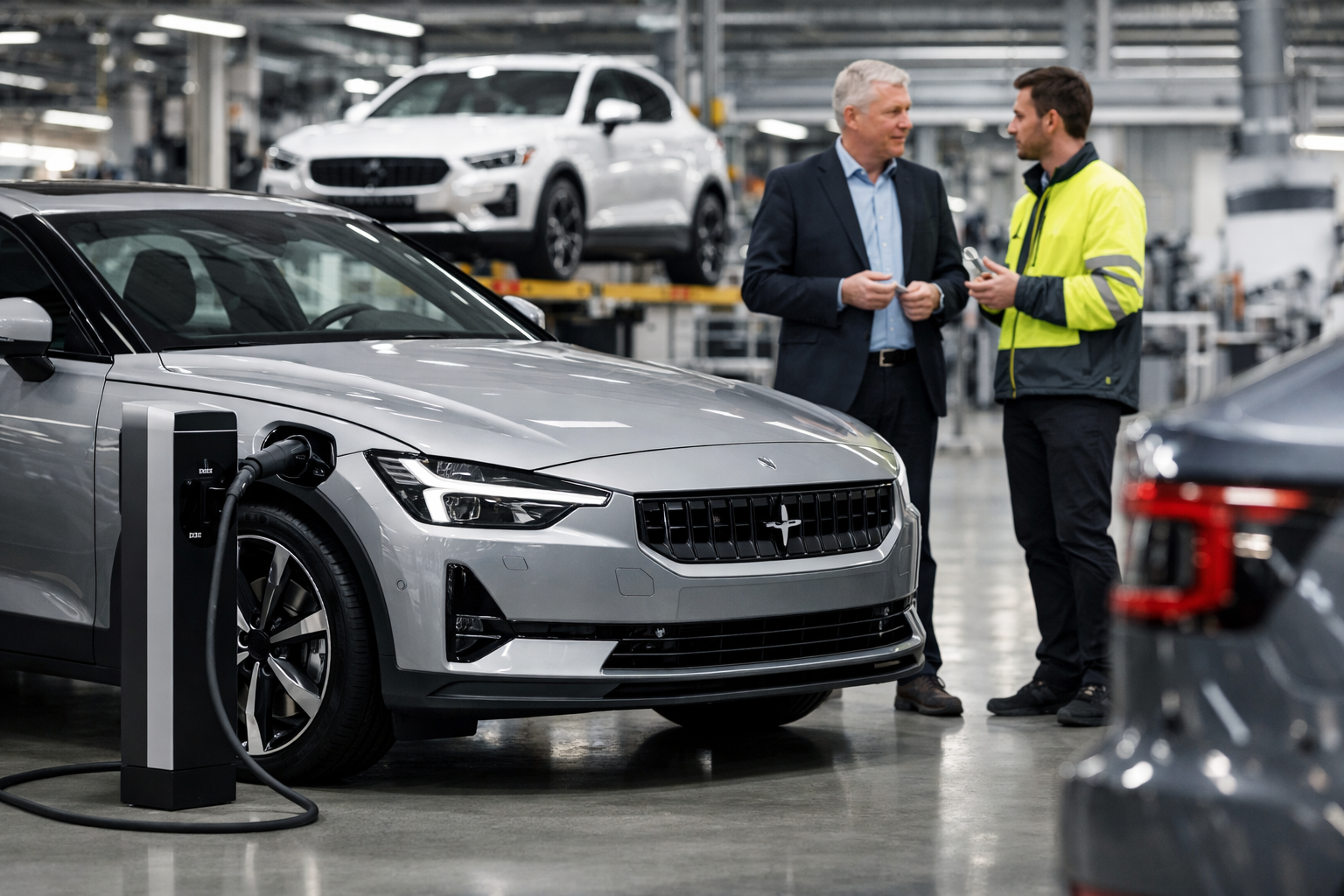
Polestar has reignited the EV vs PHEV debate by arguing that plug-in hybrids are “the worst of both worlds” — a claim that cuts directly into one of the fastest-growing segments of the U.S. market. The Polestar PHEV criticism, made by CEO Thomas Ingenlath during an April 29, 2026 media roundtable in New York, challenges the industry’s growing reliance on plug-in hybrids as a transitional technology.
However, this isn’t just rhetorical sparring. U.S. plug-in hybrid (PHEV) sales jumped roughly 42% year-over-year in Q1 2026, according to Reuters, outpacing battery-electric vehicle (EV) growth in several mainstream segments. Therefore, Polestar’s stance lands at a moment when many automakers — including Toyota, BMW, and Hyundai — are doubling down on plug-in hybrid future strategies.
Notably, Polestar is one of the few premium brands betting almost exclusively on full battery-electric models. That makes its criticism as much a strategic declaration as a philosophical one.
The Headlines
- What: Polestar publicly criticizes plug-in hybrids as inefficient and unnecessary
- Who: Polestar CEO Thomas Ingenlath and global automakers investing in PHEVs
- When: Comments made April 29, 2026
- Impact: Reignites debate over whether PHEVs are a bridge or a detour in electrification
- Key Number: 42% — estimated U.S. PHEV sales growth in Q1 2026
What Happened
Speaking to journalists during the New York media preview week, Ingenlath argued that plug-in hybrids carry “two complete drivetrains, two cost centers, and two sources of complexity.” He claimed that most PHEVs are rarely plugged in consistently, limiting their environmental benefit.
“If customers don’t charge them daily, they’re simply heavier combustion cars,” Ingenlath said. “That’s not a sustainable long-term solution.”
Polestar’s current lineup — the Polestar 2, 3, and 4 for 2026 — is fully electric, with no plug-in hybrid variants planned, according to the company’s newsroom. Meanwhile, Volvo, its former sibling brand under Geely ownership, continues to offer multiple recharge plug-in models despite reporting sales headwinds earlier this year, as we analyzed in Volvo Sales Decline: What Buyers Must Know.
Additionally, Ingenlath pointed to lifecycle emissions studies from the International Energy Agency showing that PHEV emissions vary widely depending on driver charging behavior. In Europe, regulators have begun tightening real-world PHEV testing rules after studies found higher-than-expected CO₂ output.
Why It Matters
The EV vs PHEV debate has shifted from theoretical to practical. U.S. consumers are increasingly wary of full EV ownership due to charging infrastructure gaps, higher upfront costs, and insurance premiums — themes we’ve explored in our Hybrid vs Plug-In Hybrid vs EV: 2026 Buying Guide.
However, PHEVs offer a compelling compromise: 30–50 miles of electric range for daily driving and gasoline backup for road trips. According to EPA testing data at EPA.gov, many 2026 PHEVs achieve over 70 MPGe combined in electric mode while still delivering 35+ mpg on gasoline.
Therefore, Polestar’s blanket dismissal may oversimplify consumer reality. In fact, Toyota’s RAV4 Prime and Prius Prime continue to post waiting lists in several states, while BMW’s X5 xDrive50e has become one of the brand’s strongest electrified sellers in North America.
Yet Polestar’s core argument has merit: dual powertrains mean higher production costs and added weight. Automakers must engineer, certify, and support two propulsion systems, which often results in higher sticker prices. For example, a 2026 BMW 5 Series PHEV carries roughly a $6,000 premium over its mild-hybrid counterpart, according to manufacturer pricing.
The Bigger Picture
Historically, plug-in hybrids were positioned as a bridge technology. When Chevrolet launched the Volt in 2010, charging networks were sparse and battery costs exceeded $1,000 per kWh. Today, BloombergNEF estimates battery pack prices have fallen below $120 per kWh globally.
Meanwhile, the Biden administration’s updated EPA emissions standards for 2027–2032 — detailed at EPA.gov — effectively push automakers toward higher EV adoption rates. However, the rules remain technology-neutral, allowing PHEVs to count toward compliance.
Globally, China’s market shows a different trajectory. Reports indicate extended-range electric vehicles (EREVs), a close cousin to PHEVs, are surging in popularity there. That trend intersects with broader concerns about Chinese automakers’ competitiveness, which we examined in Are Chinese Cars in America a Real Threat in 2026?.
Therefore, the plug-in hybrid future may differ dramatically by region. Europe is tightening incentives for PHEVs. China is embracing range-extenders. The U.S. sits somewhere in between.
What the Competition Is Doing
Toyota remains the strongest defender of hybrid relevance 2026. The company sold over 3.4 million electrified vehicles globally in 2025, according to its annual report, with hybrids and plug-ins forming the backbone of that strategy. Executives argue that maximizing total emissions reduction requires scaling hybrids broadly rather than focusing only on full EVs.
BMW takes a hedging approach. It offers EVs on dedicated platforms while expanding high-performance plug-in hybrids like the 2026 Audi RS5 Hybrid competitor set. BMW’s strategy reflects customer diversity: urban EV buyers coexist with suburban drivers unwilling to commit fully to charging infrastructure.
In contrast, Hyundai and Kia are aggressively expanding both EV and PHEV offerings. Meanwhile, Ford has pulled back on some EV production targets but continues to support the Escape and Lincoln Corsair PHEVs as compliance tools.
Polestar, by comparison, has no fallback. That purity simplifies its messaging but increases risk if EV demand softens — something Porsche is already navigating, as discussed in Porsche sales 2026: Slump or Strategic Warning?.
What It Means for You
If you’re shopping in 2026, this debate affects availability, incentives, and resale value. Full EVs still qualify for up to $7,500 in federal tax credits under certain sourcing rules, while some PHEVs qualify for partial credits depending on battery capacity and assembly location, according to the U.S. Department of Energy.
However, insurance and charging installation costs can tilt the math. Additionally, PHEVs may offer better resale stability in regions with limited charging infrastructure. Used EV prices have shown volatility over the past two years, as we’ve covered in our broader ownership cost analysis.
Therefore, the right answer depends less on ideology and more on your driving pattern. If you commute under 40 miles daily and can charge at home, a PHEV could function as an EV 80% of the time. If you rely on public charging or take frequent long trips, a high-range EV may make more sense.
What to Watch Next
First, watch Q2 and Q3 2026 sales data. If PHEV growth continues outpacing EV adoption, automakers may slow full-electric rollouts further. Conversely, improved charging reliability and lower battery costs could validate Polestar’s position.
Additionally, regulatory adjustments in Europe and potential U.S. policy shifts after the 2026 midterm elections could reshape incentive structures. Finally, battery cost trajectories — tracked closely by BloombergNEF — will determine whether dual-powertrain vehicles remain economically viable.
The Upside
- Accelerates clarity around long-term electrification strategy
- Encourages investment in charging infrastructure
- Reduces engineering complexity if industry standardizes on EVs
- Aligns with tightening global emissions regulations
The Concerns
- Ignores real-world charging behavior diversity
- Risks alienating transitional buyers
- Higher short-term compliance pressure if EV demand stalls
- Market volatility if incentives shift unexpectedly
Having covered multiple electrification cycles, I’ve seen this pattern before: early adopters embrace purity, mainstream buyers prefer flexibility. The Polestar PHEV criticism is bold and strategically consistent, but the market rarely moves in absolutes.
Ultimately, the EV vs PHEV debate will be decided less by executive soundbites and more by infrastructure reliability, battery economics, and consumer habits. For now, plug-in hybrids remain highly relevant in 2026 — even as brands like Polestar push the industry toward a fully electric horizon.
Disclosure: This article may contain affiliate links. If you make a purchase through these links, we may earn a small commission at no extra cost to you. This helps support RevvedUpCars.com. Learn more.