
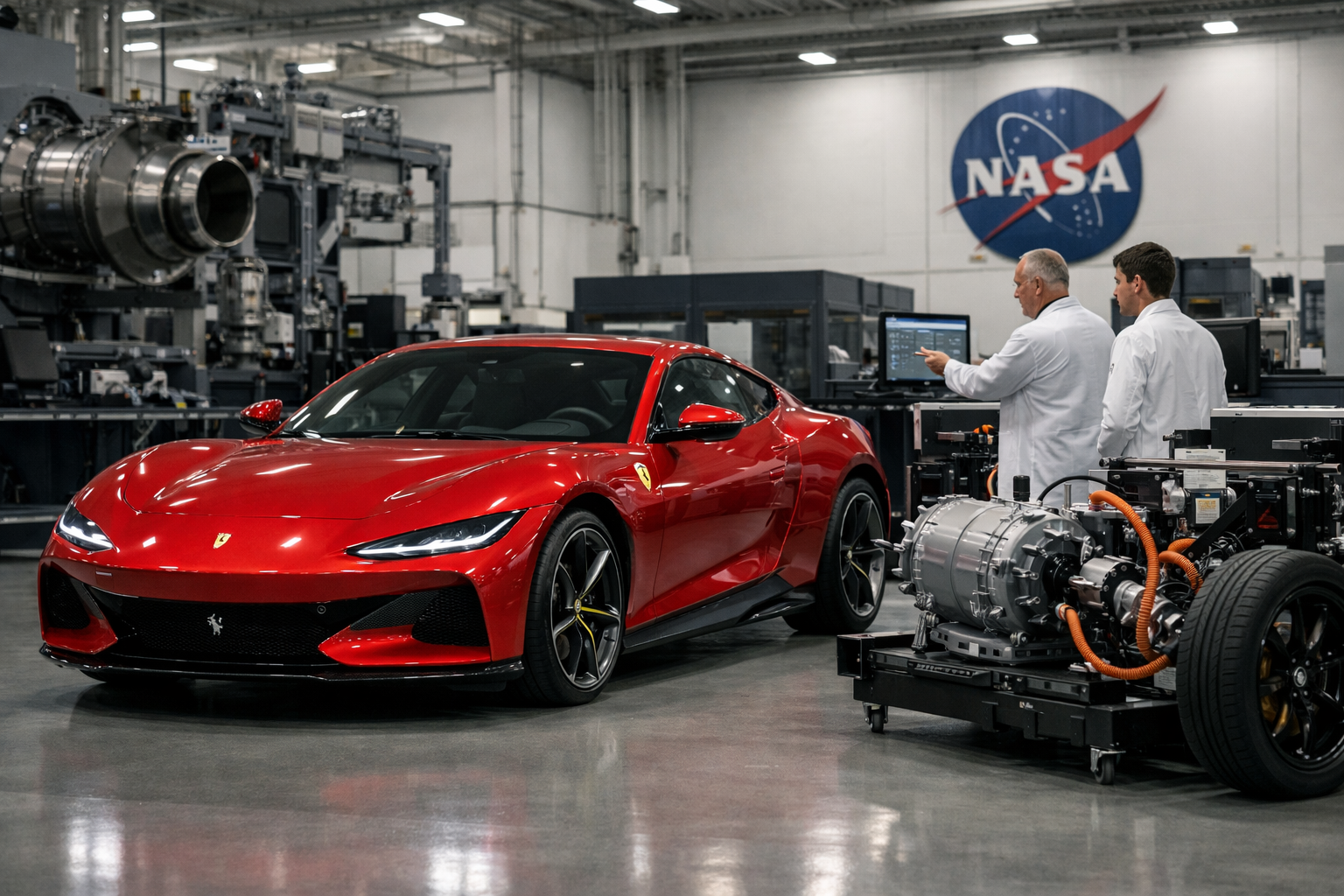
Ferrari confirmed on April 27, 2026 that its first fully electric model, the Ferrari EV Luce, will debut later this year with engineering input inspired by NASA acceleration research. The Maranello brand says it has been studying how astronauts and fighter pilots tolerate sustained G-forces to fine-tune how its electric supercar delivers instant torque.
This is not a gimmick. Instant torque is both the promise and the problem of high-performance EVs. Ferrari’s leadership, speaking at its Capital Markets Day according to Reuters, framed the Luce as a “new chapter” that must feel unmistakably Ferrari—despite lacking a V12 soundtrack.
The announcement matters because Ferrari sits at the emotional pinnacle of internal combustion performance. If the Ferrari EV Luce can preserve brand identity while going electric, it signals the industry’s final psychological hurdle may be falling.
The Headlines
- What: Ferrari detailed its first electric supercar and its NASA-inspired acceleration tuning strategy
- Who: Ferrari N.V.; references to NASA human acceleration research
- When: Announced April 27, 2026; global reveal expected late 2026
- Impact: Signals how ultra-luxury brands will manage extreme EV torque for drivability and brand feel
- Key Number: 0–60 mph estimated under 2.5 seconds (company target, not yet independently verified)
What Happened
Ferrari executives confirmed that the Luce will use a tri-motor setup with torque vectoring and a proprietary battery pack developed in-house in Maranello. While final specifications remain under wraps, executives indicated a target output north of 1,000 horsepower and a sub-2.5-second 0–60 mph sprint.
However, the headline-grabber was Ferrari’s admission that it studied NASA acceleration research to calibrate throttle response. According to company engineers, data on how the human body reacts to rapid G-load changes informed how quickly torque ramps in after initial pedal input.
“Electric motors can deliver 100% torque at zero rpm. The challenge is making that surge exhilarating rather than overwhelming,” Ferrari’s chief technology officer said during the briefing.
Notably, Ferrari did not claim a formal partnership with NASA. Instead, engineers referenced publicly available aerospace research on G-force tolerance and vestibular response. The goal: shape longitudinal acceleration curves so drivers feel progressive thrust rather than a blunt-force hit.
Production will begin in 2027 at Ferrari’s new e-building facility, which opened in 2025. According to prior company filings, Ferrari invested roughly €4.4 billion ($4.7 billion) between 2022 and 2026 in electrification and hybridization programs.
Why It Matters
Instant torque defines EV performance. Tesla normalized it. Rimac weaponized it. Now Ferrari must domesticate it without dulling it. That balance will define the Ferrari EV Luce and the broader Ferrari electric supercar strategy.
Furthermore, this move aligns with EU fleet CO₂ rules tightening toward 2030, as outlined by the European Commission. Ferrari’s low volumes give it flexibility, but electrification reduces regulatory risk and protects margins.
For consumers, this signals that EV performance is maturing beyond straight-line bragging rights. As we’ve discussed in our Hybrid vs Plug-In Hybrid vs EV: 2026 Buying Guide, the next wave of EV differentiation is about tuning and feel—not just range and horsepower.
There’s also a psychological layer. Ferrari’s average transaction price exceeds $350,000, and buyers expect drama. If torque arrives too clinically, the car risks feeling more appliance than icon.
The Bigger Picture
Ferrari is hardly alone in confronting the torque dilemma. The broader shift to dedicated EV platforms, explored in our coverage of EV Architecture Benefits Reshape Car Design Now, allows engineers to program character in ways impossible with mechanical drivetrains.
Meanwhile, Porsche’s recent slowdown—detailed in Porsche sales 2026: Slump or Strategic Warning?—shows how fragile the transition can be when EV demand softens. According to Bloomberg, several premium brands have recalibrated EV rollout timelines amid uneven global demand.
However, Ferrari operates differently. It caps production—13,663 units globally in 2025 per company reports—to maintain exclusivity. That scarcity insulates it from the inventory swings hitting mass-market EV makers.
The non-obvious insight? Managing acceleration feel may matter more for brand preservation than maximum range. A 300-mile EPA figure is table stakes. A recognizable “Ferrari thrust curve” could be the real moat.
What the Competition Is Doing
Rimac Nevera already produces 1,914 horsepower and a verified 0–60 mph time of 1.85 seconds, according to independent testing cited by Car and Driver. Rimac emphasizes raw numbers and record-setting runs.
Meanwhile, Porsche’s Taycan Turbo GT focuses on repeatable performance and thermal management. Porsche engineers prioritize sustained lap times over single-launch theatrics.
Tesla, by contrast, democratized instant torque with the Model S Plaid. However, Tesla’s brand leans on software updates and price adjustments rather than emotional heritage.
Additionally, Lamborghini—Ferrari’s closest rival—plans its first EV for 2028. CEO statements suggest a high-riding 2+2 GT rather than a pure supercar, signaling a slightly more cautious approach.
In short, Rimac chases records, Porsche chases precision, Tesla chases scale. Ferrari appears to be chasing sensation.
What It Means for You
If you’re in Ferrari’s tax bracket, the Luce represents a hedge against tightening emissions rules without sacrificing status. Expect pricing north of $400,000, based on current 296 GTB and SF90 positioning.
However, even if you’ll never own one, the Ferrari EV Luce will influence mainstream EV tuning. Technologies developed here—torque modulation, software-defined throttle maps—filter down within five years.
For buyers considering high-performance EVs today, the takeaway is this: don’t judge solely by 0–60 times. As we’ve seen across segments, including performance hybrids like the 2026 Audi RS5 Hybrid, character increasingly lives in calibration.
Additionally, resale dynamics could shift. Limited-production first-gen Ferrari EVs may carry collectible appeal if they successfully bridge eras.
What to Watch Next
Watch for final homologation specs late in 2026, including EPA-rated range and curb weight. Battery weight will determine handling character as much as power output.
Moreover, pay attention to independent instrumented testing in 2027. Manufacturer acceleration claims often differ from real-world results.
Finally, monitor order bank demand. Ferrari typically sells out years in advance. If allocations linger, that would signal hesitation among traditional buyers.
The Upside
- Elevates EV performance beyond raw torque numbers
- Reduces regulatory risk for Ferrari’s lineup
- Potential halo effect for broader EV acceptance
- Software-driven tuning offers long-term upgrade potential
The Concerns
- Risk of alienating purists loyal to V12 engines
- High battery weight could blunt handling finesse
- EV demand volatility in premium segments
- First-generation reliability unknown
Having covered multiple electrification waves, I can tell you this: the brands that survive transitions are the ones that reinterpret their core strengths rather than abandon them. The Ferrari EV Luce is Ferrari’s attempt to translate combustion drama into code and current.
If it works, expect every performance EV that follows to obsess less over peak torque and more over how that torque feels. And that’s a far more interesting engineering challenge than just chasing the next tenth of a second.
Disclosure: This article may contain affiliate links. If you make a purchase through these links, we may earn a small commission at no extra cost to you. This helps support RevvedUpCars.com. Learn more.