
You know that feeling when you’re 400 miles from home, dust everywhere, and your SUV starts making a noise it’s never made before? Yeah — that’s not the time to start thinking about rally car prep. Whether you’re dreaming of something wild like a Porsche 911 Dakar rally run or just planning a 2,000-mile backcountry trek, preparation is what separates epic stories from expensive tow bills.
A long-distance off-road trip beats up your SUV in ways daily driving never will. Heat, vibration, water crossings, long highway stretches — it’s like running a marathon in work boots. In this SUV adventure guide, I’ll walk you through how to prep your rig the right way, what’s worth upgrading, and what the dealer will happily overcharge you for.
You don’t need a race team. You need the right tools, some patience, and a plan.
What You’ll Need
- Tools: 3/8″ drive ratchet, 10mm–19mm socket set, torque wrench, tire pressure gauge, tread depth gauge, OBD2 scanner, floor jack, jack stands, breaker bar
- Parts/Materials: Engine oil ($35–$70), oil filter ($8–$18), engine air filter ($15–$30), cabin filter ($15–$25), wiper blades ($25–$45), brake pads if needed ($60–$150/axle), coolant ($25–$40), tire plug kit ($15), portable air compressor ($40–$80)
- Time: 3–6 hours for a thorough prep (first-timer), 2–3 hours experienced
- Difficulty: 🔧🔧🔧 (moderate)
- Dealer Cost: $600–$1,200 “Adventure Inspection Package” vs DIY Cost: $180–$400 — You Save: $400–$800
Why This Matters
A 2,000-mile rally-style trip exposes every weak link in your SUV. Marginal brakes? They’ll fade in the mountains. Old coolant? It’ll boil in desert heat. Tires at 4/32″ tread? They’ll hydroplane in the first storm.
In 20 years of wrenching, I’ve seen neglected prep destroy engines and transmissions — not because the vehicle was junk, but because small issues were ignored. A $20 serpentine belt turns into a $900 tow and a ruined weekend.
For rally car prep or serious long distance off-road prep, I recommend doing a full inspection 2–3 weeks before departure. That gives you time to order parts and test-drive everything. Follow your manufacturer’s maintenance schedule — you can find official intervals on your brand’s website or through resources like NHTSA.gov for recall checks.
Before You Start
⚠️ WARNING: Always support your SUV with jack stands on a flat surface. Never rely on a hydraulic jack alone.
⚠️ WARNING: Let the engine cool completely before checking coolant or removing any caps.
Park on level ground. Set the parking brake. If you’re lifting the vehicle, chock the wheels. Basic stuff — but I’ve seen seasoned DIYers skip it and regret it.
Check for open recalls before you touch anything. If you drive a Ford Explorer, for example, there have been suspension-related recalls — see our breakdown here: Ford Explorer Recall: Suspension Risk for 412K SUVs. Fix recall items first — they’re free.
Scan for OBD2 codes. Even if the check engine light isn’t on, pending codes can signal weak coils, EVAP leaks, or sensor issues that’ll show up 800 miles into nowhere.
If you notice transmission slipping, severe oil leaks, or overheating already happening — this is not a DIY-prep situation. Fix those first.
Step-by-Step Guide
-
Change Engine Oil and Filter
Use the correct viscosity (check your oil cap). Most SUVs take 5–7 quarts. Replace the drain plug washer. Torque to spec — consult your owner’s manual.
Pro Tip: If you’re within 1,000 miles of your oil interval, change it early. Fresh oil handles heat better on long runs. -
Inspect Brakes (Pads & Rotors)
Remove wheels using a breaker bar and correct socket (usually 19mm or 21mm for lugs). Pads under 4mm? Replace them. Check for rotor grooves or blue heat spots.
Dealer will charge $450–$700 per axle. DIY with quality pads? $120–$250. -
Check Tires Thoroughly
Minimum 6/32″ tread for mixed terrain. Check sidewalls for cracking. Set pressure according to door jamb sticker.
Pro Tip: Bring a portable compressor. Airing down for dirt roads improves traction — just reinflate before highway speeds. -
Inspect Suspension & Steering
With the SUV lifted safely, grab each wheel at 3 and 9 o’clock. Wiggle. Excess play? Tie rods or ball joints may be worn.
In rally car prep, suspension failure is a trip-ender. -
Replace Air Filters
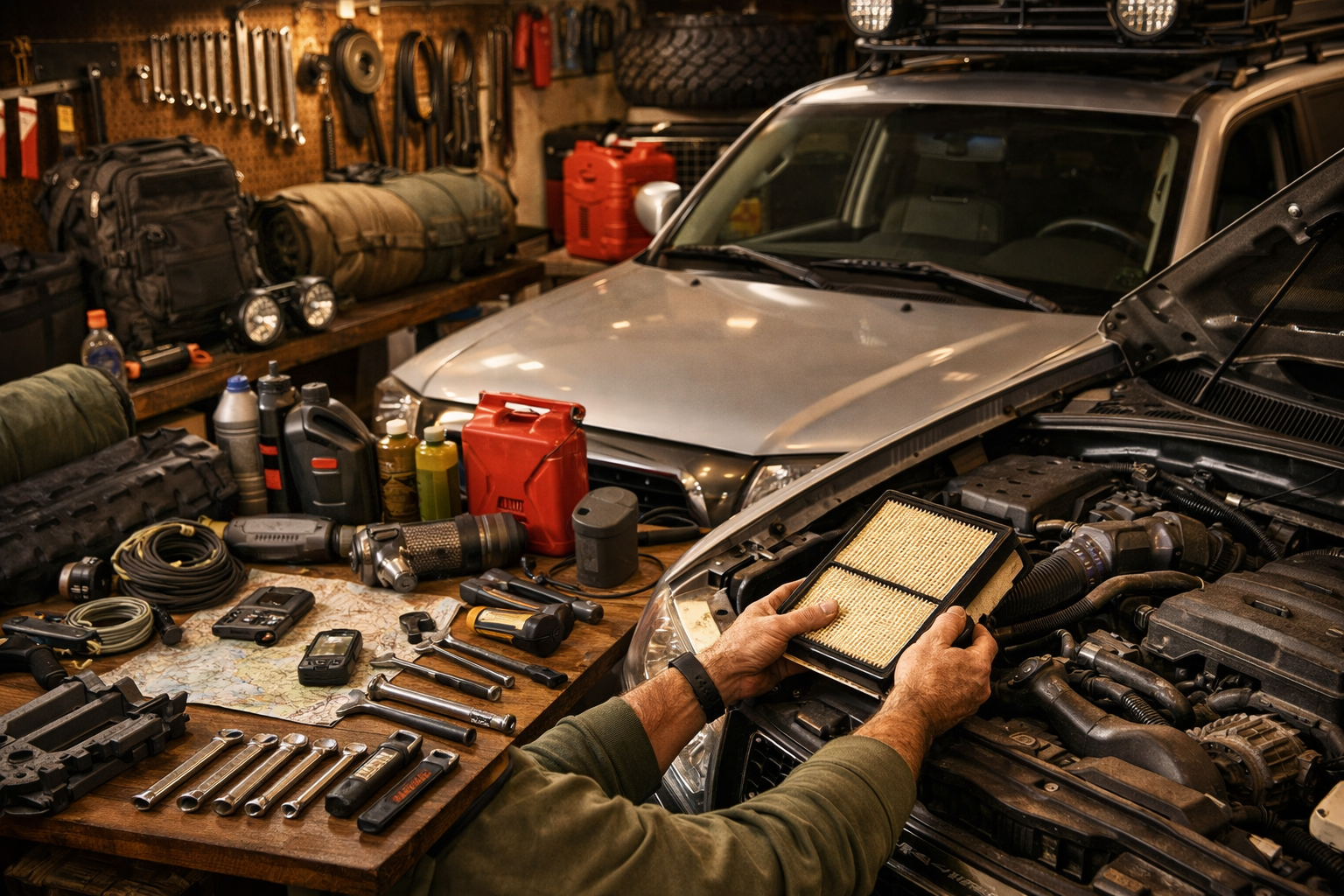
Engine air filter: 5-minute job, usually no tools or a Phillips screwdriver. Dust kills MPG and power. Cabin filter keeps you breathing clean air during long hauls. -
Check Cooling System
Coolant should be bright (green, orange, or pink depending on type). Brown = contamination. Most SUVs hold 1.5–3 gallons.
⚠️ WARNING: Never open a hot radiator cap. -
Test Battery & Charging System
Batteries older than 4–5 years? Replace proactively ($150–$220). Heat and vibration shorten life. Clean terminals with a 10mm wrench and battery brush. -
Update Tech & Safety Systems
Update navigation and check driver-assist sensors. Modern SUVs rely on cameras and radar. If you want to avoid electronic headaches on the road, read our guide on practical car cybersecurity tips.
If you’re driving a hybrid SUV, pay special attention to cooling systems and battery health. We break that down here: Hybrid Car Reliability in 2026: DIY Owner Tips.
Common Mistakes to Avoid
- Ignoring tire age. I’ve seen 8-year-old tires with good tread blow out because the rubber hardened.
- Overloading the roof. Check your roof rack dynamic weight rating. Too much weight ruins handling.
- Skipping torque checks. Lug nuts must be torqued properly. Not “good and tight.” Use a torque wrench.
- Assuming AWD = invincible. AWD helps you go. It doesn’t help you stop.
- Waiting until the night before departure. That’s when parts stores are closed and stress is high.
I’ve seen this in the shop a hundred times — people prep cosmetically but ignore mechanical basics. Fancy lights won’t save worn brake pads.
When to Call a Professional
If you find fluid leaks from the transfer case, differential whining, or electronic AWD faults — get it inspected. A fair pre-trip inspection runs $120–$200 at an independent shop.
Ask: “Did you measure brake pad thickness in millimeters?” If they can’t answer clearly, that’s a red flag. Avoid vague “you might need this soon” upsells.
For emissions-related readiness or compliance questions, check EPA.gov guidelines, especially if crossing state lines with inspections.
Recommended Products
- Mobil 1 or Castrol Edge Full Synthetic Oil — Handles high heat well. What I use in my own garage.
- WIX or OEM Oil Filters — Avoid bargain-bin filters. $6 savings isn’t worth engine wear.
- Viair 88P Portable Air Compressor — Reliable and compact.
- NOCO Boost Jump Starter — Safer than jumper cables and priceless when solo.
- Slime Tire Plug Kit — Cheap insurance for remote areas.
Do This
- Inspect brakes and suspension 2–3 weeks early
- Bring a real spare tire (not just a donut)
- Torque lug nuts properly
- Check recalls before departure
Don’t Do This
- Ignore small leaks
- Overpack heavy gear on the roof
- Assume new means ready
- Skip test-driving after maintenance
Good rally car prep isn’t about turning your SUV into a race truck. It’s about stacking the odds in your favor before you point it toward 2,000 miles of dirt, asphalt, and adventure. Whether you’re channeling Porsche 911 Dakar rally vibes or just heading deep into national forest land, the basics win every time.
You can absolutely do this. Take your time, double-check your work, and give yourself a test drive before departure day. Drop your questions in the comments — I’ll help you sort it out.
Stay safe under there, and remember — a $20 repair manual saves a $2,000 repair bill.