
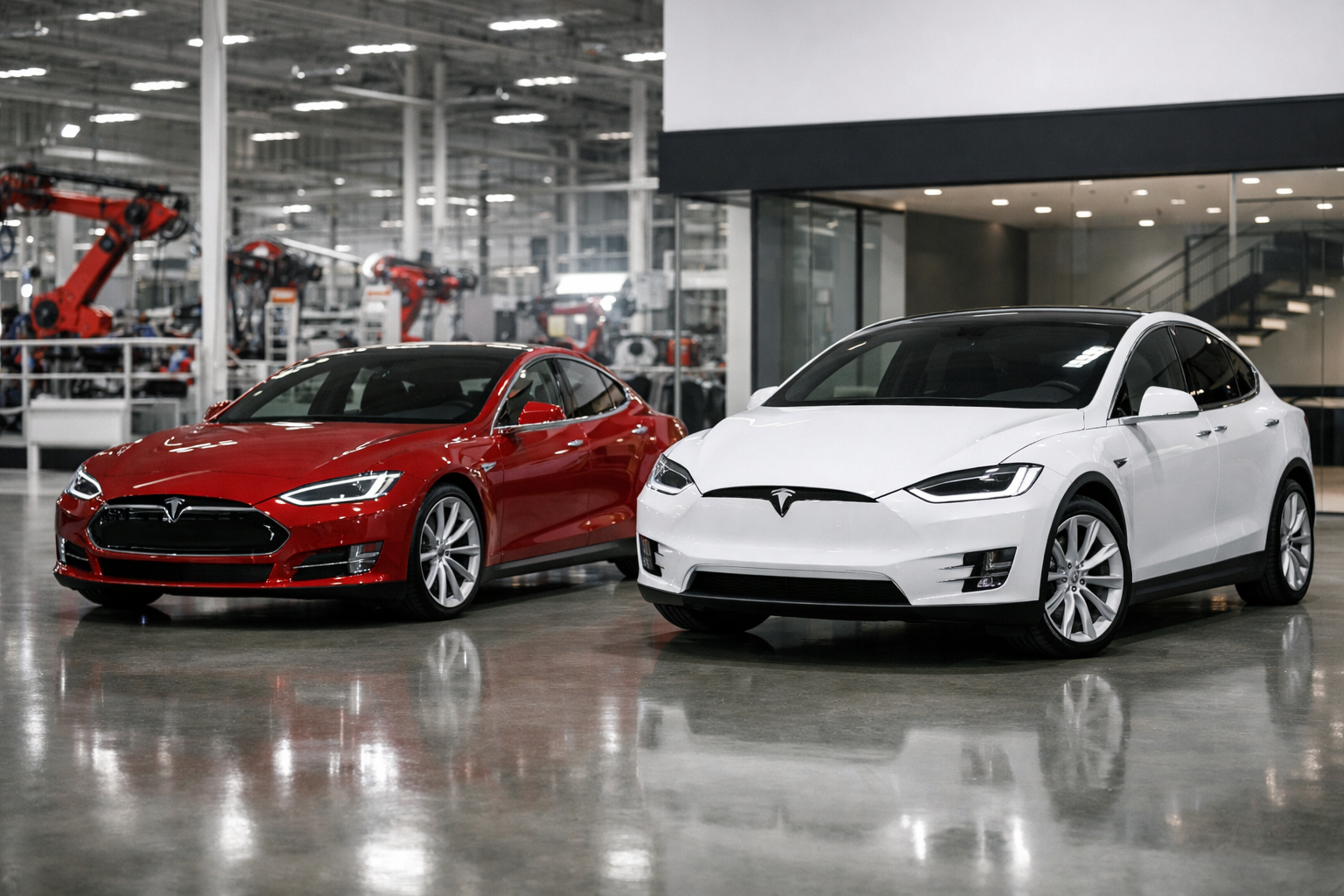
Tesla confirmed on April 30, 2026 that it will cease production of its flagship sedans and SUVs after a final run of limited-edition trims, effectively marking the Tesla Model S discontinued era in all but name. The company unveiled “Signature Series” versions of the Model S and Model X as farewell editions, with production slated to end by late 2026, according to a statement posted in Tesla’s investor relations newsroom.
This is not just another trim update. The Model S launched in 2012 and the Model X in 2015; together, they defined the modern premium EV segment. However, with the Model 3 and Model Y accounting for the overwhelming majority of Tesla’s 2025 deliveries, the decision reflects a strategic shift toward scale and profitability rather than halo products.
The Headlines
- What: Tesla will end regular production of Model S and Model X, replacing them with limited Signature Series editions
- Who: Tesla Inc.
- When: Announcement April 30, 2026; production ends by Q4 2026
- Impact: Signals Tesla’s pivot away from low-volume luxury EVs toward mass-market and next-gen platforms
- Key Number: Less than 5% of Tesla’s 2025 global deliveries came from Model S and X combined (company estimates)
What Happened
Tesla introduced the Model S and Model X Signature Series as capped-production variants featuring unique badging, upgraded interior trims, and bundled Full Self-Driving capability. Pricing starts at an estimated $99,990 for the sedan and $109,990 for the SUV, according to Tesla’s website and early order pages. The company did not disclose exact production volumes but indicated they would be “extremely limited.”
Meanwhile, Tesla confirmed that standard versions will be phased out globally by the fourth quarter of 2026. In its most recent earnings call, CEO Elon Musk said the company is “focusing engineering resources on next-generation platforms and autonomy,” a comment echoed in coverage by Reuters.
Notably, Model S and X deliveries totaled roughly 60,000 units globally in 2025, based on Tesla’s SEC filings, compared with more than 1.7 million combined Model 3 and Model Y deliveries. That math makes the business case clear: flagship models now represent a rounding error in Tesla’s scale-driven strategy.
Why It Matters
The Tesla Model S discontinued shift underscores how dramatically the EV market has matured. When the Model S debuted, there were virtually no long-range electric competitors. Today, buyers can cross-shop the Porsche Taycan, Mercedes EQS, BMW i7, and Lucid Air — each targeting the same six-figure clientele.
However, Tesla’s margins increasingly depend on high-volume production and software revenue. According to company filings, automotive gross margin excluding regulatory credits fell below 20% in 2025 amid price cuts and rising battery costs. Maintaining low-volume, aluminum-intensive platforms designed more than a decade ago simply doesn’t align with that cost discipline.
For consumers, this signals a narrowing of Tesla’s lineup at the top end. The brand that once built its identity on aspirational tech-luxury now leans heavily on the Model Y, which remains America’s best-selling EV. If you’re weighing EV options in 2026, our Hybrid vs Plug-In Hybrid vs EV: 2026 Buying Guide lays out how the competitive landscape has evolved.
The Bigger Picture
This moment caps a 14-year run that reshaped the industry. The Model S forced incumbents to take EVs seriously; in fact, former GM and Ford executives have acknowledged its impact in past interviews. According to the International Energy Agency, global EV sales surpassed 17 million units in 2025 — a world the Model S helped create.
Yet Tesla’s own strategy has shifted from premium disruptor to mass-market juggernaut. As detailed in our coverage of Q1 2026 Auto Sales: Winners and Losers, growth is now concentrated in compact crossovers and affordable EVs, not six-figure sedans.
Additionally, regulatory pressure continues to shape priorities. U.S. EV tax credits under the Inflation Reduction Act reward domestic battery sourcing and high production volume, per the U.S. Department of Energy. The aging S and X platforms were never optimized for that new cost and sourcing environment.
What the Competition Is Doing
Lucid, by contrast, is doubling down on the high-end sedan with its Air lineup, though it delivered just over 10,000 vehicles in 2025, according to company reports. Porsche continues investing in the Taycan and the upcoming electric 718, even as we analyze broader luxury softness in Porsche sales 2026: Slump or Strategic Warning?.
Meanwhile, Mercedes-Benz is recalibrating its EQ strategy, blending EVs back into core nameplates after slower-than-expected EQS demand. BMW, notably, spreads risk across combustion, hybrid, and EV platforms — a hedge Tesla never embraced.
The non-obvious insight: by exiting the flagship segment, Tesla may actually cede technological bragging rights. Historically, automakers use top-tier models to debut new hardware. Without a clear successor to the S and X, Tesla risks appearing less innovative at the high end while competitors showcase 800-volt architectures and next-gen interiors.
What It Means for You
If you’ve been considering a Model S or X, this is effectively your last call. Limited editions often hold value better, particularly when they represent the end of a production run. However, depreciation trends for luxury EVs remain volatile, as used pricing data throughout 2025 demonstrated.
Therefore, buyers should approach the Signature Series as an emotional purchase rather than a rational investment. Incentives are unlikely, given the capped volumes. Financing conditions also remain tighter than pre-2023 norms, so check broader rate trends before committing.
For most shoppers, the real story is resource allocation. Tesla’s engineering focus will likely shift to autonomy, robotics, and next-gen affordable EVs. If your priority is cutting-edge software, the Model 3 or Y may receive updates faster than a sunset flagship.
What to Watch Next
First, watch whether Tesla announces a true successor on a new platform. Musk has hinted at a next-generation architecture for years, but timelines have repeatedly slipped. If no replacement appears by 2027, the Tesla Model S discontinued decision becomes permanent rather than transitional.
Second, monitor resale values through early 2027. Historically, “final edition” models can spike temporarily, then normalize. Data from major auction platforms and dealer networks will tell us whether collectors see long-term value.
Finally, pay attention to how competitors respond. If Lucid, Porsche, and Mercedes accelerate flagship investments, Tesla’s absence could reshape brand perception in the premium EV space.
The Upside
- Sharper focus on high-volume, higher-margin models
- Potentially improved profitability and R&D efficiency
- Limited editions may become collectible
- Resources redirected toward autonomy and next-gen platforms
The Concerns
- Loss of a technological halo product
- Reduced options for luxury EV buyers loyal to Tesla
- Brand perception risk in the premium segment
- Uncertainty around future flagship replacement
Having covered three Tesla product cycles, I can tell you this pattern is familiar: disrupt, dominate, then ruthlessly streamline. The Tesla Model S discontinued chapter closes an era that forced every legacy automaker to electrify faster than planned.
However, the next five years will determine whether stepping away from the flagship tier frees Tesla to innovate — or leaves an opening competitors eagerly fill. Either way, the EV market the Model S created no longer revolves around it. And that, more than any limited-edition badge, defines the end of an era.
Disclosure: This article may contain affiliate links. If you make a purchase through these links, we may earn a small commission at no extra cost to you. This helps support RevvedUpCars.com. Learn more.