
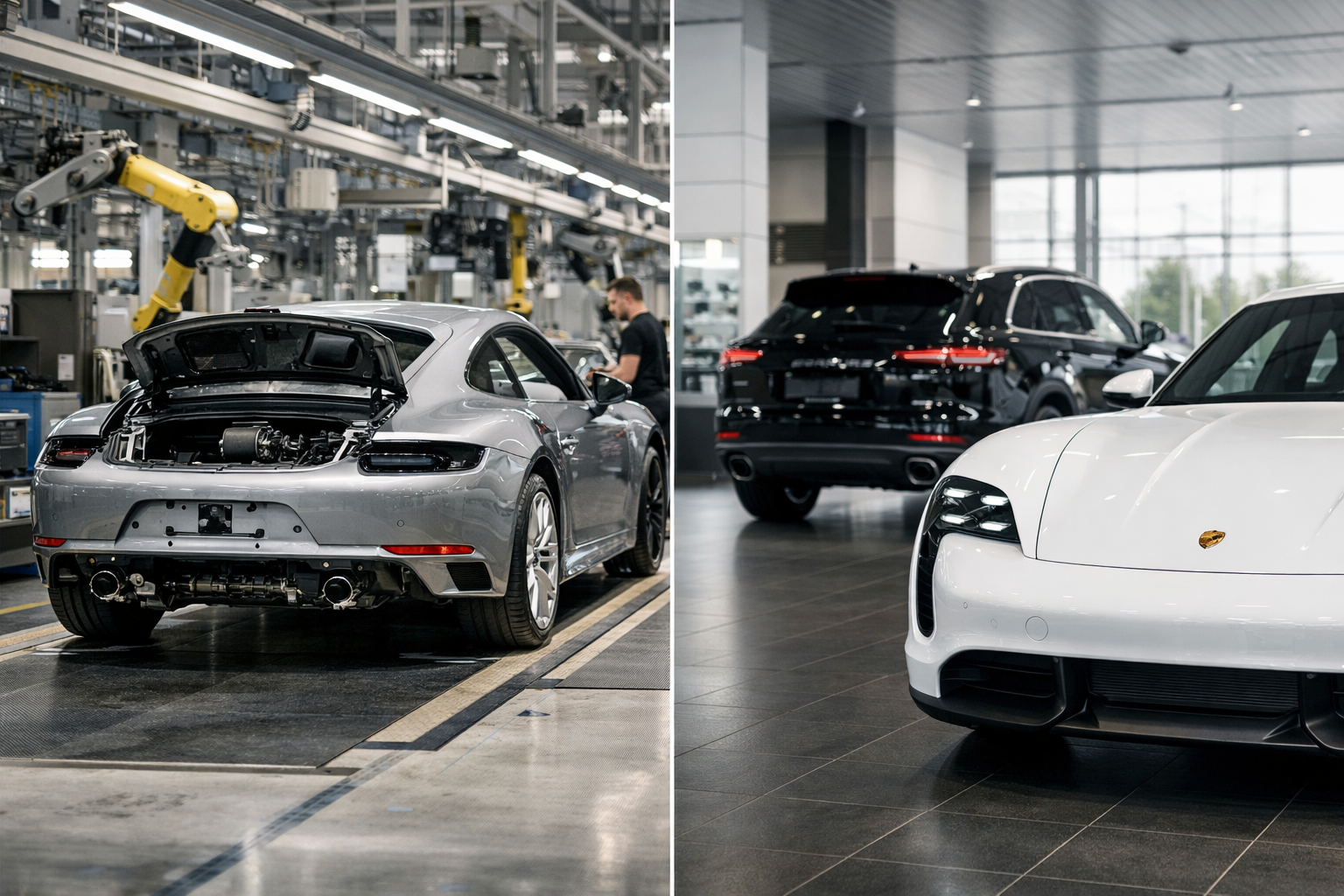
Porsche is facing a sharp slowdown in the U.S. and China, and Porsche sales 2026 are now trending below internal targets set just a year ago. According to preliminary figures released April 23, global deliveries for Q1 2026 fell an estimated 8% year-over-year, with China down nearly 15% and the U.S. off 6%. For a brand that posted record global sales of 320,221 units in 2023 and held steady through 2024, that reversal is notable.
However, the real question isn’t whether one weak quarter matters. It’s whether this reflects temporary model-cycle timing and EV transition friction—or deeper structural issues in the luxury car market. With interest rates still elevated and EV demand normalizing across segments, Porsche’s stumble lands at a sensitive moment for premium brands.
The Headlines
- What: Porsche reports an estimated 8% global sales drop in Q1 2026
- Who: Porsche AG, with major impact in China and the U.S.
- When: Preliminary figures released April 23, 2026
- Impact: Signals pressure from EV transition gaps and softening luxury demand
- Key Number: China sales down approximately 15% year-over-year
What Happened
Porsche’s Q1 2026 delivery update showed declines in two of its largest markets. According to company statements and reporting from Reuters, China remains the biggest drag as local EV competition intensifies and high-end demand cools. Meanwhile, U.S. sales dipped despite continued strength in the 911 and Cayenne lines.
Executives pointed to “model transition effects” and supply adjustments. The gasoline Macan has effectively exited Europe, and the all-electric Macan EV is still ramping production in Leipzig. Similarly, the next-generation 718—expected to go fully electric—has yet to arrive in volume, leaving what analysts call “Porsche lineup gaps” in the entry sports segment.
“We are navigating a period of product changeover and volatile macro conditions,” a Porsche spokesperson said in an April 23 earnings call, according to company transcripts.
Notably, Porsche confirmed it will moderate EV expansion targets first outlined during its 2022 IPO, when it aimed for 80% of global sales to be all-electric by 2030. Bloomberg reported earlier this year that Porsche is reassessing combustion-engine investments in response to softer EV growth in North America.
Why It Matters
The dip in Porsche sales 2026 comes as the broader luxury segment shows signs of fatigue. Mercedes-Benz reported a 5% decline in global car sales in Q1, while BMW held roughly flat thanks to strong EV uptake, according to manufacturer releases and Bloomberg. In other words, Porsche is not alone—but it may be more exposed.
Additionally, Porsche’s reliance on high-margin performance models makes it more sensitive to interest rates and asset-market swings. According to Federal Reserve data, auto loan rates remain above 7% for new vehicles. That’s manageable for a $40,000 crossover buyer; it’s more consequential for a $120,000 911 financed over 60 months.
Furthermore, the EV transition adds cost pressure. Battery sourcing, software development, and platform investments require billions in capital expenditure. As we’ve detailed in our look at EV architecture benefits reshaping car design, brands that commit to dedicated EV platforms early can gain efficiency—but only if demand materializes on schedule.
The Bigger Picture
Luxury car market trends have shifted dramatically since 2021’s post-pandemic boom. Back then, constrained supply pushed margins to record highs. However, inventory levels normalized in 2025, incentives crept back, and buyers became more price-sensitive.
At the same time, Chinese brands like BYD and Nio expanded aggressively in the premium EV space. While U.S. tariffs still limit direct competition, the pressure in China is intense. We’ve examined related dynamics in our analysis of whether Chinese cars pose a real threat in 2026. Porsche’s 15% China drop suggests that threat is no longer theoretical.
Moreover, U.S. demand appears stable but cautious. The latest industry outlook projects a 2.6% overall market decline this year, as covered in our report on the US Auto Sales 2026 forecast drop. In a shrinking market, niche luxury brands often feel outsized pressure.
What the Competition Is Doing
BMW is doubling down on its Neue Klasse EV platform, with the new iX3 earning global accolades and strong early orders. Mercedes, by contrast, is pivoting back toward high-efficiency combustion and plug-in hybrids after scaling back some EQ branding. Audi, Porsche’s corporate cousin within Volkswagen Group, faces similar EV ramp challenges but benefits from broader segment coverage.
Tesla remains a wildcard. Although its growth has moderated, it still commands roughly 50% of the U.S. EV market, according to industry estimates. Meanwhile, Lucid and Rivian are targeting the high-end EV buyer Porsche hopes to convert with the Macan Electric and future 718 EV.
In contrast to rivals with wider portfolios, Porsche’s relatively tight lineup amplifies any timing missteps. When the entry 718 pauses and the Macan shifts powertrains, there’s limited backfill.
What It Means for You
For buyers, short-term softness in Porsche sales 2026 could translate into more negotiable deals—especially on outgoing gasoline Macans or Taycan inventory. Incentives remain modest compared to mainstream brands, but dealer flexibility typically increases when quarterly targets slip.
However, if you’re waiting for the electric 718 or broader EV availability, expect some uncertainty. Porsche has not locked in final U.S. timing for all variants. Therefore, shoppers cross-shopping BMW’s i4 or Mercedes’ EQE may find more immediate availability.
Additionally, financing strategy matters more in this rate environment. Our guide on how to score car finance deals in 2026 outlines where captive lenders are quietly offering support. Porsche Financial Services has occasionally subsidized rates during slower quarters.
What to Watch Next
First, monitor Q2 delivery data for signs of stabilization. If China remains down double digits, Porsche may revise full-year guidance. Second, watch for updates on combustion-engine reinvestment; any reversal of EV-only commitments would signal strategic recalibration.
Additionally, pay attention to margins. Porsche’s operating return on sales exceeded 18% in peak years. If that falls materially, investors—and by extension, product planners—will react.
The Upside
-
Short-term softness may improve dealer flexibility and incentives
-
EV transition could broaden Porsche’s customer base long term
-
Strong brand equity in 911 and Cayenne provides stability
-
Potential recalibration may align production more closely with real demand
The Concerns
-
China weakness may persist amid intense domestic EV competition
-
Lineup gaps risk losing entry-level sports car buyers to rivals
-
High interest rates disproportionately impact six-figure vehicles
-
EV investment costs pressure margins if demand underperforms
Ultimately, Porsche sales 2026 may rebound once product cycles normalize. Having covered multiple luxury downturns, I can tell you timing often explains more than headlines suggest. However, if China fails to recover and EV uptake remains uneven, this could mark a more structural shift.
The next 12 months will reveal whether this is a temporary trough—or the first signal that the golden era of easy luxury growth is over. For now, Porsche still has the brand strength to adapt. The question is how quickly it does so.
Disclosure: This article may contain affiliate links. If you make a purchase through these links, we may earn a small commission at no extra cost to you. This helps support RevvedUpCars.com. Learn more.