
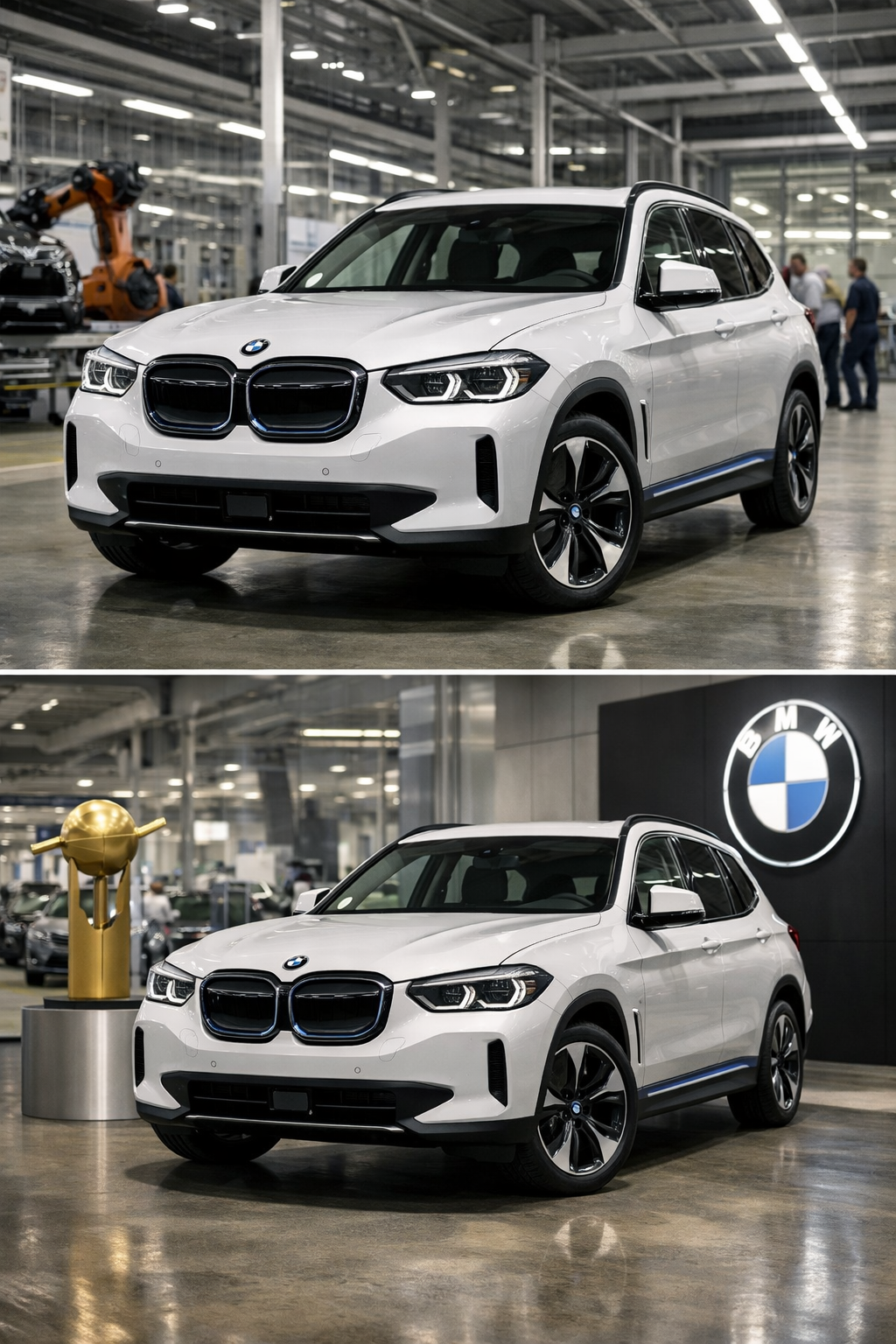
BMW’s all-electric compact SUV just claimed one of the industry’s highest honors. The BMW iX3 World Car of the Year win was announced April 13, 2026, at the New York International Auto Show, putting the German automaker at the center of this year’s awards conversation and signaling a broader shift in how EVs are judged against combustion rivals.
This isn’t just another trophy for the shelf. The World Car Awards jury—made up of more than 100 automotive journalists from over 30 countries—has historically favored breakthrough products that reflect where the market is heading. By awarding the iX3 top honors at the 2026 NY Auto Show winners ceremony, the panel effectively endorsed BMW’s next-generation EV platform strategy at a time when global electric vehicle growth has begun to moderate.
Moreover, the timing matters. With U.S. auto sales forecast to dip 2.6% in 2026, according to industry analysts cited in our US Auto Sales 2026 Forecast Drops 2.6% report, automakers need clear product wins to sustain momentum. BMW just secured one.
The Headlines
- What: BMW iX3 named 2026 World Car of the Year at the New York Auto Show
- Who: BMW AG; World Car Awards jury
- When: Announced April 13, 2026
- Impact: Validates BMW’s next-gen EV platform amid slowing global EV growth
- Key Number: 100+ jurors from 30+ countries voted
What Happened
The 2026 BMW iX3 took top honors over a shortlist that included finalists from Hyundai, Kia, and Volvo, according to the official World Car Awards announcement. The model is the first built on BMW’s dedicated Neue Klasse EV architecture, which underpins the company’s next wave of battery-electric vehicles.
BMW says the new iX3 delivers up to 400 miles (WLTP estimate) of range and supports 800-volt fast charging capable of adding roughly 200 miles in 10 minutes under ideal conditions. U.S.-spec EPA figures have not yet been finalized, and BMW has not confirmed pricing, though analysts expect a starting MSRP in the mid-$50,000 range when it reaches American showrooms later this year.
In a statement released through BMW’s global newsroom, executives described the win as “a clear signal that sustainable mobility and driving pleasure are no longer mutually exclusive.” The press release says “revolutionary.” The reality is more nuanced: the iX3 refines BMW’s EV formula rather than reinventing it, but it does so on a scalable platform critical to future profitability.
Additionally, the World Car Awards have become increasingly influential as automakers use them to bolster global marketing campaigns. Previous winners such as the Hyundai Ioniq 5 and Kia EV6 saw measurable bumps in consumer awareness and showroom traffic, according to industry analysts cited by Reuters.
Why It Matters
The BMW iX3 World Car of the Year title lands at a pivotal moment. Global EV sales growth slowed to single digits in several major European markets in early 2026, according to industry data and our analysis in Europe EV Market Share Slows — Feb 2026. Meanwhile, U.S. adoption remains sensitive to pricing and charging infrastructure gaps.
Therefore, this award isn’t just about prestige; it’s about credibility. BMW is betting heavily on its Neue Klasse platform to lower production costs, improve battery density, and standardize software across models. Company filings indicate BMW plans for EVs to represent 50% of global sales by 2030. A high-profile validation now helps reassure investors and dealers that the strategy is resonating.
For consumers, awards influence perception more than many realize. According to J.D. Power studies, third-party accolades can meaningfully boost buyer confidence, particularly among shoppers transitioning from combustion to electric. If you’re debating between hybrid and full EV options, our guide on How to Choose Hybrid vs Electric SUV 2026 breaks down the trade-offs.
The Bigger Picture
BMW’s win reflects a broader recalibration in the EV race. Early adopters have largely made their purchases. Now, automakers must convince mainstream buyers who are cost-conscious and range-anxious. That requires competitive pricing, reliable charging access, and software that works seamlessly.
In contrast to earlier compliance-driven EVs, the iX3 was engineered from the ground up as electric. BMW claims 30% faster charging and 20% higher energy density versus its previous-generation batteries, though independent EPA verification is pending. Furthermore, the company has emphasized circular economy initiatives and lower embedded carbon in production, aligning with tightening EU sustainability regulations.
Meanwhile, policy uncertainty clouds the U.S. outlook. Federal EV tax credits remain subject to sourcing requirements tied to battery materials, as outlined by the U.S. Department of Energy. Whether the iX3 qualifies for the full $7,500 incentive could materially affect its competitiveness against domestic rivals.
Historically, award winners often signal platform longevity. Having covered three product cycles, I can tell you this pattern is familiar: when a manufacturer wins with a first-generation architecture, it typically leverages that system across multiple body styles within 24 to 36 months. Expect the iX3’s underpinnings to spread quickly across BMW’s lineup.
What the Competition Is Doing
BMW’s German rivals are hardly standing still. Mercedes-Benz is investing heavily in next-gen electric drivetrains even as it reassesses high-cost projects, as we explored in Mercedes V12 Future: Flagship Engine at Risk. Additionally, Mercedes’ EQ lineup is undergoing a design and branding rethink after mixed sales performance in 2024 and 2025.
Audi, meanwhile, continues expanding its PPE (Premium Platform Electric) architecture co-developed with Porsche. The Q6 e-tron and upcoming Q4 refresh aim squarely at the same premium compact SUV buyer the iX3 targets. In the U.S., Tesla still commands roughly 50% of the EV market, according to estimates reported by Bloomberg, though its share has gradually declined as legacy automakers introduce competitive models.
Hyundai and Kia also remain aggressive. The Hyundai Ioniq 5 and Kia EV6 have already captured multiple global awards in recent years, and the Korean brands plan expanded North American production to secure federal incentives. In short, BMW’s victory doesn’t eliminate competition—it intensifies it.
What It Means for You
If you’re shopping in the $50,000 to $65,000 electric SUV bracket, the BMW iX3 World Car of the Year recognition makes the model a must-test-drive contender. Awards don’t guarantee reliability or resale value, but they do indicate a well-rounded product vetted by global experts.
However, pricing discipline will be critical. With average new-car transaction prices still hovering near record highs, as discussed in our New Car Prices 2026 May Rise Again analysis, even a well-reviewed EV can stumble if incentives shrink or financing costs rise.
Additionally, buyers should scrutinize charging access in their region. The iX3’s 800-volt architecture promises rapid charging, but real-world results depend on infrastructure availability. Therefore, evaluate your local DC fast-charging network before committing.
What to Watch Next
First, watch for EPA-certified range figures and official U.S. pricing, expected later this spring. Those numbers will determine whether the iX3 competes head-on with the Tesla Model Y Long Range, Audi Q6 e-tron, and Mercedes EQE SUV.
Second, monitor how quickly BMW scales the Neue Klasse platform. The company has indicated multiple models will launch by 2028, but execution risk remains. Supply chain stability and battery sourcing compliance will shape profitability.
Finally, pay attention to consumer demand signals. If showroom traffic and order banks surge in the months following the award, it could reinforce BMW’s EV strategy. If not, the trophy may prove more symbolic than transformative.
The Upside
- Validates BMW’s next-generation EV platform globally
- Boosts consumer confidence in premium electric SUVs
- Strengthens BMW’s competitive stance against Tesla and Mercedes
- Signals maturation of EVs as mainstream award winners
The Concerns
- Final U.S. pricing and tax credit eligibility remain unclear
- EV market growth is slowing in key regions
- Charging infrastructure gaps could limit real-world appeal
- Awards don’t guarantee long-term reliability or resale value
The BMW iX3 World Car of the Year win won’t single-handedly accelerate EV adoption, but it sharpens the competitive stakes in the premium SUV segment. Moreover, it signals that electric vehicles are no longer niche disruptors—they’re now the benchmark.
Over the next two to five years, watch how BMW capitalizes on this momentum. Awards fade quickly; execution endures. If BMW translates this recognition into strong sales, disciplined pricing, and reliable software, the iX3 could mark the moment its EV strategy truly hits stride.
Disclosure: This article may contain affiliate links. If you make a purchase through these links, we may earn a small commission at no extra cost to you. This helps support RevvedUpCars.com. Learn more.