
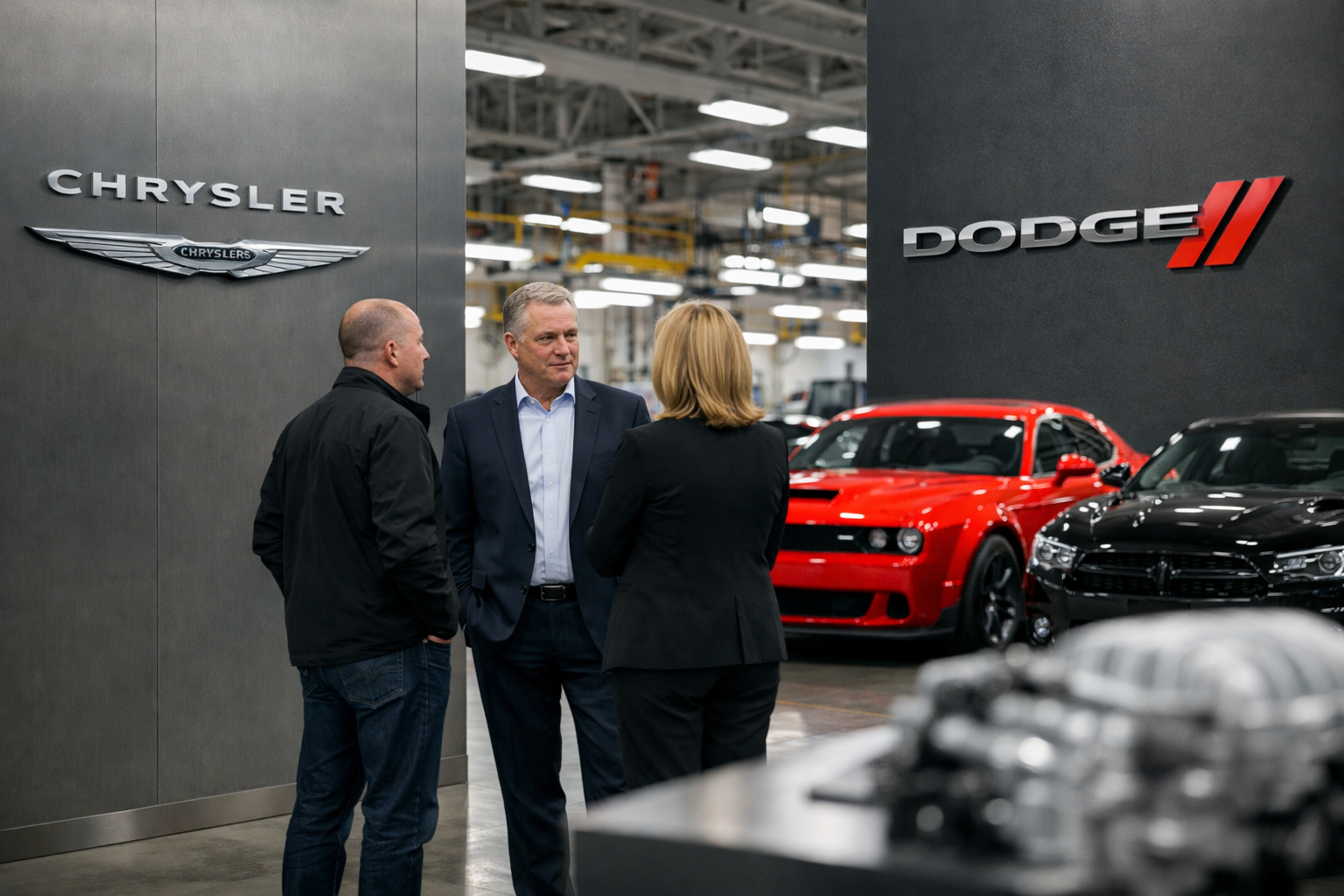
Stellantis confirmed sweeping leadership changes on March 15, appointing a Chrysler new CEO and reshuffling brand chiefs at Dodge and Ram in what amounts to the most significant Stellantis management shift since the PSA–FCA merger in 2021. The move comes as the company grapples with slowing EV demand in North America, uneven global sales, and mounting pressure to define the future of Chrysler and Dodge in an electrified era.
According to a statement posted on Stellantis’ global newsroom and covered by Reuters, the new CEO will oversee Chrysler’s long-delayed product revival while Dodge’s leadership changes are aimed at accelerating performance EV development. This isn’t just executive musical chairs. After five years of strategy pivots—from aggressive EV targets to more recent flexibility—the stakes are existential for two of America’s most storied nameplates.
Notably, Chrysler currently sells just one vehicle in the U.S., the Pacifica minivan, while Dodge is in the middle of transitioning from V8 muscle to the all-electric Charger Daytona. Leadership clarity now could determine whether those brands regain relevance or fade into niche status.
The Headlines
- What: Stellantis appoints a new Chrysler CEO and reshuffles Dodge leadership
- Who: Stellantis, Chrysler, Dodge, Ram
- When: Announced March 15, 2026; effective immediately
- Impact: Signals strategic reset for Chrysler and Dodge amid EV transition
- Key Number: 1 — Chrysler currently sells just one model in the U.S.
What Happened
Stellantis said the Chrysler new CEO will report directly to CEO Carlos Tavares’ successor leadership team, with a mandate to “restore product cadence and brand clarity.” According to company materials and reporting from Bloomberg, the executive previously led one of Stellantis’ European EV programs, signaling a stronger electrification focus for Chrysler.
Meanwhile, Dodge leadership changes include a new global brand chief tasked with managing the rollout of the 2025 and 2026 Dodge Charger lineup, which includes both the electric Daytona and a forthcoming twin-turbo inline-six gasoline variant. Stellantis confirmed that Dodge’s performance roadmap will remain “multi-energy,” a phrase the company increasingly uses to describe its hedge between EVs and combustion.
Furthermore, the management shift consolidates North American product planning under a single regional structure. Stellantis said this will “reduce duplication and improve speed to market,” a tacit acknowledgment that the company has struggled with launch timing and dealer inventory imbalances over the past 18 months.
“We are entering a decisive phase for our American brands,” Stellantis said in its March 15 release. “Leadership alignment is critical to delivering competitive products at the right pace.”
According to Stellantis’ most recent annual filing, U.S. sales declined in 2025 by an estimated mid-single-digit percentage, with Dodge down more sharply following the discontinuation of the Challenger and Charger sedans. Chrysler’s sales remain heavily concentrated in the Pacifica, which competes in a shrinking minivan segment dominated by Toyota and Honda.
Why It Matters
The Chrysler new CEO appointment matters because Chrysler has effectively been in product limbo for nearly a decade. The brand previewed the Airflow EV concept in 2022 but delayed its launch as EV demand softened and battery costs fluctuated. As we’ve seen with other automakers recalibrating EV ambitions—Hyundai’s Ioniq 6 retreat is a case in point, as detailed in our analysis of the Ioniq 6 discontinued: what it means—overpromising and underdelivering can erode brand credibility.
Additionally, Dodge’s transition from V8 muscle to electrified performance is one of the boldest experiments in the industry. The electric Charger Daytona targets up to 670 horsepower in its Scat Pack form, but it must convince traditional buyers that synthetic exhaust notes and instant torque can replace the emotional pull of a HEMI V8.
Therefore, leadership stability becomes critical. Performance brands thrive on clear identity. Any mixed messaging—electric today, gas tomorrow—risks confusing buyers and dealers alike.
The Bigger Picture
This Stellantis management shift unfolds against broader volatility in the global auto market. European EV sales rose nearly 20% year-over-year in January 2026, according to ACEA data covered in our report on Europe EV sales surge. In contrast, U.S. EV growth has moderated as federal incentives face political scrutiny and inventory builds.
Moreover, regulatory uncertainty complicates planning. The EPA’s emissions standards for model years 2027–2032 remain under debate, per EPA.gov, while some policymakers have floated rollbacks that could ease short-term compliance costs. Our recent breakdown of the emissions regulations rollback explains how shifting rules can affect pricing and powertrain strategy.
In that environment, Stellantis is hedging. Unlike General Motors, which has publicly committed to an all-electric light-duty lineup timeline, or Ford, which split its EV and combustion operations, Stellantis has embraced a “multi-energy” approach. That flexibility could prove wise—or it could dilute focus.
Historically, Chrysler has suffered most during corporate transitions. Since 1998, it has cycled through Daimler, Cerberus, Fiat, FCA, and now Stellantis ownership. Each promised revival. Few delivered sustained product investment.
What the Competition Is Doing
Ford, for its part, continues to lean heavily on heritage performance while cautiously expanding EVs. The Mustang Mach-E remains on sale alongside the V8 Mustang, and as our coverage of Ford February sales shows, Ford’s SUV strength is cushioning softer EV demand.
Meanwhile, General Motors is doubling down on Ultium-based EVs across Chevrolet, Cadillac, and GMC. However, GM has also slowed certain EV plant investments, according to Reuters, reflecting similar demand recalibrations.
Toyota, in contrast, has maintained its hybrid-first strategy. The company argues hybrids provide immediate emissions reductions without relying on charging infrastructure expansion, a position that has gained credibility as U.S. EV adoption growth cools.
Against that backdrop, Dodge’s bet on high-performance EVs is riskier than it first appeared in 2022. Additionally, Chrysler’s future product mix—whether crossover EVs, plug-in hybrids, or a reimagined sedan—must carve space between Toyota’s hybrid dominance and Tesla’s EV brand equity.
What It Means for You
If you’re a Dodge fan, the leadership changes likely mean faster clarification on the Charger lineup and future trims. Expect clearer messaging around gas versus electric variants by late 2026. However, pricing will be crucial; performance EVs often carry $10,000–$15,000 premiums over comparable gas models.
For Chrysler shoppers, the short-term reality remains the Pacifica. The plug-in hybrid Pacifica continues to qualify for certain federal and state incentives, and for families weighing electrification, our EV vs Hybrid 2026 guide breaks down cost differences in practical terms.
Additionally, if you’re considering waiting for a new Chrysler EV, be prepared for uncertainty. Leadership resets typically delay product timelines before they accelerate them. Based on past cycles I’ve covered, a full product renaissance rarely materializes in less than 24–36 months.
What to Watch Next
First, watch for a detailed product roadmap from the Chrysler new CEO within the next two quarters. Investors and dealers will demand concrete timelines, not just concepts.
Second, monitor how Dodge’s electric Charger sales track through 2026. If demand underperforms projections, Stellantis may lean harder into its gasoline variants.
Third, keep an eye on capital allocation in Stellantis’ next earnings call. According to prior SEC filings, North American profitability funds much of the company’s global EV investment. Any shift there will signal how serious this reset is.
The Upside
- Clearer leadership could accelerate overdue Chrysler product launches
- Dodge gains focused oversight during critical EV transition
- “Multi-energy” strategy offers flexibility amid regulatory uncertainty
- Potential for stronger dealer confidence and brand messaging
The Concerns
- Frequent leadership changes can delay execution
- Chrysler’s thin lineup leaves little margin for error
- Dodge risks alienating core V8 enthusiasts
- Unclear EV demand trajectory in the U.S. market
The Chrysler new CEO appointment isn’t a silver bullet, but it is a pivotal inflection point. After years of drifting strategy, Stellantis is signaling that its American brands require sharper focus and faster execution.
Having covered multiple Detroit turnarounds, I can tell you this: vision statements are easy. Product cadence is hard. Over the next 24 months, we’ll learn whether this leadership reset finally delivers the future of Chrysler and Dodge—or simply restarts the clock.
Disclosure: This article may contain affiliate links. If you make a purchase through these links, we may earn a small commission at no extra cost to you. This helps support RevvedUpCars.com. Learn more.