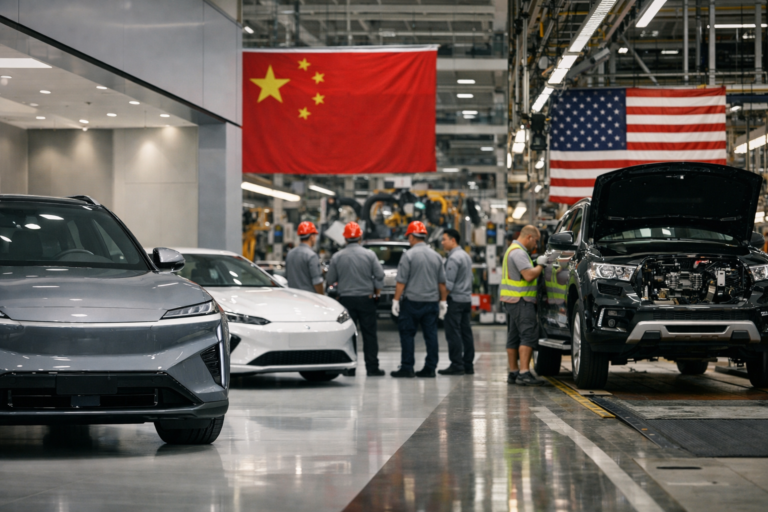

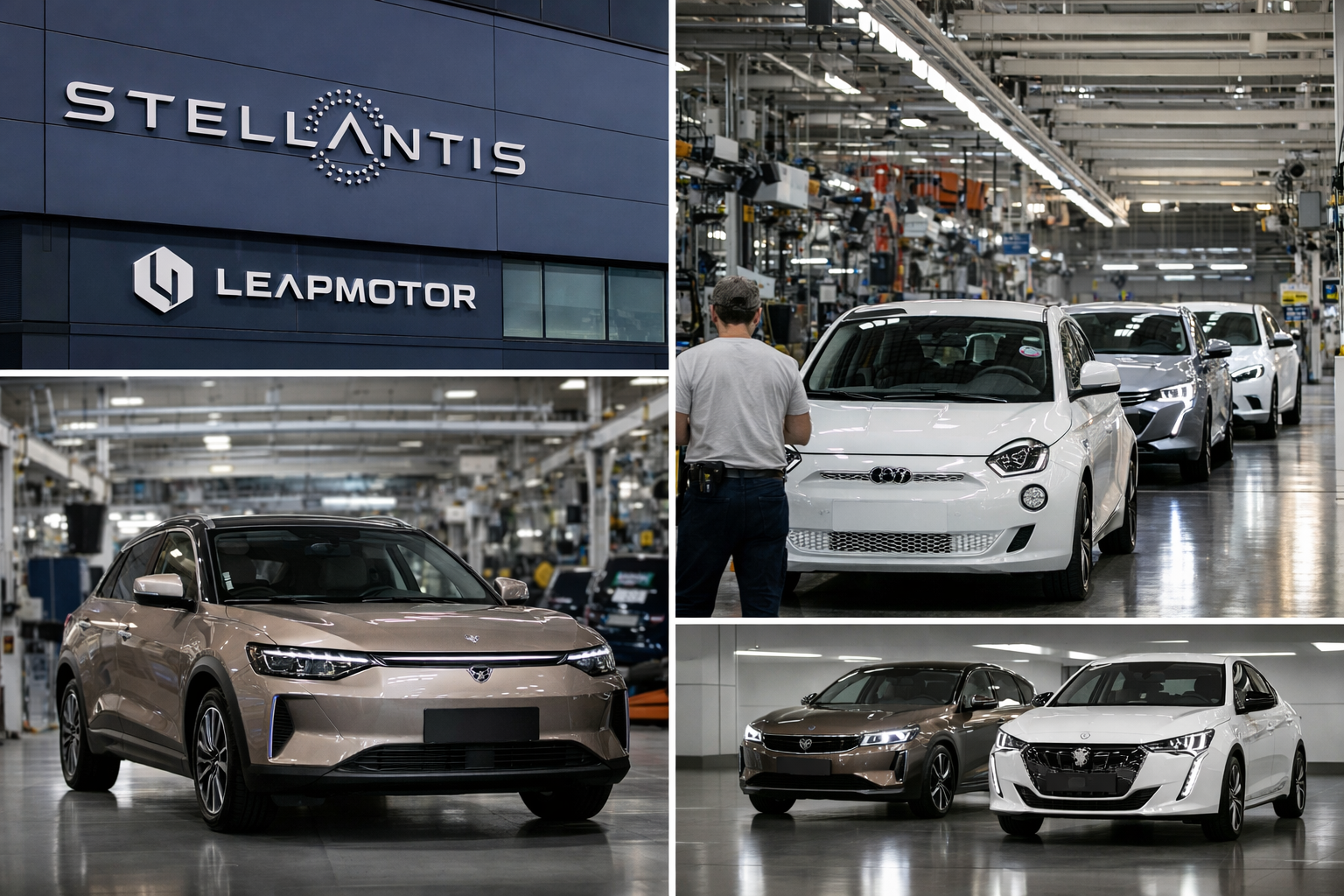
Stellantis doubled down on its China strategy this week, confirming that the Stellantis Leapmotor partnership will expand beyond distribution into deeper platform and technology sharing for future Fiat, Peugeot, and Opel electric models. The announcement, made March 7, 2026, at a joint press briefing in Amsterdam and Hangzhou, signals that Europe’s second-largest automaker is leaning heavily on Chinese EV expertise to stay competitive.
On paper, this builds on Stellantis’ 2023 investment in Leapmotor, when it acquired a 20% stake for roughly €1.5 billion, according to Reuters. However, this latest move goes further: executives confirmed that Leapmotor architectures will underpin select A- and B-segment EVs for Fiat, Peugeot electric cars, and Opel EV tech programs starting in 2027.
This isn’t just another cross-border JV. It could redefine the Fiat EV future in Europe’s most price-sensitive segments, where Chinese brands are already undercutting incumbents by thousands of euros.
The Headlines
- What: Stellantis expands Leapmotor tie-up to share EV platforms and technology with Fiat, Peugeot, and Opel
- Who: Stellantis and China’s Leapmotor
- When: Announced March 7, 2026; first models expected from 2027
- Impact: Lower-cost EVs for Europe, but deeper reliance on Chinese tech
- Key Number: €1.5 billion initial investment for a 20% stake in Leapmotor
What Happened
Stellantis confirmed that future compact EVs for Fiat, Peugeot, and Opel will integrate Leapmotor’s electric vehicle platforms and software stacks, rather than relying solely on Stellantis’ in-house STLA Small architecture. According to company statements, this includes battery management systems, e-motor modules, and portions of the digital cockpit.
CEO Carlos Tavares said the expanded cooperation will “accelerate time-to-market and significantly reduce cost per vehicle.” He added that leveraging Leapmotor’s supply chain in China could cut bill-of-material costs by up to 15% for certain models, though the company did not disclose exact vehicle pricing targets.
Notably, Stellantis will continue producing these vehicles in Europe to meet local content rules and avoid potential tariff complications. That’s a crucial point as trade tensions remain fluid, especially after recent court scrutiny of U.S. tariff authority, covered in our Supreme Court tariffs analysis.
Furthermore, Leapmotor will gain broader access to Stellantis’ global distribution network, including Latin America and selected Asian markets. Analysts at Bloomberg Intelligence estimate that Leapmotor’s overseas sales could triple by 2028 if those channels open fully.
Why It Matters
Europe’s EV market is growing—but margins are shrinking. According to the European Automobile Manufacturers’ Association and recent data we analyzed in Europe EV Sales Surge: Nearly 20% in Jan 2026, battery-electric vehicles accounted for nearly 20% of new car registrations in January 2026. However, price wars—sparked largely by BYD, MG (SAIC), and Tesla—have compressed profitability across the board.
For Fiat and Opel in particular, the sub-€25,000 EV segment is existential. Fiat’s 500e has struggled to scale profitably, while Opel’s Corsa Electric faces aggressive pricing from Chinese imports. By tapping Leapmotor’s lower-cost engineering base, Stellantis hopes to close a cost gap that some analysts peg at €3,000–€5,000 per vehicle versus leading Chinese rivals.
However, this also marks a strategic pivot. Stellantis previously positioned its STLA platforms as a unifying global EV backbone. Now, it’s implicitly acknowledging that internal development alone may not deliver competitive costs quickly enough.
The Bigger Picture
The Stellantis Leapmotor partnership reflects a broader industry realignment: legacy automakers increasingly depend on Chinese supply chains and know-how even as regulators debate trade barriers. According to the International Energy Agency, China accounted for over 60% of global EV production in 2025 and an even higher share of battery cell manufacturing.
Meanwhile, the European Commission continues to investigate Chinese EV subsidies, with potential tariff decisions expected later in 2026, per reporting from Bloomberg. Therefore, Stellantis is walking a tightrope—leveraging Chinese efficiency while localizing production to hedge against regulatory backlash.
Historically, Western automakers entering China shared technology to gain market access. Now the flow is reversing. In fact, we’re seeing the same dynamic in Germany, where Volkswagen has deepened ties with Xpeng, and in the U.S., where Ford has licensed Chinese battery technology for domestic plants.
Additionally, consumer expectations are shifting. Features like advanced driver-assistance systems and over-the-air updates—areas where Chinese brands excel—are now baseline requirements. That’s where Opel EV tech and Peugeot electric cars could benefit most from Leapmotor’s software-heavy approach.
What the Competition Is Doing
Volkswagen has invested billions into partnerships with Xpeng and SAIC, aiming to launch China-developed EVs for global markets by 2027. Similarly, Renault’s Ampere unit is pursuing cost reductions through joint ventures, while maintaining tighter control over intellectual property.
In contrast, Tesla continues to rely heavily on its Shanghai Gigafactory for global exports, using vertical integration to maintain margins. Meanwhile, BYD is expanding European assembly to sidestep tariffs and solidify its position as the continent’s fastest-growing EV brand.
Stellantis sits somewhere in the middle. It lacks Tesla’s software dominance and BYD’s battery scale, yet it has broader brand coverage than most rivals—from Peugeot to Jeep to Fiat. The expanded Stellantis Leapmotor partnership could give it a cost structure closer to Chinese competitors without fully surrendering brand identity.
However, there’s risk. As we’ve reported in Europe car sales 2026: Chinese brands surge, European consumers are increasingly open to buying directly from Chinese marques. If Leapmotor gains brand recognition under its own name, Stellantis could be nurturing a future competitor.
What It Means for You
If you’re shopping for a 2027 or 2028 compact EV, expect more aggressive pricing from Fiat, Peugeot, and Opel. A sub-€25,000 European-built EV with 250–300 miles of WLTP range becomes more realistic under this cost structure.
Additionally, buyers could see improved infotainment systems and driver-assistance features, areas where Chinese platforms often outperform legacy European systems. However, long-term durability and resale values remain open questions until these shared architectures prove themselves in real-world conditions.
For consumers weighing hybrid versus full EV options, this partnership could tip the balance if pricing narrows further. Our Hybrid vs Electric 2026 guide breaks down when the math starts favoring battery-electric models—and lower upfront prices are the missing piece for many households.
Still, I’d advise caution on first-year models. Early production runs on new platforms often reveal software bugs or supply bottlenecks. Waiting 6–12 months after launch can provide clearer reliability data.
What to Watch Next
First, monitor the European Commission’s tariff decision later this year. If punitive duties hit Chinese-sourced components, Stellantis may need to adjust sourcing or absorb higher costs.
Second, watch how quickly Leapmotor-branded vehicles expand in Europe under the joint venture. If sales ramp rapidly, brand overlap tensions could surface inside Stellantis’ portfolio.
Third, pay attention to production localization. Stellantis has not yet confirmed which European plants will build these Leapmotor-based models. Factory allocation decisions often reveal how serious a company is about long-term commitment.
The Upside
- Lower EV production costs could reduce retail prices
- Faster development cycles for Fiat and Peugeot electric cars
- Access to advanced Chinese software and battery tech
- Stronger competitiveness in Europe’s entry-level EV segment
The Concerns
- Increased dependence on Chinese supply chains
- Potential tariff or political backlash in Europe
- Brand dilution risk for Opel and Fiat
- Unproven long-term reliability of shared platforms
Having covered multiple EV strategy resets over the past decade, I can tell you this pattern is familiar: ambitious in-house plans meet harsh market economics. The difference this time is the speed. Chinese manufacturers have compressed development cycles and cost curves so dramatically that even global giants like Stellantis are adapting in real time.
The Stellantis Leapmotor partnership may ultimately determine whether Fiat EV future models remain relevant—or become cautionary tales. Over the next five years, the winners in Europe won’t just be the brands with the best heritage. They’ll be the ones that can build compelling EVs profitably at mass-market prices. Stellantis just placed a very public bet on how to get there.
Disclosure: This article may contain affiliate links. If you make a purchase through these links, we may earn a small commission at no extra cost to you. This helps support RevvedUpCars.com. Learn more.