
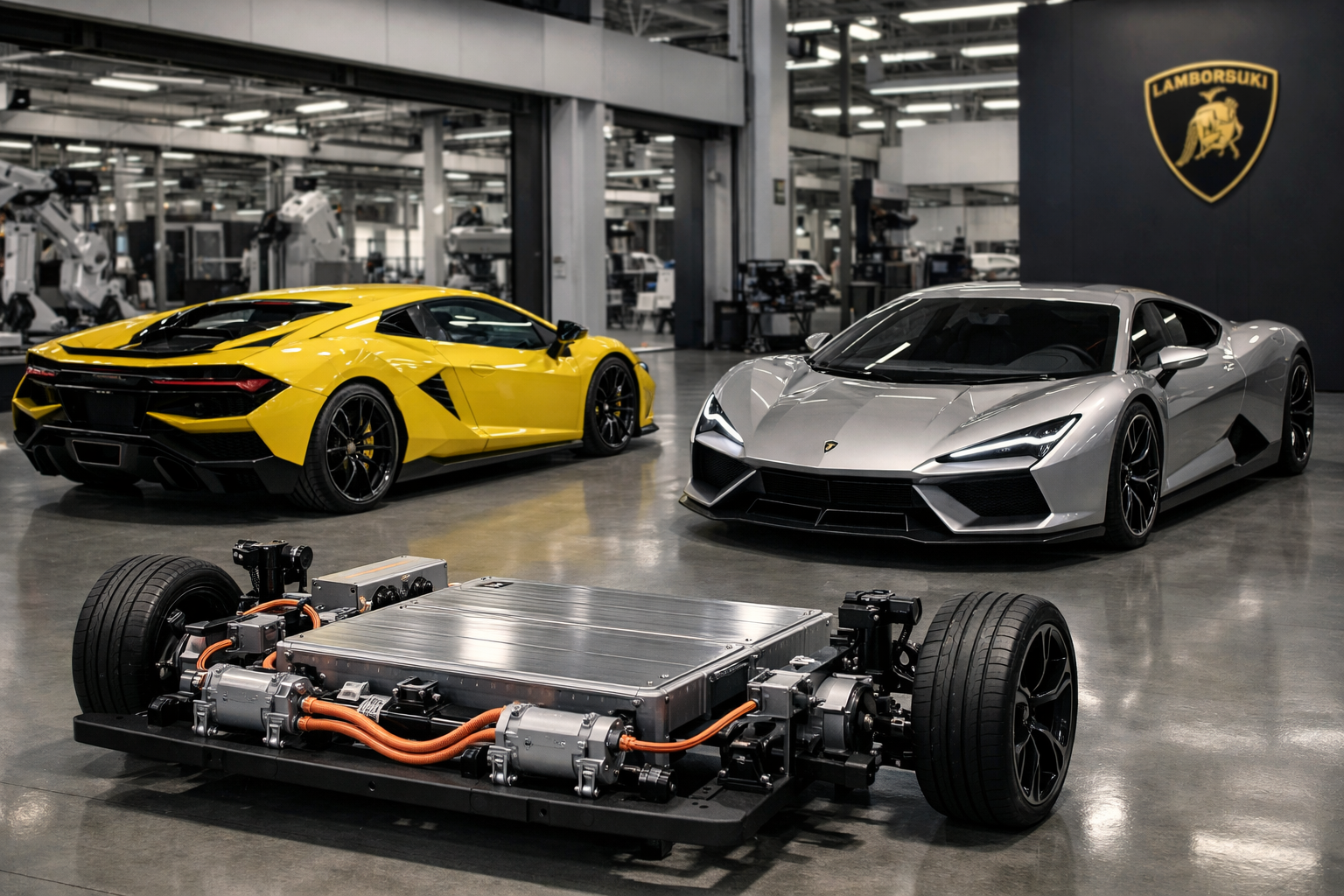
Lamborghini has officially pulled the plug on its long-anticipated electric supercar, shelving the Lanzador-based production EV that was slated for the end of the decade. The decision, confirmed February 27, 2026, effectively means the Lamborghini EV canceled headlines are accurate — at least for now. For a brand that just two years ago showcased a high-riding electric GT concept with promises of 1,300+ horsepower, this is more than a routine product delay.
According to executives speaking to Reuters and Bloomberg, Lamborghini cited “market conditions” and “evolving customer demand” in the ultra-luxury segment. That’s corporate shorthand for something significant: the electric supercar business case no longer adds up in 2026 the way it did in 2023. For buyers and rivals alike, this signals a recalibration in the luxury EV market.
The Headlines
- What: Lamborghini has canceled its planned all-electric production model
- Who: Lamborghini (Volkswagen Group subsidiary)
- When: Decision confirmed February 27, 2026
- Impact: Delays Lamborghini’s entry into the electric supercar segment and reshapes its decarbonization timeline
- Key Number: €1.8 billion previously earmarked for electrification investments through 2027
What Happened
Lamborghini’s management board voted this week to halt development of its first full battery-electric vehicle, originally previewed by the 2023 Lanzador concept. The production model had been expected around 2028, riding on a Volkswagen Group PPE-derived architecture adapted for high performance.
CEO Stephan Winkelmann said in a statement that “the timing is not right for a fully electric Lamborghini in this segment,” adding that customers continue to “value combustion character and hybrid performance.” While the company did not disclose sunk development costs, Volkswagen Group filings show Lamborghini committed €1.8 billion between 2022 and 2027 for hybridization and electrification.
Importantly, this is not a retreat from electrification altogether. Lamborghini confirmed it will continue rolling out plug-in hybrids across its lineup, including the Revuelto V12 hybrid and the Temerario V8 hybrid successor to the Huracán. However, the dedicated battery-electric flagship is now off the table, at least for this product cycle.
Why It Matters
The Lamborghini EV canceled decision lands at a fragile moment for electric supercars. Rimac sells the $2.1 million Nevera in extremely low volumes. Lotus has struggled to ramp the Evija. Even Porsche has reportedly moderated Taycan production targets as global EV growth slowed in 2025, according to Reuters.
Meanwhile, the broader luxury EV market is showing mixed signals. The International Energy Agency reported global EV sales growth slowing to roughly 18% in 2025, down from 35%+ annual gains earlier in the decade. In the U.S., shifting emissions policy — including regulatory changes covered in our analysis of the EPA Emissions Repeal: What 2026 Buyers Need — has reduced immediate compliance pressure on low-volume manufacturers.
For Lamborghini, which sold a record 10,112 vehicles globally in 2025, according to company statements, the risk calculus is clear. Its average transaction price exceeds $300,000. Additionally, its buyers tend to own multiple cars and often view EVs as complementary daily drivers, not replacements for emotional weekend machines. The brand’s differentiation hinges on sound, vibration, and drama — areas where battery-electric platforms struggle to replicate combustion theater.
The Bigger Picture
Historically, Lamborghini follows a deliberate technology curve. It was late to turbocharging. It resisted hybridization until regulatory and performance gains aligned. Now, it appears to be pacing its entry into full electrification similarly.
Moreover, Volkswagen Group’s capital allocation priorities are shifting. The group is investing tens of billions into software, batteries, and volume EV platforms for Audi, VW, and Porsche. In that context, a low-volume electric supercar program with uncertain demand may have struggled to justify additional investment.
There’s also a regulatory nuance. Supercar makers benefit from fleet-average emissions flexibility due to low volumes. In contrast to mass-market brands, Lamborghini can meet EU and U.S. targets through hybrids and limited-run models without immediately launching a pure EV. As policy momentum fluctuates — especially in the U.S. — the urgency fades.
However, the optics matter. The luxury EV narrative in 2022 assumed every prestige brand would rush to market with halo EVs. By 2026, that assumption looks optimistic.
What the Competition Is Doing
Ferrari is staying the course — publicly. The company plans to unveil its first EV in 2026, with deliveries expected in 2027, according to statements reported by Bloomberg. At the same time, Ferrari’s real commercial momentum sits with hybrids like the 296 and SF90. We recently drove the 2026 Ferrari 296 Challenge Stradale, a hybrid that underscores how electrification currently enhances, rather than replaces, combustion performance.
Porsche, meanwhile, doubled down on EVs with the Taycan and upcoming electric 718. Yet Porsche also extended combustion Macan and Cayenne timelines in key markets. Aston Martin delayed its first EV to later in the decade. Maserati scaled back production forecasts for the Folgore line.
In contrast, Rimac remains all-electric but operates in hyper-limited volumes. Therefore, Lamborghini’s retreat does not isolate it; it reflects a broader recalibration among brands that rely heavily on emotional engagement rather than regulatory compliance volume.
What It Means for You
If you’re in the rarefied market for a $250,000–$500,000 supercar, this reinforces one trend: hybrids are the sweet spot. They deliver instant torque and regulatory breathing room without sacrificing sound. Consequently, resale values for limited-production V10 and V12 models may remain strong as the all-electric threat recedes.
Additionally, buyers considering luxury EVs should recognize that technology maturity and infrastructure still vary by region. Our broader Car Buying Tips 2026: Avoid Overpaying Smartly guide applies even at the high end — timing and incentives matter.
For mainstream shoppers, the direct impact is minimal. However, halo technologies often trickle down. If electric supercars stall, expect more development focus on high-output hybrid systems, which could influence performance SUVs and grand tourers over the next five years.
What to Watch Next
First, watch Ferrari’s 2026 EV reveal closely. If early demand appears soft, Lamborghini’s decision will look prescient. Conversely, if Ferrari secures strong order books, pressure could mount on Sant’Agata to revisit the program.
Second, monitor battery energy density breakthroughs. Lamborghini executives have hinted they want lighter solid-state or next-generation chemistries before committing to a pure EV. Without a step-change in weight and charging time, the supercar formula remains compromised.
Finally, track policy shifts in the EU and U.S. Emissions targets, incentives, and tariff structures — including those we analyzed in our Supreme Court tariffs coverage — can quickly reshape the economics of low-volume EVs.
The Upside
- Allows Lamborghini to focus resources on profitable hybrid models
- Preserves brand identity centered on combustion drama
- Reduces risk amid uncertain luxury EV demand
- May support strong residual values for current models
The Concerns
- Signals slowing momentum in electric supercars
- Could leave Lamborghini behind if EV tech accelerates quickly
- Risks perception of strategic hesitation
- Limits early learning in high-performance EV platforms
Having covered three product cycles of supercar “reinventions,” I’ve learned that timing is everything. The Lamborghini EV canceled decision isn’t an anti-EV statement; it’s a bet that battery technology and buyer psychology need more time to converge.
Over the next five years, expect Lamborghini strategy to center on ever-more-sophisticated hybrids while quietly monitoring breakthroughs in batteries and charging. If — or when — electric supercars truly deliver lighter weight and visceral engagement, Sant’Agata will return. For now, the combustion era just earned a stay of execution.
Disclosure: This article may contain affiliate links. If you make a purchase through these links, we may earn a small commission at no extra cost to you. This helps support RevvedUpCars.com. Learn more.