
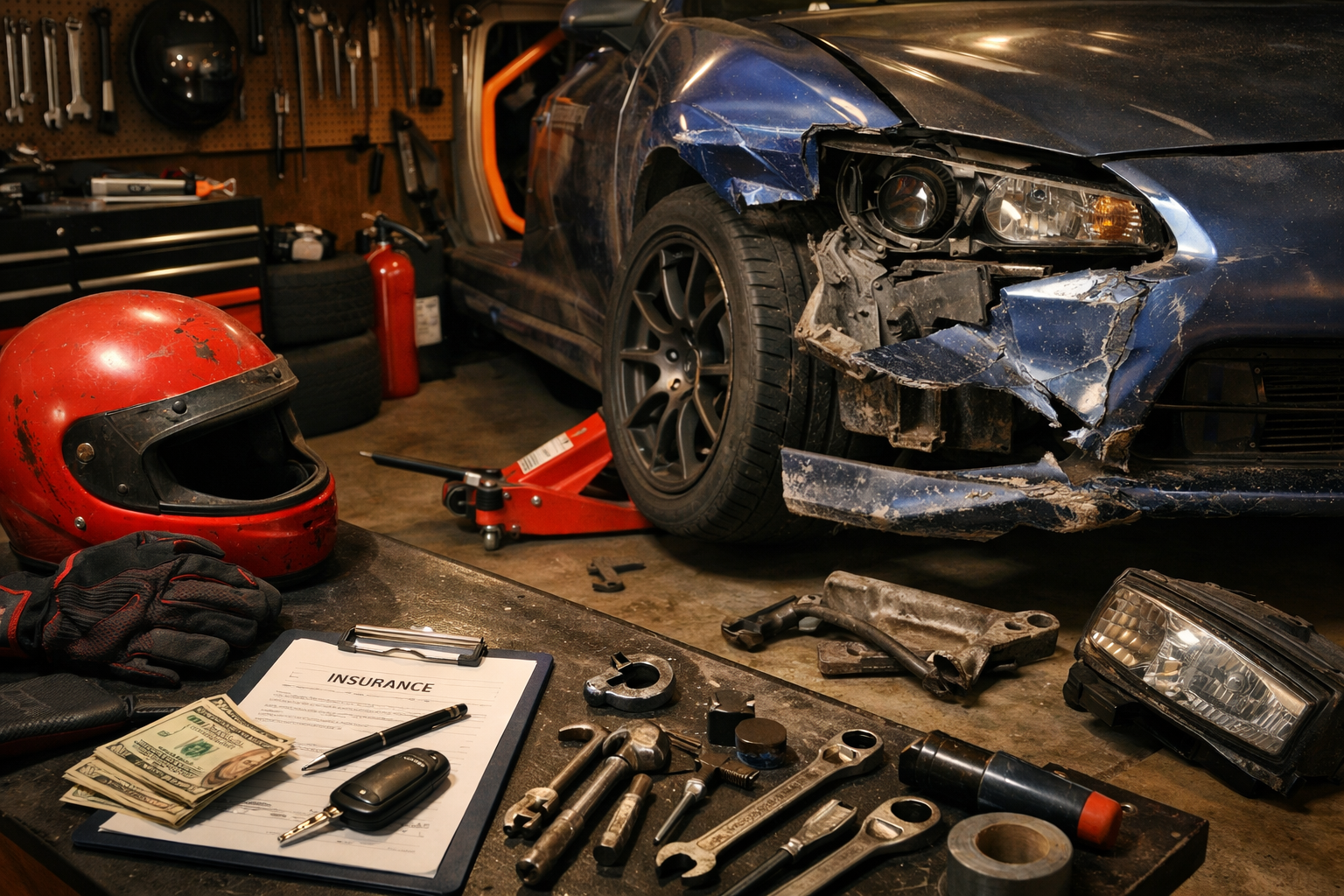
You finally worked up the nerve to push your pride and joy at a track day… and then it happens. A missed braking point, a little too much throttle, and now you’re staring at a bent fender thinking, “Is my insurance about to ghost me?” That’s where track day insurance comes in — and most folks don’t think about it until after the tow truck shows up.
A car crash at track isn’t like bumping a Camry in a grocery store parking lot. Different rules. Different liability. And if you’ve got $40,000–$120,000 tied up in a sports car, you better know what’s covered and what’s not. Today I’m walking you through race track liability, how insurance really works at HPDE events, and how to protect your investment before and after things go sideways.
You’ll learn what to do immediately after an incident, how to deal with insurance, and how to avoid the financial gut-punch I’ve seen wipe out people’s savings in one bad afternoon.
What You’ll Need
- Tools: Smartphone (photos + policy access), copy of your insurance policy, torque wrench (to re-check wheels after incident), OBD2 scanner
- Parts/Materials: Pre-purchased track day insurance policy ($150–$400 per event typical in 2025)
- Time: 30 minutes trackside admin; weeks for claims resolution
- Difficulty: 🔧🔧 (paperwork, not wrenching)
- Dealer Cost: Body repair $3,000–$25,000 vs DIY prep cost: $200–$500 policy — You Save: Potentially tens of thousands
Why This Matters
Here’s the hard truth: most standard auto insurance policies exclude track use. Even if it’s a “non-competitive” HPDE event. I’ve seen guys assume they’re covered — then get denied and handed a $18,000 repair estimate for their Mustang GT.
A simple off-track excursion can mean bent suspension arms ($1,200), cracked bumper covers ($900), or deployed airbags ($3,000+). On something like a 2026 Ferrari Luce, you’re talking mortgage-level money.
This is exactly why track day insurance exists. It’s designed for high-performance driving events — not racing — and can protect sports cars from collision damage during the event. Skip it, and you’re self-insuring.
Before You Start
⚠️ WARNING: After any car crash at track, assume hidden damage. Suspension, brakes, and fuel lines can be compromised even if the car “looks fine.” Do not drive home without a thorough inspection.
First, confirm whether your event was timed or competitive. Most HPDE events are non-timed. If you were racing wheel-to-wheel, many policies won’t touch it.
Check your regular auto policy. Look for exclusions mentioning “racing,” “timed events,” or “closed-course driving.” You can also verify policy language through your insurer’s website or state filings. If you’re unsure, ask directly — and get it in writing.
If airbags deployed, fluids are leaking, or you have structural damage, stop. This isn’t a “drive it home carefully” situation.
Track Day Insurance and Race Track Liability Explained
Let’s clear up confusion around race track liability. At most HPDE events, you sign a waiver. That means if another driver makes a mistake and hits you, you typically can’t sue them for damages. Everyone accepts their own risk.
So if someone punts you in Turn 3? You’re usually paying for your own repairs. That’s where track day insurance steps in — it covers your car regardless of fault (subject to deductible).
Policies usually include:
- On-track collision damage
- Off-track incidents (walls, barriers)
- Sometimes towing and debris cleanup
They usually do NOT include:
- Mechanical failure (blown engine from over-rev)
- Wear items (brakes, tires)
- Intentional or competitive racing
Typical deductible? 10% of agreed vehicle value. On a $50,000 car, that’s $5,000 out of pocket. Still better than $50,000.
Step-by-Step Guide
- Get Safe Immediately
Come to a controlled stop. Follow track marshal instructions. ⚠️ WARNING: Do not exit the vehicle until directed — hot track conditions are dangerous. - Document Everything
Take photos of damage, track position, barriers, and any other vehicles involved. Screenshot your event registration confirmation. - Notify Event Organizer
File an incident report. Get a copy. This helps during insurance claims. - Inspect Critical Systems
Check wheels (use a torque wrench — consult your owner’s manual for specs), look for fluid leaks, and scan for codes with an OBD2 reader. - Contact Your Track Day Insurance Provider
Call within 24 hours. Provide documentation and event details. The smoother your paperwork, the faster the payout. - Get a Professional Estimate
Dealer body shops charge $150–$200/hour labor in 2025. Independent performance shops run $100–$140/hour. Compare both.
Pro Tip: Before every event, walk around your car and film a 360-degree video. That protects you against pre-existing damage disputes.
Common Mistakes to Avoid
- Assuming regular insurance covers it. I’ve seen this denial letter too many times.
- Underinsuring the car. If your mods aren’t declared, they’re not covered.
- Driving home on damaged suspension. I’ve seen a $1,500 control arm turn into a $6,000 subframe repair.
- Skipping pre-event inspection. Loose lug nuts cause more “accidents” than driver error.
- Not understanding deductibles. 10% of value surprises people.
When to Call a Professional
If airbags deployed, frame rails are bent, or alignment won’t hold — this is body shop territory. Modern unibody cars (like the 2026 Honda Civic Sport Hybrid) rely on structural integrity for safety.
A fair body repair estimate in 2025:
- Minor bumper damage: $1,500–$3,000
- Suspension rebuild: $2,000–$6,000
- Frame damage: $8,000–$25,000+
Ask the shop:
- “Do you have frame measuring equipment?”
- “Will this be reported to Carfax?”
- “Are you using OEM or aftermarket panels?”
Check for recalls or structural advisories at NHTSA.gov. If you’re unsure about vehicle integrity, ASE-certified techs can be verified at ASE.com.
Recommended Products
- Lockton Motorsports Track Insurance – Solid reputation, easy online quotes. What I’ve seen most customers use.
- Hagerty Track Day Insurance – Great for higher-value collector cars.
- BlueDriver OBD2 Scanner ($120) – What I use in my own garage for post-incident scans.
- Tekton 1/2″ Drive Torque Wrench ($60) – Reliable, budget-friendly.
If you’re prepping your car for events, our full breakdown on Track Day Insurance: Protect Your Sports Car Now goes deeper into policy comparisons.
Do This
- Buy track day insurance before every event
- Film your car pre-event
- Torque wheels before each session
- Read your deductible carefully
Don’t Do This
- Assume waivers protect your car
- Drive home with hidden suspension damage
- Hide modifications from insurer
- Cheap out on safety inspections
Look, nobody plans to wad up their car. But if you’re serious about protecting sports cars at the track, track day insurance is part of the cost of admission — like brake pads and fuel.
You can’t eliminate risk. But you can control the financial fallout. Do the prep, read the fine print, and treat insurance like a helmet — you hope you don’t need it, but you’ll be glad it’s there.
Got questions about a specific policy or incident? Drop it in the comments. Stay safe out there — and remember, a $20 repair manual saves a $2,000 repair bill.