
That moment at the gas pump when it clicks past $80 and you mutter, “There’s gotta be a better way.” If you’re stuck deciding on a hybrid vs electric SUV 2026, you’re not alone. Half my customers lately aren’t asking about brake jobs — they’re asking whether to ditch gas altogether or hedge their bets with a hybrid.
This choice isn’t just about saving fuel. It’s about how you drive, where you live, what winter looks like in your ZIP code, and how much you want to hand the dealer in service bills. In this guide, I’ll break down the real-world EV vs hybrid comparison — not the brochure fluff — so you can make a smart call.
We’ll cover costs, maintenance, charging, resale, and what I’ve seen hold up (or not) after years in the shop.
What You’ll Need
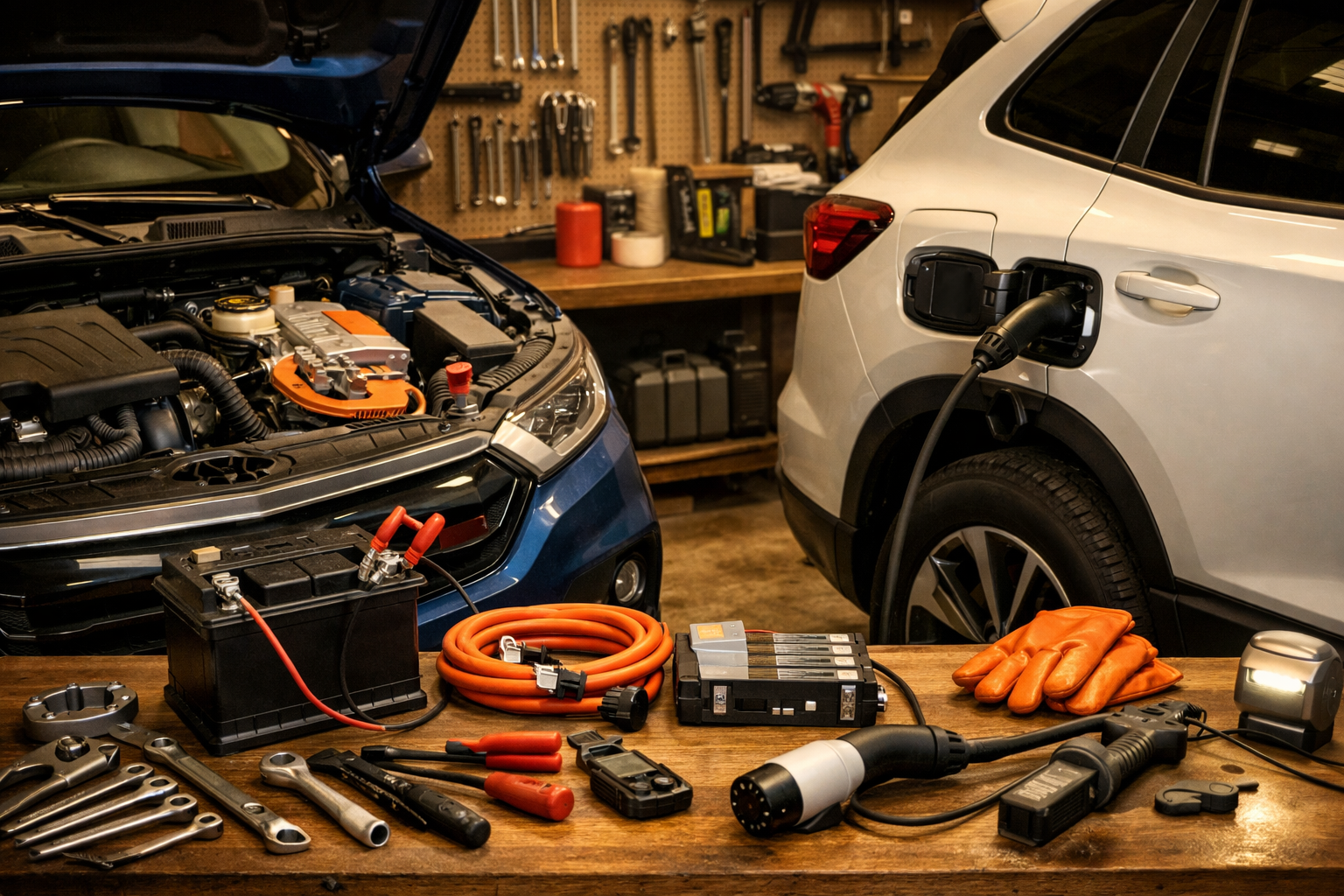
- Tools: 10mm socket (for battery terminal checks), digital tire pressure gauge, OBD2 scanner (optional but smart)
- Parts/Materials: Level 2 home charger ($500–$800) if buying EV; none required for hybrid beyond normal maintenance
- Time: 2–4 weeks of research and test drives; 1 afternoon to install home charger (electrician needed)
- Difficulty: 🔧🔧 (decision-making, not wrenching)
- Dealer Cost: $40,000–$65,000 average SUV price vs smarter shopping savings of $3,000–$5,000 — You Save: Big if you negotiate right
Why This Matters
Pick wrong, and you’ll either hate charging stops or regret buying gas every week. I’ve seen folks trade in a 1-year-old EV because they didn’t plan for apartment living. I’ve also seen hybrid owners wish they’d gone full electric after realizing they only drive 20 miles a day.
In a proper hybrid vs electric SUV 2026 decision, it comes down to usage. Drive under 40 miles daily with home charging? EV makes sense. Road-trip 400 miles every other weekend? Hybrid might be your sanity saver.
Maintenance-wise, EVs skip oil changes and timing chains. Hybrids still have engines, meaning oil every 5,000–10,000 miles (check your owner’s manual). Over 10 years, that’s $800–$1,500 in oil service alone you won’t pay with an EV.
Fuel economy? Check the EPA for real numbers. Most 2026 hybrids average 35–45 MPG. Electric SUVs get 90–110 MPGe equivalent. Big difference — if you can charge cheaply.
Before You Start
⚠️ WARNING: If you live in an apartment without reliable charging access, do NOT assume public chargers will be convenient. I’ve had customers frustrated beyond belief hunting chargers at 9 p.m.
Ask yourself:
- Can I install a Level 2 charger at home? (240V outlet)
- What’s my average daily mileage?
- Do I tow? (EV range drops fast when towing)
- What are winter temps like?
Cold climates can reduce EV range by 20–30%. Minnesota winters are no joke. Hybrids handle cold a little more predictably since they’ve got that gas engine backup.
Also, check incentives. Federal and state rebates change yearly. Verify eligibility at NHTSA.gov and your state energy site.
Before signing anything, read our guide on Spot Dealership Pricing Tricks & Save Money. Dealers love padding EVs with “market adjustments.” Don’t fall for it.
Step-by-Step Guide
- Calculate Your Real Driving Needs.
Track your mileage for two weeks. If you average under 250 miles weekly, most EVs (like the 2026 Toyota bZ4X or Hyundai Ioniq 5) will cover that easily on one or two charges. - Compare 5-Year Fuel Costs.
Example: 12,000 miles/year.
Hybrid at 40 MPG = 300 gallons/year. At $3.50/gallon = $1,050/year.
EV at 0.30 kWh/mile = 3,600 kWh/year. At $0.15/kWh = $540/year.
That’s a $510 annual savings with EV — if you charge at home. - Factor Maintenance.
Hybrid: oil changes ($80 each), engine air filters, spark plugs at 100k.
EV: tire rotations, brake fluid, cabin filter. That’s mostly it.
Pro Tip: EV brakes last longer due to regenerative braking. I’ve seen 100k-mile Teslas on original pads. - Check Insurance Rates.
EV premiums can run $200–$400 higher annually due to battery repair costs. Call your insurer before buying. - Consider Resale & Tech Longevity.
Software matters more now. Read about Future Proof Car Tech: DIY Tips for 2026 Updates. Over-the-air updates can keep EVs fresh longer than older hybrids.
In my shop experience, battery longevity on modern hybrids (Toyota, Honda) is solid — 150k+ miles isn’t rare. Replacement costs? $2,000–$3,500 installed for hybrids. EV battery replacement? $10,000+ out of warranty. That’s rare, but it’s real.
Common Mistakes to Avoid
- Assuming public charging is cheap. Some fast chargers cost more per mile than gas. I’ve seen receipts to prove it.
- Ignoring home electrical capacity. Panel upgrades can cost $1,500–$3,000.
- Overestimating towing range. EV towing can cut range in half. I’ve seen this surprise RV owners.
- Falling for dealer add-ons. Nitrogen tires and paint protection packages are profit machines.
- Not test-driving both types. The driving feel is different — instant torque in EVs is addictive.
When to Call a Professional
If your breaker panel is full or under 200 amps, call a licensed electrician before buying an EV. Fair install price for a Level 2 charger? $800–$2,000 depending on wiring distance.
If you’re confused about incentives, talk to a tax professional. Dealers sometimes “estimate” credits that don’t apply to your income bracket.
Buying used? Get a pre-purchase inspection. Expect $150–$250. Totally worth it. Also review broader market timing in Car Prices 2026: Buyer’s Market?.
Red flag: any dealer refusing to show battery health data on a used EV. Walk away.
Recommended Products
- ChargePoint Home Flex Level 2 Charger ($699): Reliable, Wi-Fi enabled. What I recommend most.
- Emporia Level 2 Charger ($399): Budget option that still performs well.
- NOCO Boost Plus GB40 ($129): Keep in hybrids for 12V battery emergencies.
- Michelin Defender 2 Tires ($180–$220 each): Low rolling resistance for better range.
Do This
- Track your real driving habits before deciding
- Install home charging before taking delivery
- Compare 5-year ownership costs, not sticker price
- Test drive both back-to-back
Don’t Do This
- Rely only on public charging
- Ignore winter range loss
- Skip insurance quotes
- Pay dealer “market adjustments” without negotiating
So what’s the verdict in the hybrid vs electric SUV 2026 debate? If you’ve got home charging and mostly short commutes, EV wins on operating cost and simplicity. If you road-trip often or can’t charge at home, a hybrid gives flexibility without range anxiety.
You can figure this out with a calculator and a little honesty about your driving habits. No mechanic required — just smart planning. Drop your questions in the comments and tell me what you’re considering.
Stay smart with your money, and remember — the right decision today saves you thousands tomorrow.