
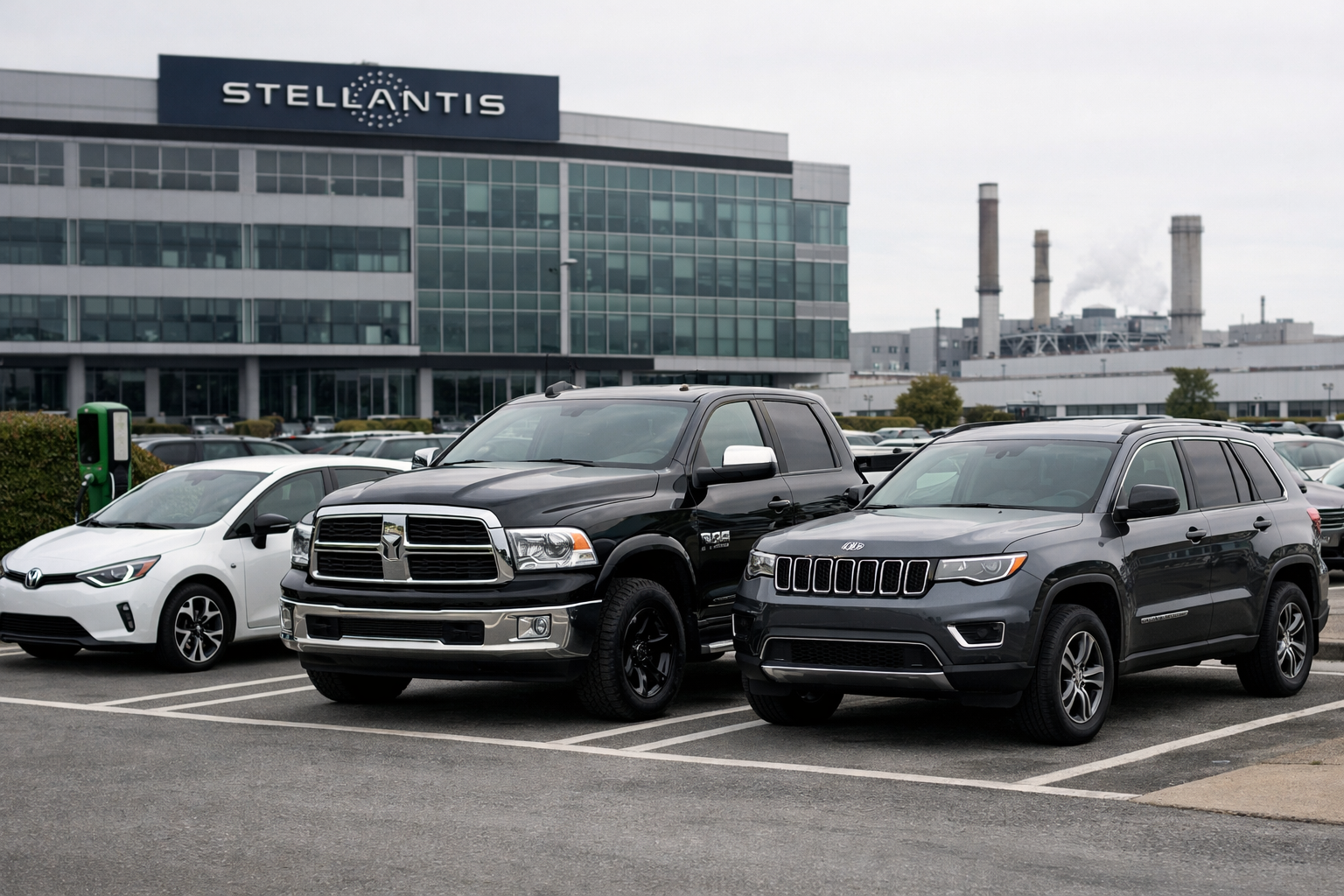
Stellantis has ignited a workplace firestorm after internal communications revealed a tightened Stellantis parking policy that restricts where employees can park vehicles from rival brands at several U.S. facilities. The guidance, circulated in late March 2026 and confirmed by the company on April 10, affects salaried staff at select engineering and executive campuses.
The policy doesn’t ban employees from owning competitors’ cars outright. However, it limits access to preferred or on-site parking for non-Stellantis vehicles, according to company statements provided to Reuters. For an automaker fighting for EV market share and brand loyalty, this is about optics and culture. For workers, it raises a more personal question: can your employer dictate what you drive?
The Headlines
- What: Stellantis limits preferred on-site parking for employees driving rival-brand vehicles
- Who: Stellantis (Jeep, Ram, Dodge, Chrysler, Fiat, Peugeot)
- When: Internal guidance circulated late March 2026; confirmed April 10, 2026
- Impact: Sparks debate over auto industry workplace rules and employee choice
- Key Number: 14 brands under the Stellantis umbrella globally
What Happened
Stellantis told employees at certain U.S. sites that while they remain free to purchase any vehicle, only Stellantis-branded models are eligible for primary on-campus parking areas. Employees driving competitors’ vehicles may be directed to off-site or overflow lots, according to internal memos reviewed by multiple outlets, including Reuters.
The company framed the move as reinforcing “brand pride” and aligning employee behavior with corporate identity. In a statement, a spokesperson said:
“We encourage our employees to experience and advocate for our products. Designated parking areas help showcase our vehicles and foster a strong internal culture.”
Notably, this isn’t unprecedented. Ford and GM have historically encouraged employees to drive company vehicles, often sweetened by steep lease discounts. However, formal restrictions tied to parking access are less common in 2026, particularly amid heightened scrutiny over workplace equity.
Stellantis, formed in 2021 from the merger of Fiat Chrysler and PSA Group, controls brands ranging from Jeep and Ram to Alfa Romeo and Peugeot. In North America, Jeep and Ram account for the bulk of profits, according to company filings and SEC disclosures. That profitability pressure partly explains the emphasis on internal brand loyalty.
Why It Matters
The Stellantis parking policy lands at a delicate moment. U.S. auto sales are projected to fall 2.6% in 2026, according to our analysis in US Auto Sales 2026 Forecast Drops 2.6%. Meanwhile, average transaction prices hover near $48,000, per industry data cited by Bloomberg, squeezing both consumers and automakers.
Therefore, automakers are doubling down on loyalty—from employee lease programs to subscription incentives. Internal buyers matter more than most realize. At Detroit’s Big Three, employees and retirees can represent tens of thousands of annual sales through discount programs.
However, restricting parking rather than simply incentivizing purchases shifts the tone from encouragement to enforcement. Labor attorneys note that while private employers generally control workplace property, policies that disproportionately affect certain workers could face scrutiny depending on state laws.
For consumers, this signals how intensely competitive the market has become. Automakers are fighting not just for customers, but for visible brand advocacy within their own ranks.
The Bigger Picture
This debate over parking rival brands reflects deeper anxiety about loyalty in a fragmented market. Tesla commands roughly 55% of the U.S. EV market as of early 2026, according to Cox Automotive estimates cited by Bloomberg. Meanwhile, Hyundai-Kia and GM are rapidly expanding EV portfolios, pressuring legacy players like Stellantis.
Additionally, trade tensions and tariffs—covered in our breakdown of Auto Tariffs 2026: U.S. Trade Shifts Hit Industry—have increased production costs. As a result, internal alignment becomes more symbolic. Executives want parking lots filled with Jeep Wranglers and Ram 1500s, not Toyota RAV4s or Ford F-150 Lightnings.
Historically, automakers cultivated fierce internal brand identity. Having covered three product cycles, I can tell you this pattern is familiar during downturns. When margins tighten, companies turn inward—tightening perks, reinforcing culture, and signaling unity.
Yet today’s workforce is more mobile and less brand-loyal than in past decades. Engineers and software specialists can jump between Tesla, Rivian, Apple’s car project, or traditional OEMs. A rigid stance on parking rival brands may clash with that reality.
What the Competition Is Doing
Ford offers substantial employee pricing and lease deals but does not broadly restrict parking access for non-Ford vehicles, according to company HR guidelines. Instead, it leans on discounts that can knock thousands off MSRP.
General Motors similarly incentivizes internal purchases, especially for high-demand models like the Chevrolet Silverado EV and Cadillac Lyriq. However, GM campuses in Michigan typically allow mixed-brand parking, per employee accounts and local reporting.
Meanwhile, Toyota and Hyundai focus more on flexible workplace perks than brand enforcement. Hyundai Motor Group, which gained U.S. market share in 2025, emphasizes employee test-drive programs rather than parking controls.
In contrast, Tesla’s culture strongly encourages employees to drive Teslas, but public reporting has not indicated formal parking restrictions. The difference is strategic: incentives feel optional; parking penalties feel compulsory.
Who benefits? Stellantis may see a modest bump in internal leases. Who risks losing? Potential recruits who interpret the policy as heavy-handed.
What It Means for You
If you don’t work for Stellantis, this may seem like corporate inside baseball. However, the Stellantis parking policy reflects broader auto industry workplace rules that can shape pricing and incentives.
When automakers push employee purchases, they often expand discount programs. That can indirectly affect resale values and fleet supply. For buyers already navigating rising costs—see our analysis in New Car Prices 2026 May Rise Again—any shift in incentive strategy matters.
Moreover, this highlights how brand perception influences corporate behavior. If you’re cross-shopping a Jeep Grand Cherokee against a Toyota 4Runner or Ford Bronco, remember: internal confidence sometimes signals product strength—but sometimes it signals pressure.
For employees in the industry, the takeaway is practical. Review your company’s vehicle purchase and parking policies before signing a lease on a rival model.
What to Watch Next
First, watch whether Stellantis expands the policy beyond select campuses. Additionally, monitor employee reaction—particularly among engineering and EV talent. If recruiting slows, leadership may recalibrate.
Furthermore, pay attention to whether Ford or GM adopt similar measures during the 2026 sales slowdown. If this spreads, it becomes a trend. If not, Stellantis may stand alone.
The Upside
- Reinforces internal brand loyalty during a competitive sales environment
- May boost employee lease uptake and showcase vehicles on campus
- Signals unified corporate identity to visitors and investors
- Costs little compared to major incentive overhauls
The Concerns
- Risks alienating employees and prospective recruits
- Creates negative publicity during a sales downturn
- May have limited measurable impact on actual vehicle sales
- Could invite legal scrutiny depending on implementation
Ultimately, the Stellantis parking policy is less about parking spaces and more about pressure. Automakers are entering a phase where symbolism, cost control, and loyalty campaigns intersect. Whether this proves savvy or short-sighted depends on one factor: talent retention.
If the next generation of engineers shrugs and signs a Jeep lease, Stellantis wins quietly. If they choose employers with fewer strings attached, this becomes a cautionary tale about confusing brand pride with brand control.
Disclosure: This article may contain affiliate links. If you make a purchase through these links, we may earn a small commission at no extra cost to you. This helps support RevvedUpCars.com. Learn more.