
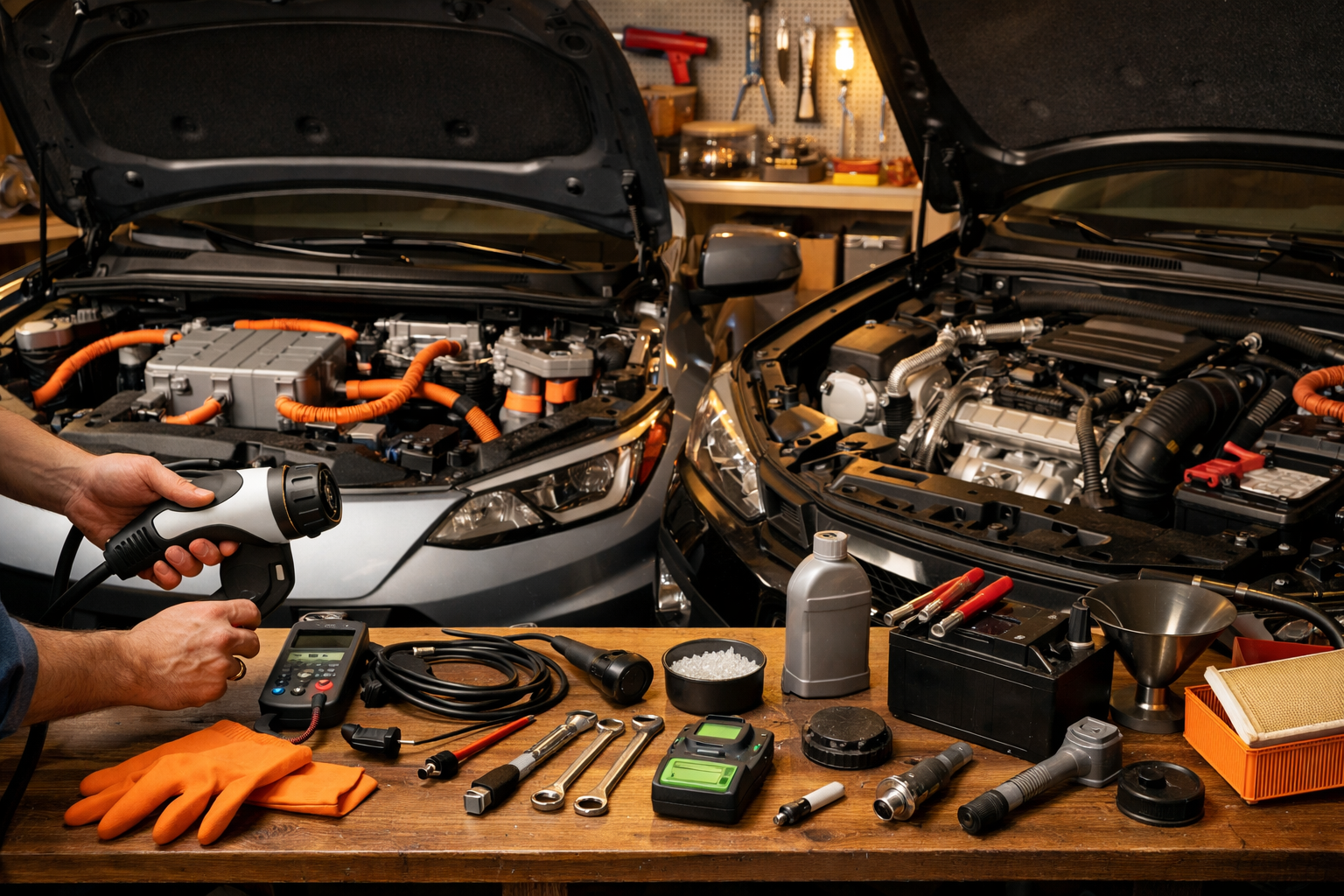
You’re standing on the lot staring at two price tags — one says “EV,” the other says “Hybrid” — and both sales guys swear theirs will save you a fortune. Welcome to the EV vs hybrid 2026 debate, where the wrong choice could cost you thousands over the next five years.
Gas is hovering around $3.50–$4.00 a gallon in most states. Electricity rates are all over the map. Tax credits are shifting. And dealers? Some are still pushing whatever has the biggest markup. I’ve seen folks buy the wrong powertrain for their lifestyle and regret it by month three.
In this electric or hybrid car buying guide, I’ll break down real-world fuel savings comparison numbers, maintenance costs, battery warranties, resale value, and who should actually buy what. No fluff. Just what I’d tell you leaning over a toolbox.
What You’ll Need
- Tools: 10 minutes, a calculator (phone works), your average daily commute mileage
- Parts/Materials: Your local gas price, home electricity rate (¢/kWh), insurance quotes
- Time: 30–45 minutes of research
- Difficulty: 🔧🔧 (decision-making, not wrenching)
- Dealer Cost: $3,000–$6,000 upsell pressure vs DIY Cost: Free research — You Save: Potentially $5,000+
Why This Matters
Pick the wrong setup, and you’ll either overpay for gas or overpay for charging you barely use. I’ve had customers trade in two-year-old EVs because they couldn’t charge at home. That’s an expensive lesson.
In the EV vs hybrid 2026 market, average price differences still matter. A 2026 Toyota RAV4 Hybrid starts around $33,000. A comparable EV like a Hyundai Ioniq 5 runs closer to $42,000 before incentives (pricing varies by region). That gap can buy a lot of gasoline.
Fuel savings comparison? The EPA shows many EVs averaging 3–4 miles per kWh (EPA fuel economy data). At $0.15/kWh, that’s roughly 4–5 cents per mile. A 40 mpg hybrid at $3.75/gallon runs about 9 cents per mile. Over 15,000 miles a year, that’s about $600–$750 difference annually.
But that’s only if you charge at home. Public DC fast charging can cost the same as gas — sometimes more.
Before You Start
⚠️ WARNING: Do not assume you can install a home charger without checking your electrical panel capacity. Upgrading a panel can cost $1,500–$3,000.
If you live in an apartment or condo without dedicated charging, think long and hard before going full EV. I’ve seen charging frustration ruin the ownership experience.
Check your driving habits:
- Daily commute under 40 miles?
- Road trips more than 3–4 times per year?
- Access to 240V Level 2 charging at home?
Also check reliability data and recalls at NHTSA.gov before signing anything. New tech means occasional growing pains.
If you want a deeper breakdown strictly on powertrains, read our full Hybrid vs Electric 2026: Cost & Range Guide. That’ll give you the spec-sheet side. I’m giving you the real-world side.
EV vs Hybrid 2026: Step-by-Step Decision Guide
- Calculate Your Real Commute
Track your actual miles for a week. Multiply by 52. If you drive 12,000–15,000 miles a year mostly local, EV math looks better. Highway-heavy driving favors hybrids slightly because EV efficiency drops at 75+ mph.
Pro Tip: Don’t trust your guess — check your odometer history. - Check Home Charging Feasibility
Look at your breaker panel. Most Level 2 chargers need a 40–50 amp 240V circuit. Installation averages $800–$1,500 if your panel can handle it.
If not? Add panel upgrade cost to your EV budget. - Compare Incentives (Before They Change)
Federal EV tax credits can be up to $7,500 if the vehicle qualifies. Hybrids often get little or none. Rules shift yearly — verify at FuelEconomy.gov.
Also read our Auto Tariffs Buying Guide: Save on Car Prices 2026 to understand pricing swings. - Factor Maintenance Costs
Hybrids still have oil changes every 5,000–10,000 miles (check manufacturer schedule). EVs? No oil, no spark plugs, fewer moving parts.
In 20 years of wrenching, I’ve seen hybrids easily hit 200,000 miles with proper maintenance. Battery warranties are typically 8 years/100,000 miles (some 10/150,000 in CARB states). - Think Resale Value
EV resale can fluctuate with tech changes and incentives. Hybrids historically hold value well (Toyota especially).
For broader strategy, see Buy or Sell Car 2026: Smart Market Strategy.
Common Mistakes to Avoid
- Ignoring insurance quotes. EVs can cost $300–$600 more per year to insure due to battery repair costs.
- Assuming public charging is cheap. I’ve seen 40–50 cents per kWh. That kills your fuel savings comparison fast.
- Overestimating road trip tolerance. If you hate waiting 30 minutes to charge, you won’t suddenly love it.
- Skipping test drives. EV torque feels different — instant, smooth. Some folks love it. Others miss engine feedback.
- Believing dealer scare tactics about battery replacement. Full battery failures are rare under warranty. Don’t let them upsell extended warranties blindly.
I’ve seen this in the shop a hundred times — buyers rushed by incentives who didn’t match the car to their life.
When to Call a Professional
If you’re unsure about electrical capacity, hire a licensed electrician before installing a charger. Expect $150–$300 for an evaluation. Cheap insurance.
If you’re confused about financing, shop rates first. Our guide on Get Best Car Loan Interest Rates 2026 Today can save you 1–2% APR. On a $40,000 car, that’s $1,000+ over the loan term.
At the dealership, ask:
- What’s the out-the-door price?
- Are incentives already applied?
- What’s the battery warranty coverage and term?
Red flag: If they won’t show you charging cost estimates based on your zip code.
Recommended Products
- Grizzl-E Level 2 Charger ($399–$499): Rugged, simple, what I’d install in my own garage.
- Emporia Smart Charger ($399): Budget-friendly with energy tracking.
- Kill A Watt Electricity Monitor ($30): Great for understanding your real kWh costs.
- OBD2 Scanner (BlueDriver, $99): Even hybrids benefit — read codes yourself instead of paying $150 diagnostic fees.
Do This
- Calculate real annual mileage
- Price home charging installation first
- Compare insurance premiums
- Verify incentives yourself
Don’t Do This
- Assume EV always equals cheaper
- Ignore charging convenience
- Let dealers rush your decision
- Skip long test drives
Here’s my straight answer on the EV vs hybrid 2026 question: If you can charge at home and drive mostly local, EV wins long-term. If you road trip often or can’t install a charger, a hybrid is the smarter, stress-free play.
This electric or hybrid car buying guide isn’t about hype — it’s about matching the machine to your life. Run the fuel savings comparison honestly. Do the math. Ignore the sales pressure.
You can make this decision with confidence. Take 30 minutes, crunch your numbers, and trust your lifestyle over marketing. Drop your commute details in the comments if you want me to sanity-check your math.
Stay smart in the showroom, and remember — a $20 notebook with real numbers beats a $2,000 impulse decision every time.