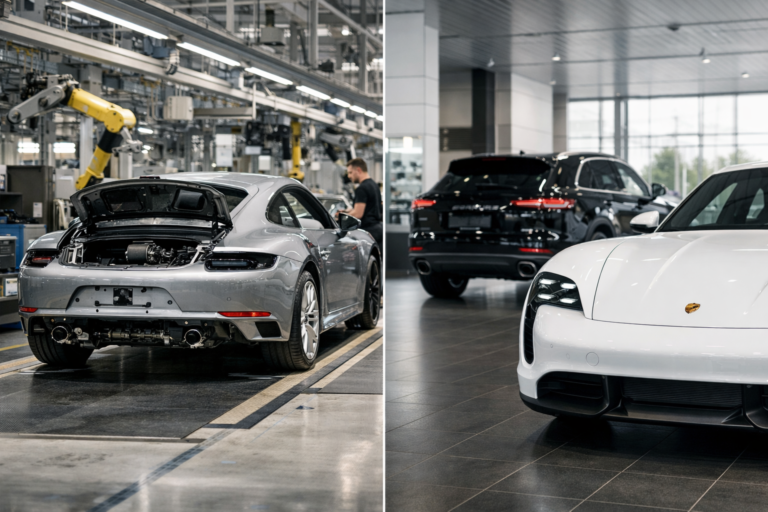

Nine major automakers have installed new chief executives since January, marking one of the most concentrated waves of auto industry CEO changes in more than a decade. From Toyota’s leadership reshuffle in Tokyo to a still-unsettled Stellantis CEO search in Amsterdam, the industry is resetting its playbook just as EV demand cools in some markets and accelerates in others.
The timing isn’t coincidental. March 2026 finds automakers squeezed between volatile tariff policy, softer margins on electric vehicles, and intensifying Chinese competition in Europe. Leadership turnover at this scale signals more than routine succession planning — it suggests strategy pivots are underway.
According to company filings and reports from Reuters and Bloomberg, at least nine global brands representing roughly 35% of worldwide vehicle sales have either appointed new CEOs or confirmed transitions effective this year. That concentration of power shifts will shape product plans through the 2028 model year.
The Headlines
- What: Nine major automakers announced CEO changes in early 2026
- Who: Toyota, Stellantis, Nissan, Volvo Cars, and others
- When: January–March 2026, with some roles effective April 1
- Impact: Strategic resets on EV investment, hybrids, and global manufacturing
- Key Number: 35% — estimated share of global sales led by new CEOs
What Happened
Toyota leadership confirmed in February that its CEO transition plan, first outlined in 2023, is now complete, with Koji Sato consolidating authority over both the Toyota and Lexus brands. However, the bigger shift is structural: Toyota created a new “mobility software” division reporting directly to the CEO, signaling a stronger push into vehicle operating systems and over-the-air services.
Meanwhile, the search for a permanent Stellantis CEO intensified after Carlos Tavares formally stepped aside at the end of 2025. According to company statements and coverage from Reuters autos coverage, the board aims to name a successor by mid-2026. Stellantis, which sold 6.2 million vehicles globally in 2025 per company estimates, faces margin pressure in North America and uneven EV uptake in Europe.
Nissan also appointed a new chief executive in January, following a year in which operating profit fell nearly 18%, according to its latest earnings release. Additionally, Volvo Cars confirmed a leadership handover focused on accelerating software-defined vehicle development, even as EV growth moderates.
In total, these auto industry CEO changes affect companies spanning Japan, Europe, and North America — markets that together account for more than 70 million annual vehicle sales globally, according to the International Energy Agency (IEA).
Why It Matters
Leadership transitions often telegraph capital allocation shifts. Under prior management, several automakers pledged aggressive EV targets — some aiming for 100% electric sales in key markets by 2030. However, recent data shows a more complex picture. Europe EV sales rose nearly 20% in January 2026, as we detailed in our Europe EV sales surge report, yet U.S. growth has slowed amid pricing pressure and policy uncertainty.
Therefore, new CEOs inherit a balancing act: continue investing billions in EV platforms while defending profits from hybrids and internal combustion vehicles. Toyota, for example, continues to double down on hybrids, a strategy validated by strong demand and improved reliability metrics — see our breakdown of hybrid reliability trends in 2026.
Additionally, tariff volatility remains a wildcard. The Supreme Court’s recent tariff rulings have clouded pricing forecasts for imported vehicles and components, as explored in our analysis of Supreme Court tariff impacts. New leadership teams must decide whether to localize production further or absorb higher costs.
The press releases emphasize “transformation” and “innovation.” The reality is more nuanced. Most of these CEOs are insiders tasked not with revolution, but with margin stabilization and disciplined capital spending after years of expansion.
The Bigger Picture
This wave of auto industry CEO changes mirrors prior inflection points. After the 2008 financial crisis, automakers similarly rotated leadership to focus on cost control and platform consolidation. Today’s catalyst isn’t a credit crunch — it’s a profitability squeeze amid electrification and software disruption.
Globally, Chinese brands such as BYD and SAIC are expanding in Europe at a rapid pace. According to ACEA data and recent market reports, Chinese manufacturers captured roughly 8–10% of European EV sales in early 2026. That competitive pressure partly explains leadership urgency at legacy brands.
Moreover, regulatory uncertainty complicates planning. The U.S. EPA’s evolving tailpipe standards, detailed at EPA.gov, and Europe’s 2035 combustion ban timeline require long-term investment commitments. Yet consumer adoption rates vary widely by region and income level.
Notably, the non-obvious story here is software. Several incoming CEOs have engineering or digital backgrounds. Automakers increasingly see recurring revenue from software subscriptions and advanced driver assistance as margin buffers against hardware commoditization.
What the Competition Is Doing
Toyota leadership continues to champion a “multi-pathway” approach: hybrids, plug-in hybrids, battery EVs, and even hydrogen. That contrasts sharply with Ford, which recently trimmed EV production targets after slower-than-expected demand, while teasing a potential product mix recalibration in Europe, as covered in our piece on Ford Europe’s sedan strategy.
Meanwhile, Stellantis faces unique complexity. The group manages 14 brands, from Jeep to Peugeot. Its prior strategy leaned heavily on cost synergies and platform sharing. However, questions remain about brand prioritization and EV rollout pace — particularly after its Leapmotor partnership signaled deeper China collaboration, which we analyzed in our Stellantis-Leapmotor EV turning point report.
In contrast, Hyundai Motor Group has maintained leadership continuity and posted relatively strong EV sales growth, according to industry data. General Motors, for its part, reaffirmed its Ultium-based EV rollout in 2026 model updates, even as it scales back some capacity expansion plans.
Who wins? Companies that align product cadence with realistic demand. Who loses? Those that overcommit capital to segments that remain price-sensitive.
What It Means for You
For car buyers, CEO turnover doesn’t change your options overnight. However, it can influence pricing strategy, feature prioritization, and incentive spending within 12–24 months.
If new leadership teams emphasize profitability, expect fewer blanket discounts and more targeted incentives. Conversely, brands under pressure may offer aggressive lease deals to defend market share. Additionally, hybrid models may receive renewed investment — a practical middle ground if you’re weighing electrification options in 2026.
Furthermore, software and over-the-air updates will likely expand. That could mean more subscription-based features. As always, read the fine print before paying monthly for capabilities your vehicle hardware already includes.
What to Watch Next
First, monitor Stellantis’ CEO appointment timeline. The strategic direction of Jeep, Ram, and Peugeot hinges on that decision. Second, watch Toyota’s capital expenditure guidance in its next quarterly earnings — particularly EV battery sourcing commitments.
Additionally, track 2026 second-quarter sales data. If EV growth reaccelerates in North America, some of these leadership recalibrations may prove temporary. If not, expect deeper cost cuts and hybrid expansion.
The Upside
- Fresh leadership may align EV investment with real-world demand
- Potential focus on profitability could stabilize pricing volatility
- Greater emphasis on software could improve vehicle functionality
- Strategic resets may strengthen long-term competitiveness
The Concerns
- Leadership transitions can delay product launches
- Cost-cutting could reduce model variety or features
- Investor pressure may prioritize margins over innovation
- Unclear EV timelines may create buyer uncertainty
Having covered multiple product cycles, I’ve learned that CEO shifts rarely show immediate effects on dealership lots. However, the cumulative weight of these auto industry CEO changes suggests a coordinated industry reset rather than isolated transitions.
The next two years will test whether this new leadership class can balance electrification ambition with financial discipline. If they succeed, consumers will see smarter product mixes and steadier pricing. If they misjudge demand, 2027 could bring another round of strategic reversals — and yet more executive turnover.
Disclosure: This article may contain affiliate links. If you make a purchase through these links, we may earn a small commission at no extra cost to you. This helps support RevvedUpCars.com. Learn more.