
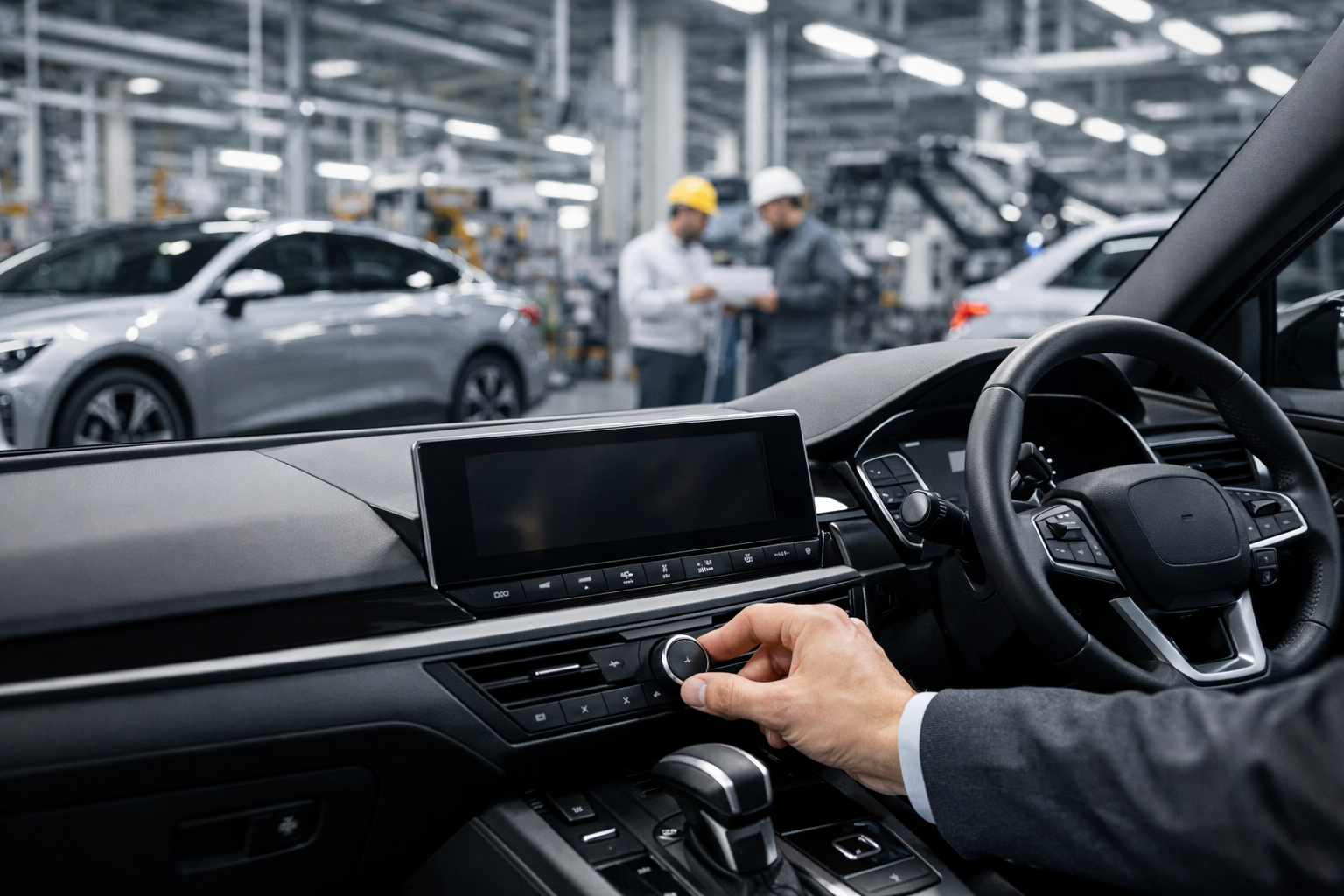
European and Chinese regulators are moving to rein in touchscreen dominance with new car screen regulations that would require physical controls for core safety functions starting in 2026 and 2027 model years. The European Commission confirmed on February 24, 2026 that updated UNECE safety guidelines will tie five-star crash ratings to the presence of dedicated buttons or stalks for key features. Meanwhile, China’s Ministry of Industry and Information Technology (MIIT) signaled parallel rules after a series of high-profile complaints about buried controls in domestic EVs.
This is not a cosmetic tweak. It marks the first coordinated push by two of the world’s largest auto markets to reverse a decade-long shift toward minimalist interiors dominated by 12- to 17-inch displays. For an industry that has treated software and screens as a profit center, the regulatory pendulum is swinging back toward tactile hardware.
The Headlines
- What: Europe and China move to require physical controls for key in-car functions
- Who: European Commission, UNECE, China’s MIIT; global automakers affected
- When: Draft rules announced February 24–25, 2026; phased in for 2026–2027 model years
- Impact: Carmakers may need to redesign dashboards, increasing costs but improving usability
- Key Number: 5-star safety ratings tied to physical controls in EU markets
What Happened
The European Commission said it will update its General Safety Regulation framework, working with UNECE, to require physical controls for indicators, hazard lights, horn, windshield wipers, and emergency call functions for vehicles seeking top safety scores. According to Reuters, the change follows lobbying by safety groups who argue that touchscreens increase cognitive load and driver distraction.
China moved in tandem. MIIT issued draft guidance on February 25, 2026, proposing mandatory “blind-operable” controls for critical driving functions, meaning drivers must be able to activate them without looking away from the road. The language mirrors China’s earlier crackdown on unconventional steering designs, covered in our report on the China’s Yoke Steering Wheel Ban: Safety Alarm.
Notably, neither region is banning touchscreens outright. Instead, regulators are leveraging safety ratings and type approval rules to force automakers to reintroduce knobs, stalks, or hard switches alongside digital interfaces. As one EU official told Bloomberg, “The goal is not to stop innovation, but to ensure essential controls remain intuitive under stress.”
Why It Matters
Over the past decade, screens became the default solution for everything from climate control to mirror adjustments. Tesla led the charge with a single central display; by 2025, even mainstream models like the Hyundai Ioniq 6 and Volkswagen ID.7 relied heavily on haptic sliders. The press releases called it “clean” and “future-forward.” The reality is more nuanced.
Studies cited by the European Transport Safety Council suggest that tasks performed on touchscreens can take up to 30% longer than using physical buttons. Meanwhile, distracted-driving fatalities in the EU remain stubbornly high, with over 20,000 road deaths annually, according to European Commission data. Regulators are connecting those dots.
For automakers, the shift complicates a cost strategy built around software-defined vehicles. Large screens reduce part counts and simplify global production. Reintroducing dedicated hardware means more tooling, supplier contracts, and validation cycles. In an era of tight EV margins, that is not trivial.
The Bigger Picture
This regulatory push sits within a broader reevaluation of in-car tech. In the U.S., policymakers are already debating automation features and driver-assist naming conventions, as we explored in our analysis of the Start Stop Feature Ban Could Reshape 2026 Rules. Europe and China are now focusing squarely on interface design.
Historically, interior design has swung between analog and digital extremes. The early 2000s favored tactile switchgear; the 2010s chased tablet-style minimalism. However, consumer surveys from J.D. Power show declining satisfaction scores tied to infotainment usability in 2024 and 2025. In other words, regulators are responding to a problem buyers already feel.
Additionally, China’s involvement raises the stakes. The country accounted for roughly 30% of global vehicle sales in 2025, according to IEA estimates. When Beijing changes type-approval standards, global automakers from BMW to Toyota often redesign products worldwide rather than engineer market-specific dashboards.
What the Competition Is Doing
BMW quietly reversed course in its 2026 5 Series refresh, restoring a physical iDrive controller and dedicated climate toggles after criticism of its curved-display interface. Mercedes-Benz, by contrast, continues to push its MBUX Hyperscreen, though insiders say hardware shortcuts are returning in upcoming E-Class updates.
Tesla faces the biggest philosophical shift. The Model 3 Highland eliminated most stalks, moving turn signals to steering-wheel buttons. If EU car safety rules require tactile stalks for top ratings, Tesla may need region-specific hardware—a cost it has historically resisted.
Meanwhile, Chinese brands like BYD and Geely are adapting quickly. After regulatory scrutiny on steering designs, as detailed in our coverage of the Yoke Steering Wheel Ban: China Issues Safety Alert, several domestic models reintroduced conventional wheels and physical HVAC toggles. In contrast, startups such as Nio and Xpeng, which built their brand around tech-heavy cabins, now face redesign expenses just as price wars squeeze margins.
What It Means for You
If you are shopping for a 2026 or 2027 vehicle, expect subtle but meaningful interior changes. More knobs for volume and temperature. More stalks behind the steering wheel. Fewer hidden submenus for defrost and hazard lights.
However, don’t expect screens to shrink. Infotainment trends 2026 still favor large displays for navigation, media, and over-the-air updates. The difference is redundancy: physical controls for safety-critical tasks, digital flexibility for everything else.
There is a potential cost impact. Analysts at UBS estimate that adding dedicated hardware controls could increase per-vehicle costs by $50 to $150, depending on complexity. Automakers may pass some of that on to buyers, especially in entry-level EVs where margins are already thin.
What to Watch Next
First, watch how quickly the EU finalizes technical language. The Commission plans a formal vote by mid-2026, with enforcement tied to 2027 model-year certifications. Additionally, China’s draft is open for industry comment through April 2026, and revisions are likely.
Second, monitor whether the U.S. National Highway Traffic Safety Administration follows suit. While NHTSA has not proposed similar car screen regulations, it has increased scrutiny of driver-distraction metrics, according to NHTSA safety briefings. If America joins Europe and China, the global dashboard reset becomes permanent.
The Upside
- Improved driver focus and potentially lower distraction-related crashes
- Higher usability scores and consumer satisfaction
- Clearer global standards across major markets
- Reduced overreliance on glitch-prone software menus
The Concerns
- Higher manufacturing costs that could raise vehicle prices
- Design compromises for brands built around minimalist interiors
- Potential delays as automakers reengineer dashboards
- Regulatory fragmentation if the U.S. does not align
Having covered three product cycles of infotainment evolution, I can tell you this pattern is familiar: the industry overcorrects toward novelty, then regulators and consumers pull it back to practicality. The new car screen regulations don’t kill the software-defined car, but they redraw its boundaries.
Over the next two to five years, expect a new design language—one where screens remain central but tactile controls reclaim critical territory. For buyers frustrated by buried menus, that’s not nostalgia. It’s progress grounded in safety.
Disclosure: This article may contain affiliate links. If you make a purchase through these links, we may earn a small commission at no extra cost to you. This helps support RevvedUpCars.com. Learn more.