
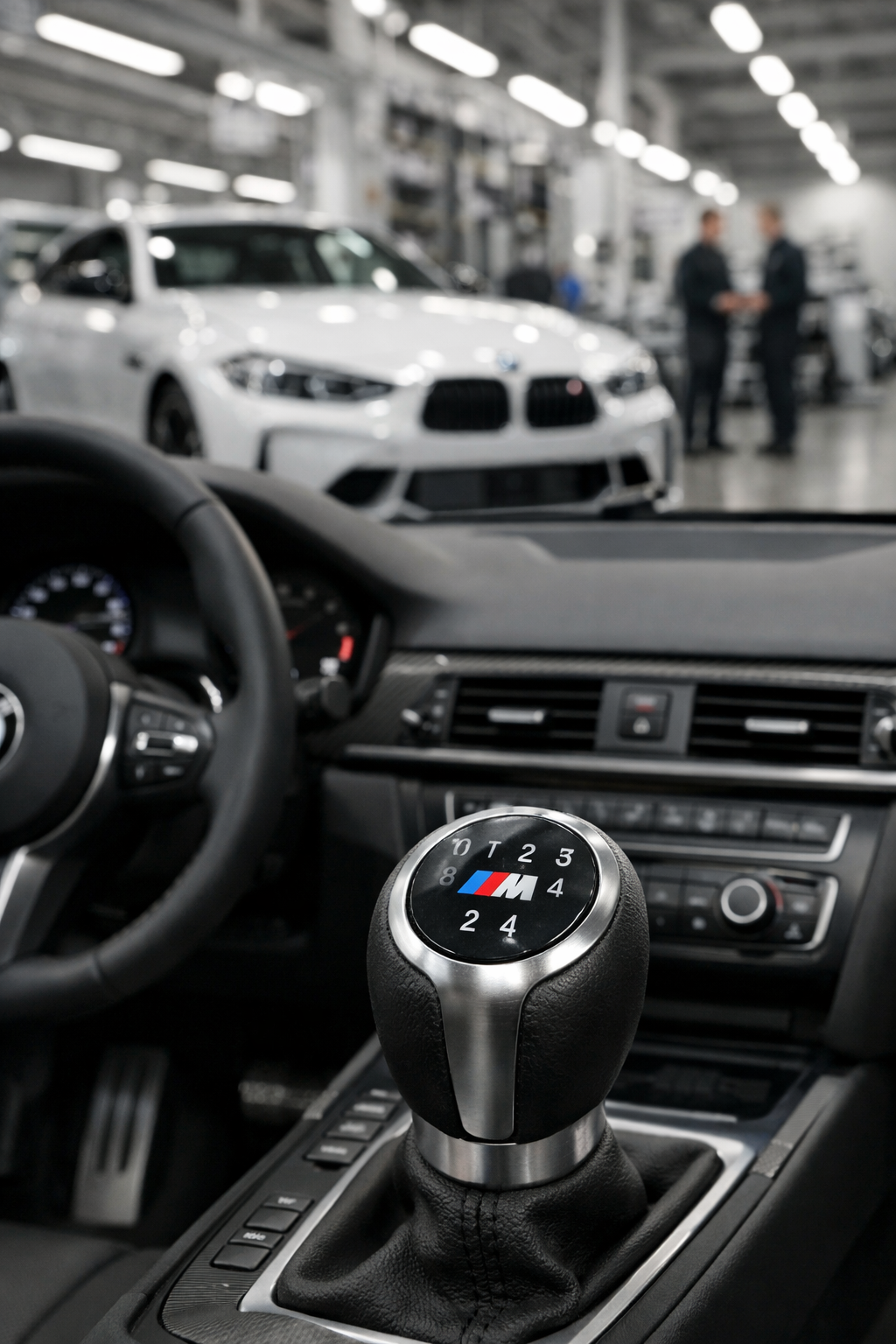
BMW M is pushing back on rumors that the BMW M manual transmission is on life support, but the company’s latest comments suggest a complicated future for three-pedal performance cars. Speaking during a February 20, 2026 roundtable in Munich, BMW M CEO Frank van Meel said manuals “remain part of the brand’s DNA” — while acknowledging tightening emissions rules and declining global take rates.
That nuance matters. Manual transmissions today account for a shrinking slice of global performance car sales, even as enthusiast demand remains vocal. The question isn’t whether BMW M can still build manuals. It’s whether the business case holds through the 2027–2030 regulatory cycle.
As performance cars 2026 models increasingly adopt hybrid systems and advanced driver assistance tech, BMW M’s comments are less about nostalgia and more about regulatory math. Here’s what’s really going on behind the headlines.
The Headlines
- What: BMW M confirms it will continue offering manual transmissions “where technically and legally feasible.”
- Who: BMW M division, led by CEO Frank van Meel
- When: Comments made February 20, 2026
- Impact: Manuals survive for now, but face pressure from emissions, hybridization, and low global demand
- Key Number: Estimated 15–20% manual take rate on current M2 and M3 in the U.S.
What Happened
During a media roundtable ahead of the 2026 Geneva Motor Show, van Meel addressed speculation that the next-generation M3 could drop its six-speed option. According to attendees and reporting from Reuters, he said BMW M is “committed to offering manual transmissions in key markets as long as regulations allow and customers demand them.”
Currently, the 2026 BMW M2 and M3 in the U.S. still offer a six-speed manual alongside the ZF-sourced eight-speed automatic. BMW does not publish exact take rates, but executives have previously indicated that manuals account for roughly half of M2 sales in North America and closer to 15–20% for the M3. In Europe and China, that figure drops into single digits.
However, van Meel acknowledged that electrification complicates the equation. Hybrid systems — increasingly necessary to meet EU7 emissions standards and U.S. EPA fleet targets — are difficult and expensive to engineer with manual gearboxes. As EPA regulations tighten CO2 and NOx limits through 2027, manufacturers must optimize every gram of emissions.
In short: BMW M can keep building manuals, but each one must justify its impact on fleet compliance and development cost.
Why It Matters
The future of manual cars isn’t just about enthusiast passion; it’s about certification costs and global scale. BMW sells more than 2.5 million vehicles annually worldwide, according to company filings, but M cars account for roughly 200,000 units. Manuals represent a fraction of that.
Moreover, emissions testing protocols favor automatics. Modern eight-speed and dual-clutch gearboxes shift faster and more consistently, producing better standardized fuel economy and CO2 results. A manual can introduce variability that hurts official ratings — and those ratings determine regulatory penalties.
For consumers, this means manuals increasingly survive only in niche trims. We’ve already seen Porsche restrict manual availability to specific 911 variants, while Mercedes-AMG eliminated manuals years ago. The economics are unforgiving.
Interestingly, BMW’s stance contrasts with broader industry retrenchment. Even as automakers experiment with tactile engagement — such as the renewed interest in physical controls in EVs — transmissions are becoming more automated, not less.
The Bigger Picture
To understand the BMW M manual transmission debate, look at regulatory timelines. The European Union’s Euro 7 standards, expected to phase in before 2030, tighten pollutant limits and durability requirements. Meanwhile, U.S. Corporate Average Fuel Economy (CAFE) targets rise steadily through 2028, per NHTSA.
Additionally, electrification is reshaping performance branding. Ferrari’s latest halo products, including the 2026 Ferrari 296 Challenge Stradale Review: Hardcore Hybrid Supercar, rely on hybrid systems that simply don’t pair with traditional manuals. Lamborghini has confirmed it will not bring manuals back. Even Chevrolet’s C8 Corvette moved exclusively to a dual-clutch setup.
However, there’s a contrarian angle. As EV adoption grows — the IEA estimates global EV sales surpassed 14 million in 2025 — manual transmissions may become a unique selling point for the shrinking internal combustion niche. In other words, what was once mainstream could become a premium enthusiast differentiator.
BMW M appears to recognize this. By keeping manuals in the M2 and M3, it positions itself as one of the last major luxury brands offering that experience at scale.
What the Competition Is Doing
Porsche continues to offer a manual in select 911 Carrera T and GT3 variants, where take rates reportedly exceed 40% in the U.S., according to Bloomberg. However, Porsche prices those trims strategically, often limiting supply to maintain exclusivity.
Toyota, meanwhile, doubled down on enthusiast credibility with the GR86 and GR Supra manual option. Yet Toyota’s broader portfolio remains heavily hybridized, insulating it from compliance risk.
In contrast, Mercedes-AMG and Audi Sport have largely exited the manual space. AMG hasn’t offered a manual in over a decade. Audi discontinued manual S and RS models globally by the early 2020s. That leaves BMW M and Porsche as the last major German performance brands still investing in three pedals.
Even outside Germany, the trend is clear. Cadillac’s CT5-V Blackwing remains a rare American holdout, but General Motors has signaled an aggressive EV pivot. Stellantis is leaning into diesel and hybrid strategies for trucks and SUVs — see our analysis of the 2026 Stellantis Diesel: SUVs & Trucks Reviewed — not manuals.
Therefore, BMW’s decision isn’t just product planning. It’s brand positioning.
What It Means for You
If you’re shopping performance cars 2026 model year, manuals are still available — but choices are narrowing. The 2026 M2 and M3 remain safe bets for now. However, the next full redesign cycle, likely landing around 2028–2029, will coincide with stricter emissions rules.
Practically speaking, if you want a new BMW M manual transmission, waiting five years may not be wise. Automakers rarely reverse course once they drop a drivetrain configuration. Just ask Subaru WRX STI fans.
Additionally, resale values could strengthen if manuals become rarer. Limited-supply enthusiast cars historically hold value well, especially when tied to the “last of its kind” narrative.
On the flip side, modern automatics are objectively quicker. BMW’s eight-speed delivers faster acceleration and often better fuel economy. If lap times matter more than nostalgia, the automatic remains the rational choice.
What to Watch Next
First, watch the next-generation M3 development cycle. If BMW introduces a hybrid-assisted inline-six around 2028, pairing it with a manual will be technically complex and costly. Second, monitor EU7 implementation details; final language could determine whether low-volume manual variants receive flexibility.
Meanwhile, pay attention to order bank data over the next 24 months. If U.S. manual take rates remain above 30% on the M2, BMW gains leverage internally to justify continued investment. If they fall below 10%, expect tough conversations in Munich.
The Upside
- BMW M reaffirms commitment to enthusiast drivers
- Manuals may become valuable differentiators in an electrified market
- Strong U.S. demand supports short-term availability
- Potential long-term resale upside for manual-equipped models
The Concerns
- Stricter EU7 and U.S. emissions rules raise compliance costs
- Hybrid performance systems are difficult to pair with manuals
- Low global take rates weaken the business case
- Competitors are exiting the segment, increasing isolation risk
Having covered three product cycles, I’ve seen this pattern before: automakers publicly support enthusiast features until the regulatory math no longer works. The difference now is that manuals aren’t just a niche — they’re becoming symbolic of the entire ICE performance era.
The BMW M manual transmission isn’t doomed today. However, its long-term survival depends less on passion and more on policy. Over the next five years, emissions rules — not enthusiast forums — will decide whether three pedals remain part of BMW M’s identity.
Disclosure: This article may contain affiliate links. If you make a purchase through these links, we may earn a small commission at no extra cost to you. This helps support RevvedUpCars.com. Learn more.