
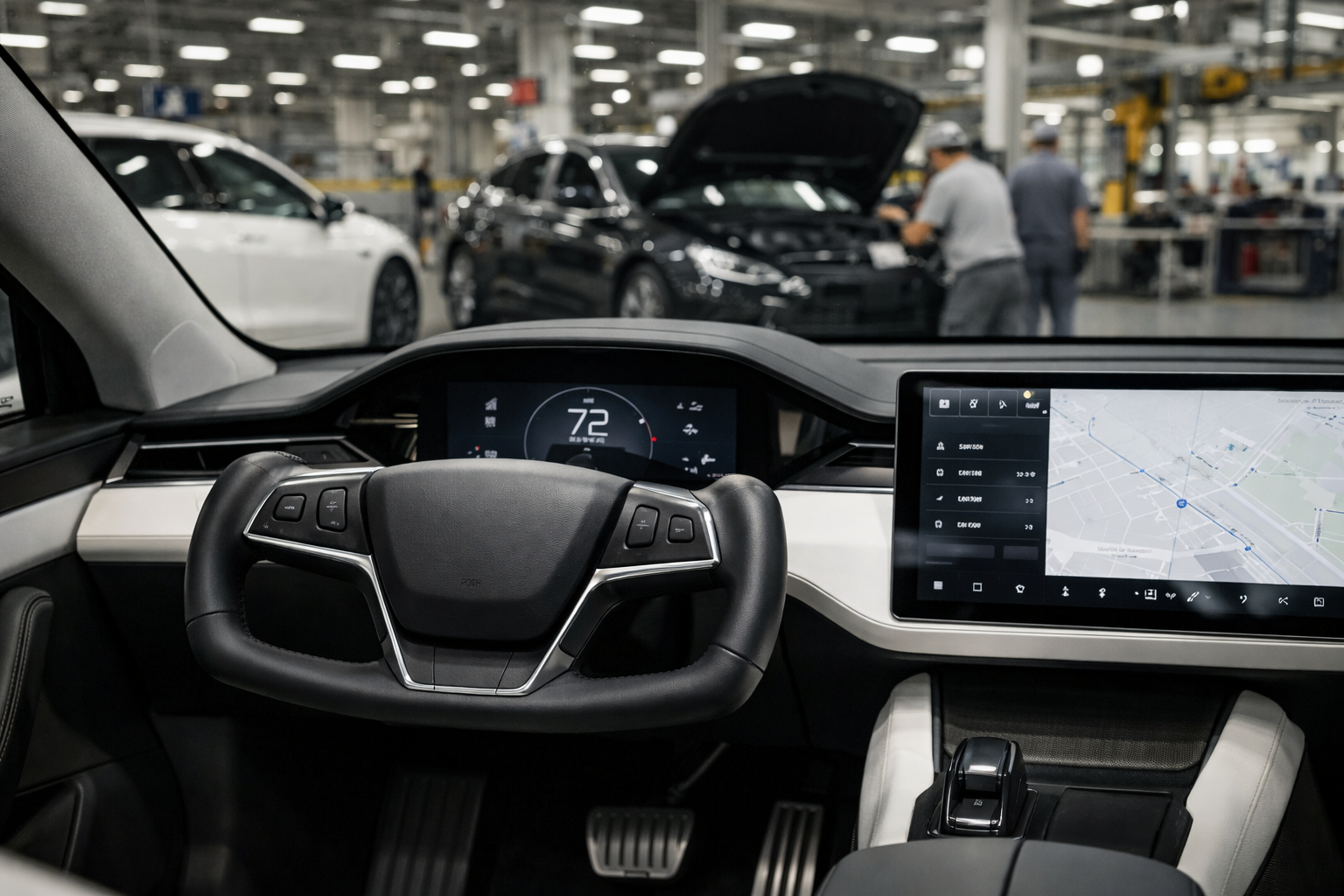
China’s Ministry of Industry and Information Technology (MIIT) has formally enacted a yoke steering wheel ban, prohibiting new passenger vehicles from being sold with non-circular steering controls starting July 1, 2026. The regulation, published February 20, 2026, cites emergency maneuver safety concerns and aligns China’s vehicle standards with UNECE guidance on steering system ergonomics.
For automakers like Tesla, which popularized the flat-topped “yoke” on its Model S and Model X, this is more than a styling setback. China is the world’s largest auto market, accounting for roughly 30% of global vehicle sales in 2025, according to the China Association of Automobile Manufacturers (CAAM). A design feature that was once a Silicon Valley flex now faces regulatory rejection in a market that delivered over 24 million passenger car sales last year.
The Headlines
- What: China bans non-circular “yoke” steering wheels in new passenger vehicles
- Who: China’s MIIT; affected automakers include Tesla and niche EV startups
- When: Effective July 1, 2026 for new model approvals
- Impact: Forces design changes for certain EVs sold in China, prioritizing steering wheel safety over styling
- Key Number: 24+ million passenger vehicles sold in China in 2025
What Happened
MIIT’s updated passenger vehicle technical standards explicitly require a “closed circular steering control interface” for vehicles without fully autonomous capability. In practical terms, that means no more half-wheels or aircraft-style yokes in conventional 2026 model-year cars sold in China.
According to Reuters, regulators pointed to concerns about hand-over-hand steering during low-speed maneuvers and emergency obstacle avoidance. The rule applies to all new type approvals submitted after July 1, though existing certified models may receive a limited transition period.
Tesla introduced its yoke steering setup on the refreshed Model S in 2021 and later offered it in China on select Model S and Model X variants built in Fremont. However, its Shanghai-built Model 3 and Model Y—Tesla’s high-volume sellers—have retained conventional wheels. In 2025, Tesla delivered an estimated 603,000 vehicles in China, according to company filings and CAAM data.
Chinese regulators did not single out Tesla by name. Instead, they framed the rule as a broader safety clarification. A translated MIIT notice stated:
“Steering control devices must ensure continuous grip and effective operation under emergency conditions. Non-closed structures may affect safe handling.”
Notably, the regulation stops short of banning steer-by-wire systems outright. It targets form factor, not the underlying technology.
Why It Matters
On the surface, this looks like a niche design tweak. In reality, it reflects a deeper tension between innovation theater and steering wheel safety. The yoke was marketed as futuristic and better suited for autonomous driving. However, most vehicles using it still require full human control in complex driving scenarios.
China has aggressively pushed advanced driver-assistance systems (ADAS), but it has also tightened safety oversight after a series of high-profile EV crashes. According to the NHTSA, U.S. regulators have also scrutinized unconventional controls, though they have not issued a similar ban. Beijing appears to be taking a more prescriptive route.
For consumers, the impact is subtle but real. Automakers must now design China-specific interiors or revert to global standard wheels. That adds engineering cost and complexity, especially for low-volume imports like the Model S and Model X.
There’s also symbolism here. China is signaling that design experimentation cannot outpace functional safety. As we’ve seen in debates over touchscreens and haptic controls—explored in our analysis of physical controls in EVs—regulators and consumers alike are re-evaluating minimalism.
The Bigger Picture
This decision fits a broader pattern in China car regulations: rapid innovation followed by equally rapid standardization. Over the past five years, Beijing has issued new rules on battery traceability, over-the-air updates, and data security. According to Bloomberg, China now reviews software updates that affect vehicle performance or safety before deployment.
Moreover, China’s regulatory assertiveness often influences global product planning. Automakers rarely design entirely separate steering systems for one market unless volumes justify it. Given China’s scale, companies may default back to circular wheels worldwide to streamline production.
Historically, design experiments that complicate homologation tend to fade. We saw this with certain camera-based mirror systems and early gesture controls. The yoke could follow a similar path—remembered as a transitional artifact of the early EV era.
There’s also geopolitical subtext. As tensions rise between Chinese and Western automakers—discussed in our breakdown of Chinese automakers vs legacy brands—regulatory compliance becomes a competitive weapon. Domestic brands that never adopted yokes now avoid costly redesigns.
What the Competition Is Doing
Tesla is the most visible player affected, but it’s not alone. Toyota, Volkswagen, and BYD have largely stuck with conventional steering wheels even as they expand Level 2+ ADAS features. In fact, BYD—China’s EV sales leader with over 3 million global deliveries in 2025—has emphasized ergonomic familiarity over radical cockpit design.
Meanwhile, Mercedes-Benz and BMW have experimented with yoke-style concepts but limited production use. Mercedes’ DRIVE PILOT Level 3 system, available in Germany and parts of China, still uses a traditional wheel to meet regulatory expectations.
In contrast, niche startups like HiPhi and certain concept-heavy brands showcased yokes as visual differentiation. However, as we’ve noted in coverage of wilder concept cars, what dazzles on an auto show stand often collides with compliance reality.
The practical winner here? High-volume manufacturers that prioritized global standardization. The loser is arguably Tesla’s brand narrative of boundary-pushing interiors.
What It Means for You
If you’re a buyer in China considering a Model S or Model X, expect a return to a traditional steering wheel by late 2026. Additionally, if you’re outside China, don’t be surprised if Tesla quietly standardizes circular wheels globally to simplify manufacturing.
For most drivers, this won’t change daily usability. In fact, many owners criticized the yoke for awkward parking maneuvers and limited visibility of turn-signal buttons. Surveys cited by consumer groups in both the U.S. and China suggested mixed satisfaction at best.
However, if you viewed the yoke as a stepping stone toward full autonomy, this is a reminder: regulators still assume human drivers are responsible. Until Level 4 autonomy becomes mainstream—and that’s likely post-2030 per industry forecasts—conventional controls will dominate.
What to Watch Next
First, watch Tesla’s response. Will it lobby for exemptions, or pivot quickly? The company has historically adjusted China-specific features, from battery chemistries to software constraints.
Second, monitor whether Europe follows suit. The UNECE framework influences both EU and Chinese standards. If Brussels mirrors Beijing, the yoke’s global lifespan shortens considerably.
Finally, pay attention to how this intersects with other regulatory moves. China is simultaneously tightening ADAS data reporting and crash accountability standards. Steering interfaces are just one piece of a broader safety recalibration.
The Upside
- Improves steering wheel safety consistency in emergency maneuvers
- Reduces consumer confusion over unconventional controls
- Simplifies global production if automakers standardize designs
- Signals clearer guardrails for cockpit innovation
The Concerns
- Limits design experimentation in EV interiors
- Adds compliance costs for low-volume imports
- May slow adoption of steer-by-wire optimization
- Raises questions about regulatory overreach
Having covered three product cycles, I’ve seen bold interior ideas rise and fall on the altar of regulation. The yoke steering wheel ban isn’t just about one quirky control—it’s about who sets the rules for the future of driving. When the world’s largest auto market prioritizes steering wheel safety over style, the industry listens.
Over the next two to five years, expect a quieter, more pragmatic era of cockpit design. The race now isn’t to look like a spaceship—it’s to prove you can innovate without sacrificing control. And in 2026, regulators clearly believe a circle still works best.
Disclosure: This article may contain affiliate links. If you make a purchase through these links, we may earn a small commission at no extra cost to you. This helps support RevvedUpCars.com. Learn more.