
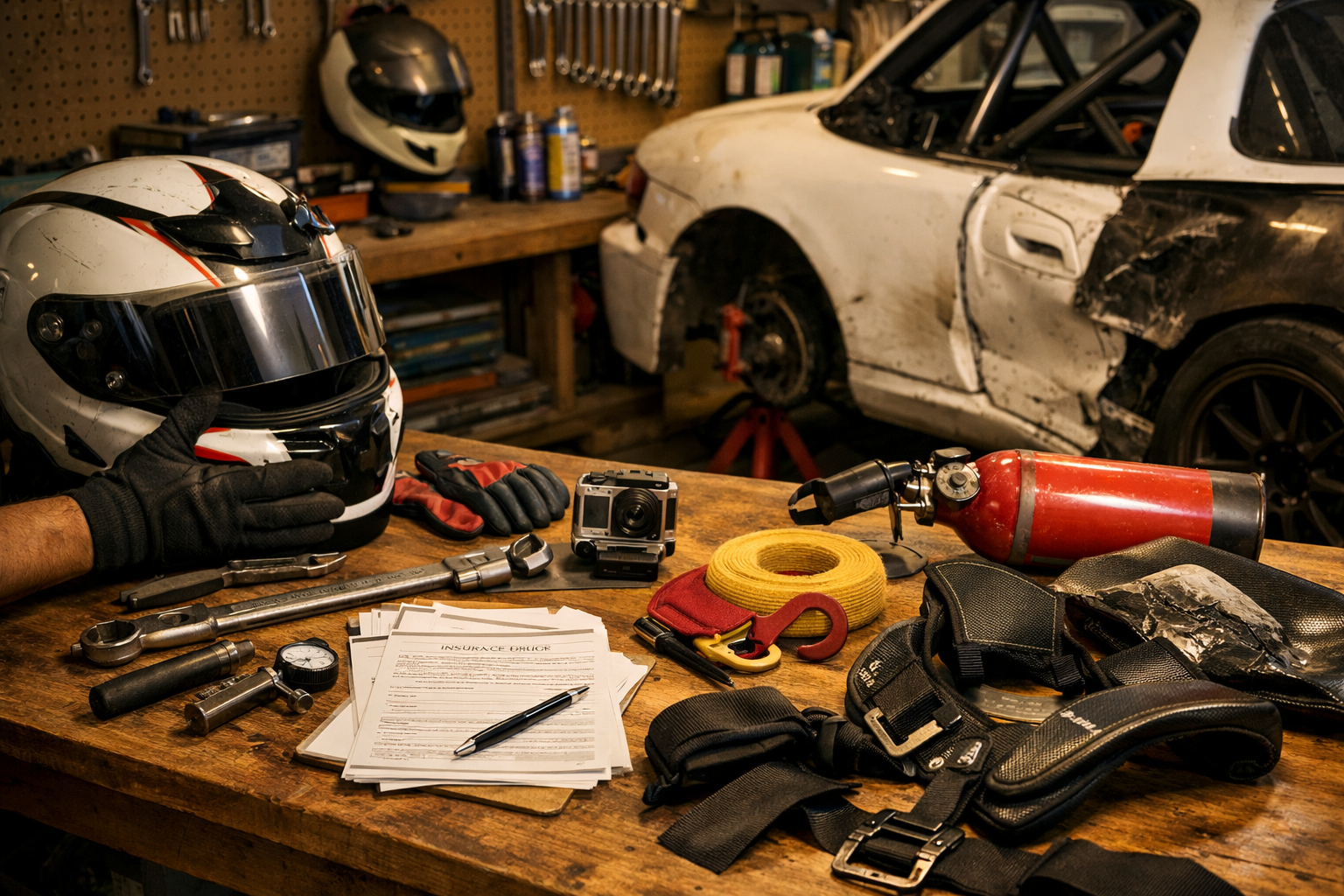
You finally get your sports car out to the track, helmet on, adrenaline pumping… and then it happens. A missed braking point, a little too much throttle, and suddenly you’re Googling track day insurance from the paddock with a crumpled fender and a sick feeling in your gut.
I’ve seen it more times than I can count — especially after high-profile incidents like a Laguna Seca crash that racks up six figures in damage. One mistake can turn a $300 weekend into a $30,000 nightmare. This isn’t just about bent sheet metal — it’s about liability, lawsuits, and whether your regular auto policy just ghosted you.
In this guide, I’m going to break down how track day insurance works, what motorsport liability really means, and how to protect your sports car before you ever roll onto pit lane. Think of this as your pre-track torque check — except for your wallet.
What You’ll Need
- Tools: Laptop or smartphone, copy of your auto policy (PDF), event registration details
- Parts/Materials: Track day insurance policy ($150–$600 per event depending on car value)
- Time: 30 minutes to compare quotes; 10 minutes to bind coverage
- Difficulty: 🔧🔧 (paperwork, not wrenches)
- Dealer Cost: $0 advice — but $20,000+ out of pocket after a crash vs DIY Policy: $250–$400 — You Save: Potentially $10,000–$100,000+
Why This Matters
Here’s the hard truth: most standard auto insurance policies do not cover on-track incidents. The second you pass through those gates, your coverage usually switches off like a garage light.
In 20 years of wrenching, I’ve seen engines window blocks, suspensions ripped off, and brand-new 2026 performance cars totaled in a single session. A modest off at 60 mph can mean $8,000 in suspension and body damage. A heavy wall hit? $25,000–$80,000 easy.
And it’s not just your car. Motorsport liability means if you leak oil and cause a multi-car incident, you could be on the hook for damages. Some tracks will also bill you for Armco barrier repair — $75 to $150 per foot, plus labor.
If you track your car even once a year — whether it’s a Miata, a Ferrari Luce, or your daily-driven Civic — you need to think about protection before spring track season kicks off.
Before You Start
⚠️ WARNING: Never assume your regular insurance covers “high-performance driving events” (HPDE). Most policies specifically exclude “timed events” and often any “racing surface” use.
Pull up your policy and search for keywords like “racing,” “competition,” or “closed-course.” If it’s vague, call your agent and get it in writing. Verbal reassurance means nothing when there’s a $40,000 claim on the table.
When should you not DIY this decision? If you’re financing or leasing your car. Lenders require full coverage — and a denied claim could leave you paying for a totaled car you no longer own.
Also check your state’s minimum liability requirements at NHTSA.gov. While they don’t govern track events, understanding baseline coverage helps you see the gap.
Understanding Track Day Insurance
Track day insurance is single-event or annual coverage specifically for non-competitive HPDE events. It typically covers:
- On-track collision damage to your car
- Off-track incidents during the event
- Sometimes limited paddock coverage
It usually does not cover:
- Mechanical failure (you over-revved it? That’s on you.)
- Wear and tear
- Liability for other drivers (often separate)
Typical cost in 2025–2026? About 1% to 2% of your car’s agreed value per event. So if your car is valued at $30,000, expect $300–$600 for a weekend with a 10% deductible.
That deductible matters. On a $30,000 agreed value with 10% deductible, you’re on the hook for $3,000 before insurance pays a dime.
Step-by-Step Guide
-
Confirm Your Event Type
Make sure it’s HPDE, not timed competition. Insurance providers differentiate. Autocross is usually easier to insure than wheel-to-wheel racing. -
Determine Agreed Value
Be honest about your car’s worth. Mods count — coilovers, big brake kits, carbon aero. Keep receipts. If you stuffed $10,000 in upgrades into your 2026 Honda Civic Sport Hybrid, declare it.
Pro Tip: Undervaluing to save $50 on premium can cost you thousands in payout. -
Compare Deductibles
Options are typically 10%, 15%, or 20%. Higher deductible = lower premium. I usually recommend 10% if the car’s your pride and joy. -
Check Motorsport Liability Coverage
Ask specifically: “Does this policy cover damage to other vehicles or track property?” Get it in writing. -
Bind Coverage Before You Leave Home
Do not wait until you’re in the paddock. Coverage must be active before the event starts. -
Document Vehicle Condition
Take time-stamped photos of all sides, wheels, interior, and engine bay. Think of it like a pre-rental inspection.
Common Mistakes to Avoid
- Assuming “it’s not racing.” I’ve seen policies denied because the car was on a closed circuit. Insurance companies love fine print.
- Not declaring modifications. That $4,000 big brake kit? If it’s not listed, it may not be covered.
- Ignoring track damage fees. Laguna Seca crash stories often include five-figure repair bills — not just for cars, but barriers.
- Thinking skill prevents crashes. Even pros spin. Oil, coolant, cold tires — stuff happens.
- Tracking a financed car without coverage. I’ve seen people paying $600/month on a car that’s sitting totaled in their driveway.
When to Call a Professional
If your car is worth over $75,000 or heavily modified, talk to a specialty motorsport insurance broker. Expect $400–$1,000 per event depending on value.
A fair annual HPDE policy for a $50,000 sports car might run $2,500–$4,000 per year. More if you’re running something exotic like what we talked about in the Genesis Magma GT comparison.
Ask these questions:
- Is this agreed value or actual cash value?
- What exactly voids the policy?
- Is off-track excursion damage covered?
Red flags? Vague answers, no written documentation, or pressure to bundle with your street policy.
Protecting Your Sports Car Beyond Insurance
Insurance is your parachute. But prevention saves the most money.
Before any event:
- Fresh brake fluid (high-temp DOT 4 or 5.1)
- Brake pads at least 50% life
- Tires under 5 years old (check DOT date)
- Torque lug nuts — consult your owner’s manual for spec
If you daily your car in winter, protect it from corrosion too. Road salt weakens suspension components over time. Check out our road salt protection guide before spring track prep.
And remember: mechanical failure isn’t covered by track day insurance. If your engine pops because you ignored oil temps, that’s on you.
Recommended Products
- Motul RBF 600 Brake Fluid ($25 per 500ml): What I run in my own track-prepped cars.
- ATE Type 200 ($18 per liter): Budget-friendly, solid for beginners.
- Longacre Tire Pressure Gauge ($45): Accurate readings prevent overinflation and spins.
- GoPro Hero ($299): Video proof of incidents can help with claims.
For broader safety data and recalls before any event, check NHTSA Recalls and your manufacturer’s maintenance schedule. ASE-certified tech standards are outlined at ASE.com.
Do This
- Buy track day insurance before every event
- Declare all modifications honestly
- Take detailed pre-event photos
- Budget deductible money in advance
Don’t Do This
- Assume your street policy covers track use
- Track a financed car without special coverage
- Ignore track property liability clauses
- Wait until you’re in the paddock to think about insurance
Look, nobody plans to crash. But I’ve watched too many drivers load a beautiful car onto a flatbed after one bad corner. Spending $300 on track day insurance is like wearing a helmet — you hope you never need it.
You can absolutely handle this prep yourself. Read the fine print, ask smart questions, and protect your sports car before you push it to the limit. Got questions about motorsport liability or coverage details? Drop them in the comments — I’ll help you sort it out.
Stay safe out there, and remember — a $20 repair manual saves a $2,000 repair bill… and a $300 insurance policy might save your entire car.