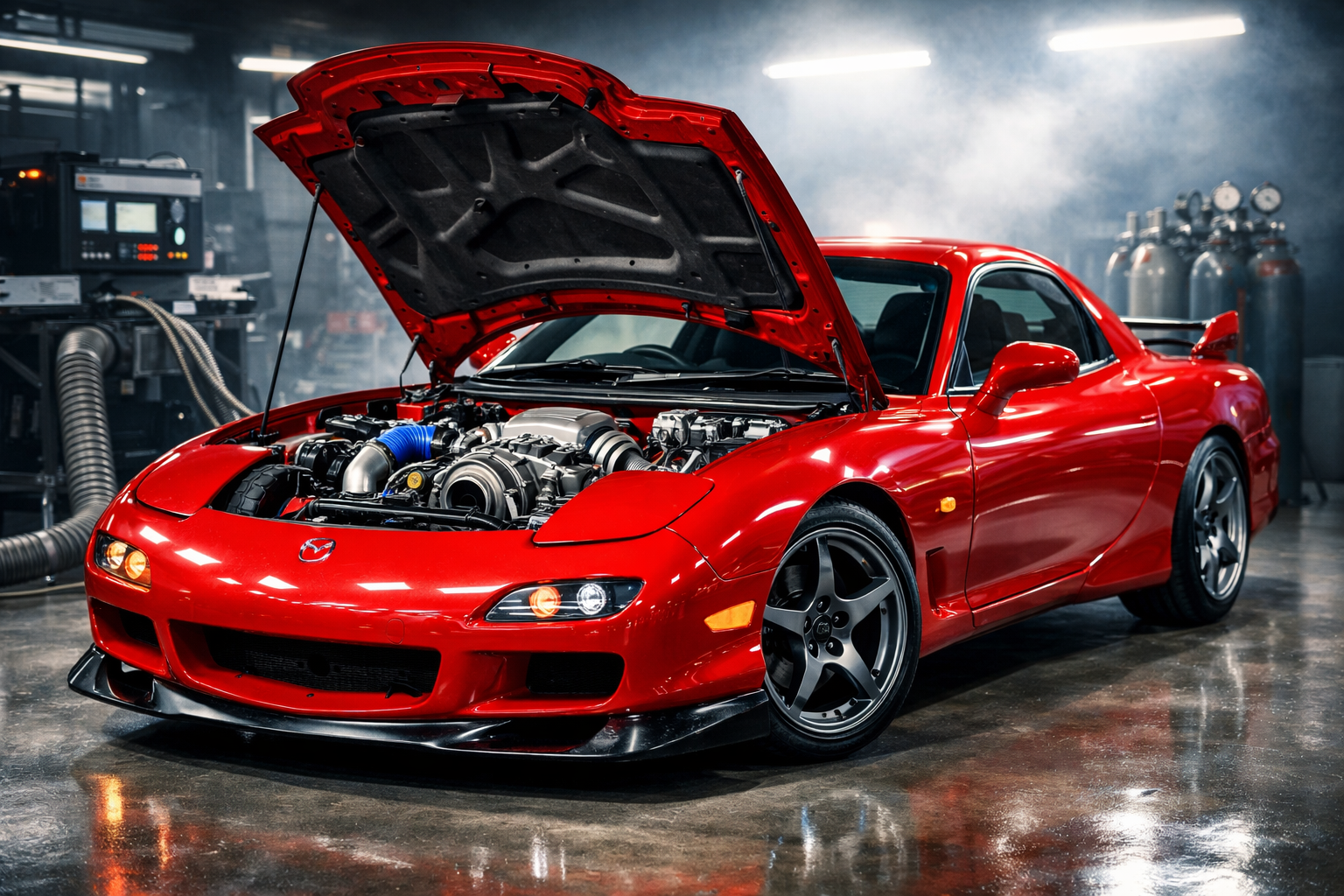

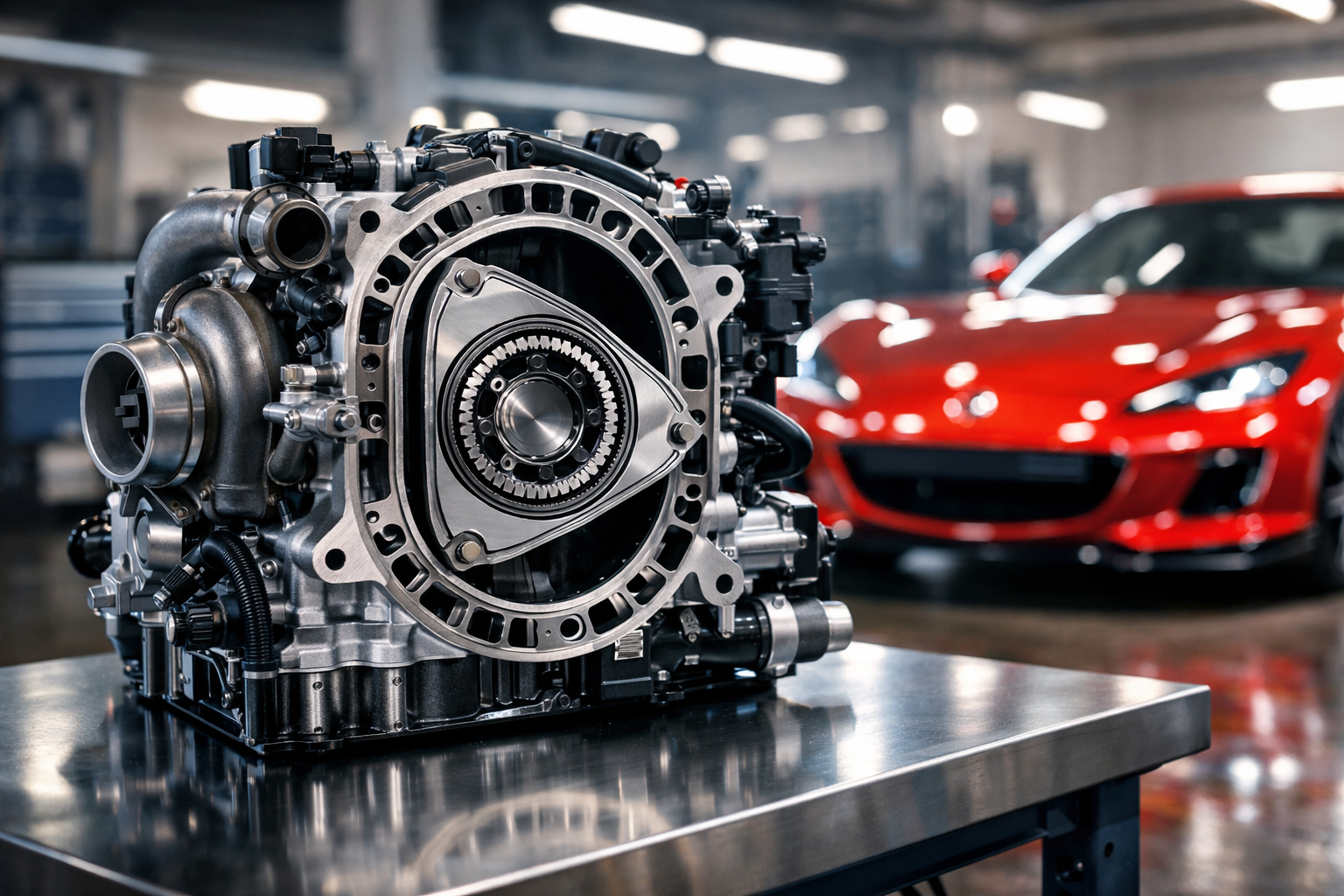
The rotary engine should be dead. Emissions rules have tightened like a noose, fuel economy standards glare at inefficiency, and yet here we are in 2026 still asking whether rotary engine emissions can ever play nicely with modern regulations. It’s the automotive equivalent of asking if vinyl can outsell Spotify—romantic, rebellious, and probably a bit irrational.
But this matters right now because every time Mazda teases a new sports car concept or files a patent, enthusiasts lose their collective minds. I’ve driven RX-7s that felt like caffeinated dragonflies and RX-8s that drank oil like a two-stroke dirt bike. The question isn’t whether we love the rotary—it’s whether lawmakers and EPA lab coats would tolerate it.
And with the 2026 Mazda lineup leaning heavily on electrification, plus the MX-30 R-EV in certain markets using a rotary as a range extender, the debate isn’t theoretical anymore. It’s engineering versus emissions, passion versus particulate filters. So, could a modern rotary actually survive?
Why Rotary Engine Emissions Are the Core Problem
Here’s the blunt truth: rotary engine emissions have always been the Achilles’ heel of the Wankel design. The shape of the combustion chamber—long and thin like a badly rolled burrito—creates incomplete combustion. That means higher hydrocarbons and worse fuel economy compared to a conventional piston engine.
In the RX-8’s final U.S. years (2011), it managed about 16 mpg city and 23 mpg highway. Compare that to a 2026 Toyota GR86 at roughly 20/27 mpg or a 2026 Ford Mustang EcoBoost pushing into the mid-20s combined, and you see the problem. Regulators don’t care that it revs to 9,000 rpm and sounds like an angry hornet’s nest—they care about grams per mile.
Worse, rotaries traditionally burn a small amount of oil by design to lubricate the apex seals. That’s charming in a “quirky engineering” way, very Doug DeMuro, but it’s a nightmare when emissions standards measure everything from NOx to particulate matter with surgical precision.
What Modern Emissions Rules Actually Demand
In the U.S., Tier 3 standards and California’s LEV III regulations are brutally strict. We’re talking fleet-wide CO2 targets and microscopic limits on hydrocarbons. Europe’s Euro 7 rules—assuming they proceed in full force—are even more aggressive, measuring emissions over a broader range of real-world conditions.
Automakers already struggle with big V8s. Just look at the cultural meltdown over AMG downsizing the C63 to a four-cylinder hybrid—something we covered in C63 Four-Cylinder: Mercedes Misread Fans. If a turbo four-cylinder with hybrid assistance causes outrage, imagine trying to homologate a thirsty 1.3-liter rotary that behaves like it’s permanently at redline.
The cold-start phase is particularly savage. Rotaries historically struggle here because of inefficient combustion at low temperatures. And guess when emissions are worst? Exactly—during cold start. Regulators know it, and they test for it.
Could Hybridization Save the Rotary?
This is where things get interesting. Mazda’s approach with the MX-30 R-EV in global markets uses a small rotary engine purely as a generator. It doesn’t drive the wheels; it just charges the battery. That means it can operate at a steady, optimized RPM—right in its sweet spot.
By running at constant load, you dramatically improve rotary engine emissions compared to the old RX-8 days of stoplight drag races and 9,000-rpm theatrics. In theory, a rotary used this way could meet modern standards because you eliminate the chaotic real-world throttle swings that cause dirty burn cycles.
It’s similar in philosophy to what we’ve seen with high-performance EVs using combustion engines as support acts, though in reverse. If you’ve read our AMG Electric SUV: 1,000+ HP 2026 Review, you’ll know electrification isn’t the enemy of performance—it’s often the enabler. A rotary hybrid sports car could be the best of both worlds: electric torque off the line, rotary scream at the top.
Hot take: the rotary’s future isn’t as a pure sports car engine. It’s as a weird, brilliant sidekick in a hybrid system. And frankly, that’s better than extinction.
Engineering Fixes: Are They Enough?
Mazda has spent decades refining apex seals, direct injection, and ignition timing. According to Mazda’s official site, their latest rotary developments focus on efficiency and reduced emissions for electrified applications. That’s corporate-speak for “we know it was dirty before.”
Direct injection can reduce unburned hydrocarbons. Improved sealing reduces oil consumption. Better engine management can optimize combustion. But here’s the Chris Harris bit: physics still applies. The combustion chamber shape simply isn’t as thermally efficient as a modern turbocharged inline-four.
Compare it to something like the 2026 Honda Civic Type R’s 2.0-liter turbo making 315 hp while returning around 22/28 mpg. Or the Toyota GR Corolla’s 300-hp three-cylinder wizardry. They make similar power with fewer compromises and far less regulatory drama.
The Sports Car Dream vs Regulatory Reality
Let’s say Mazda builds a new RX-7 for 2026 or 2027. Starting around $45,000, 350 hp from a twin-rotor hybrid setup, 0-60 mph in 4.5 seconds. It would square up nicely against the Nissan Z, Toyota Supra, and even a base Porsche 718 Cayman.
But every extra gram of CO2 would need to be offset somewhere else in the fleet. That likely means more EVs, more crossovers, and higher costs spread across the lineup. Enthusiasts might cheer, but accountants would sweat.
And in a world where we’re already debating whether EV design should be weird to stand out, a rotary sports car starts to look like a nostalgic indulgence. A glorious one, yes—but indulgent.
What History Tells Us
The RX-7 died in the U.S. after 1995 largely due to emissions and cost pressures. The RX-8 bowed out in 2011 for similar reasons. That wasn’t because enthusiasts stopped caring; it was because compliance costs skyrocketed.
I’ve spoken to engineers who say the rotary was always a labor of love inside Mazda. If you want proof of that stubborn devotion, read Mazda Rotary Engine: Why Employees Persist. The passion is real. The challenge is whether passion can overcome policy.
Today’s testing cycles are even stricter, and global harmonization means you can’t just build a “Japan-only special” without massive investment. The business case has to make sense worldwide.
So, Could It Survive?
Here’s my verdict: yes, but not in the way purists want. A standalone, naturally aspirated rotary sports car built purely for thrills would struggle mightily with rotary engine emissions compliance unless heavily electrified. The days of a simple, high-revving Wankel with a manual gearbox and nothing else are probably over.
As a hybrid range extender or part of a performance-focused electrified system? Absolutely possible. By controlling operating conditions and leaning on battery power, Mazda rotary challenges become engineering puzzles rather than regulatory death sentences.
The irony is delicious. To save the rotary, you might have to silence it most of the time.
Pros
- Compact and lightweight compared to piston engines
- Exceptionally smooth with high-revving character
- Ideal for hybrid range-extender applications
- Strong brand identity and enthusiast appeal
Cons
- Historically poor fuel economy (often under 20 mpg combined)
- Higher hydrocarbon emissions due to combustion chamber shape
- Oil consumption by design complicates compliance
The rotary isn’t dead. It’s just on probation. If Mazda can tame rotary engine emissions with electrification and clever calibration, the Wankel might yet spin into the late 2020s. Just don’t expect it to look—or sound—like 1993 anymore.
Frequently Asked Questions
Why are rotary engine emissions historically so high?
The rotary’s combustion chamber shape leads to incomplete fuel burn, increasing hydrocarbons. It also injects small amounts of oil for seal lubrication, which raises emissions compared to piston engines.
Can a rotary engine meet modern EPA standards?
Yes, but typically only with hybrid assistance or as a range extender. Running at constant RPM improves efficiency and helps meet Tier 3 and similar global standards.
Is Mazda bringing back the RX-7 or RX-8?
As of 2026, Mazda has not confirmed a new RX-7 or RX-8. However, it continues rotary development for electrified applications and concept vehicles.
How does a rotary compare to a turbo four-cylinder today?
Modern turbo fours make 300+ hp with 22–30 mpg combined. Rotaries are smoother and more compact but typically less fuel-efficient and harder to certify for emissions.