
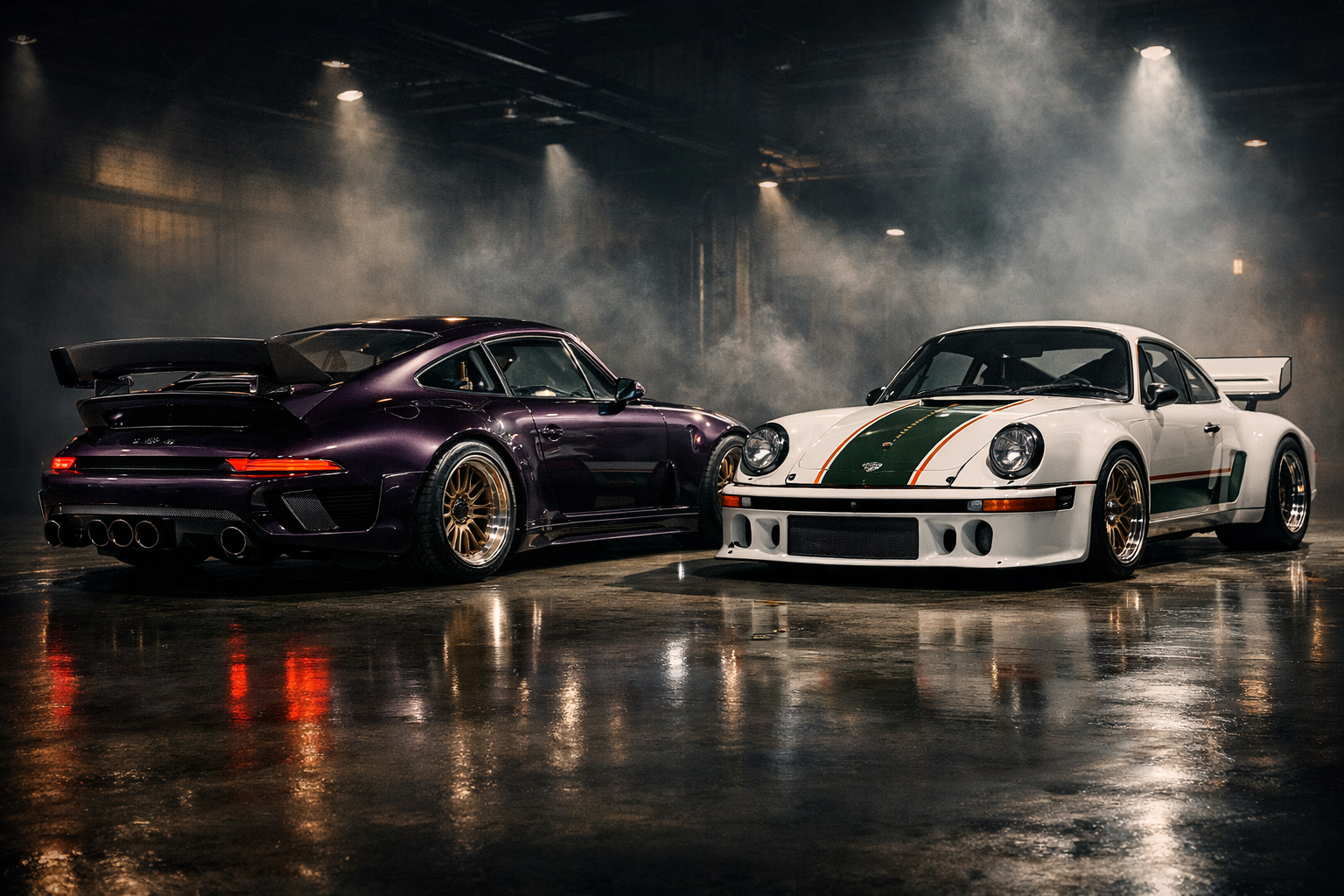
If you think turbocharging peaked in the ’70s with whale tails and bad hair, the Singer Sorcerer exists to laugh at you. The Singer Sorcerer isn’t just a restomod; it’s a $2-million middle finger to the idea that modern performance needs screens, batteries, or corporate mindfulness training. Park it next to a classic Porsche 934/5 and suddenly the question isn’t “which is faster,” but “which one scares you more while standing still.”
This matters right now because the car world is drowning in sanitized speed—EVs doing 0–60 in 2.5 seconds with the emotional engagement of an iPad swipe. The Singer Sorcerer vs Porsche 934/5 debate is about soul, intent, and whether engineering obsession beats raw motorsport brutality. I’ve driven modern GT cars that are quicker on paper, but none made my palms sweat like these two do before you even turn the key.
And yes, this is a ridiculous comparison: a 2026-era, artisan-built restomod against a homologation race car from the disco era. But if you’re the sort of enthusiast who’s cross-shopped a Pagani, a Singer, and a vintage 911 Turbo on Bring a Trailer at 2 a.m., this is your pub argument. Let’s settle it.
Quick Specs
- Starting Price: Singer Sorcerer approximately $2,000,000+ (check manufacturer website for latest pricing); Porsche 934/5 $1,800,000–$3,000,000 depending on provenance
- Engine: Singer: 3.8L twin-turbo flat-six; 934/5: 3.0L turbo flat-six
- Power: Singer ~700 hp; 934/5 ~550 hp (race trim varied)
- 0-60 mph: Singer ~2.9 seconds; 934/5 approximately 3.5 seconds (traction-limited)
- Fuel Economy: Let’s call it “not the point”
The Contenders: Singer Sorcerer vs Porsche 934/5
The Singer Sorcerer is Singer Vehicle Design’s turbocharged DLS taken to its logical extreme, co-developed with Williams Advanced Engineering. Carbon fiber everywhere, a redline north of 9,000 rpm, and tolerances tighter than a Nürburgring noise regulation. It’s built for wealthy masochists who want perfection and are annoyed that modern 911 Turbos feel too easy.
The Porsche 934/5, meanwhile, was built to win races and intimidate amateur drivers into therapy. It’s effectively a 930 Turbo turned inside-out for IMSA and FIA GT racing, with mechanical injection, enormous lag, and brakes that assume you have forearms like Popeye. Ferrari 512 BB LMs, BMW M1 Procars, and De Tomaso Panteras were its natural enemies, not café lattes.
Design Face-Off: Sculpture vs Scar Tissue
The Singer looks like a 911 that’s been to finishing school and learned Latin. Every panel gap is millimeter-perfect, the carbon weave is aligned like a Swiss watch, and the turbo intakes look functional because they are. It’s the anti-Cyberpunk: analog beauty with aerospace execution.
The 934/5 looks like it escaped from Le Mans and is still angry about it. Rivets visible, flares brutally swollen, and that towering rear wing screaming “downforce, not Instagram.” Hot take: the 934/5 is uglier than the Singer, and that’s exactly why it’s more honest.
Interior & Tech: Craftsmanship vs Bare Knuckles
Singer’s interior is where you understand where the money went. Hand-stitched leather, milled aluminum knobs, and gauges that look like Rolex collaborated with Stuttgart. No giant touchscreen nonsense either, which aligns nicely with my ongoing rant about over-digitized cabins—something even Audi’s designers are quietly walking back, as discussed in this UX deep dive.
The 934/5 interior is a roll cage, a seat, and hope. There’s no infotainment, barely any insulation, and the pedal box is offset like it was designed during a pub bet. Calling it “spartan” is generous; it’s more like vehicular minimalism by threat of violence.
Performance: Turbo Lag as a Personality Trait
On the road—or track—the Singer Sorcerer is devastatingly quick. Roughly 700 hp in a sub-2,700-pound package means it’ll embarrass a 992 Turbo S despite being rear-wheel drive. Throttle response is shockingly crisp for a turbo, like someone finally taught forced induction some manners.
The 934/5, though, has lag so dramatic it deserves its own YouTube explainer from Jason Cammisa. Below boost, it’s sleepy; above boost, it’s Armageddon. Controversial take: the 934/5 is harder to drive fast than a modern hypercar, including the Ford GT or McLaren Senna, and that’s why it’s more rewarding.
Ownership Reality: Myth, Money, and Maintenance
Buying a Singer means you’re entering a curated ownership experience with factory support, modern materials, and parts availability that won’t require bribing a retired Porsche mechanic. Yes, it’s expensive, but it’s a known quantity—something we’ve explored before when breaking down exotic ownership myths in this cost analysis.
The 934/5 is motorsport archaeology. Parts are rare, rebuilds are seven-figure conversations, and every mile driven slightly erodes its historical value. You don’t “own” a 934/5; you temporarily babysit it for the next wealthy lunatic.
Value Breakdown: Absurdity with Context
At around $2 million, the Singer Sorcerer sounds insane until you compare it to a Pagani Utopia, Bugatti Chiron, or even a modern Porsche 911 GT1 stradale if one ever surfaced. Those cars are faster, sure, but none deliver this level of bespoke craftsmanship with usable performance.
A real 934/5 can cost similar money, sometimes more, but you’re paying for history, not usability. Hot take number two: as an object to actually drive, the Singer is better value than the 934/5, even though that sentence feels morally wrong.
| Spec | Singer Sorcerer | Porsche 934/5 |
|---|---|---|
| Starting Price | ~$2,000,000+ | $1,800,000–$3,000,000 |
| Power | ~700 hp | ~550 hp |
| 0-60 mph | ~2.9s | ~3.5s |
| MPG/Range | N/A | N/A |
| Cargo Space | Front trunk (tiny) | Laughable |
| Warranty | Factory-backed support | None, just prayers |
Pros
- Unmatched craftsmanship and engineering depth
- Modern performance without digital dilution
- Usable speed that doesn’t punish the driver
- Factory support and reliability
Cons
- Eye-watering price of entry
- Still too precious for some track abuse
- Purists will scream “it’s not original”
The Winner: Heart vs History
If your goal is to own a piece of Porsche’s racing soul, the 934/5 wins by default. It’s history you can smell, hear, and occasionally wrestle into submission. But if you actually want to drive, hard and often, without a pit crew and a museum curator on speed dial, the Singer Sorcerer is the smarter lunatic choice.
For deeper driving impressions, my track-focused thoughts align closely with what we found in our Sorcerer track review, where its balance and brake feel genuinely shocked seasoned GT drivers. And if you enjoy manual, analog madness in other forms, you’ll appreciate similar themes in the Donkervoort vs Ford GT showdown.
The Porsche 934/5 is a legend you revere; the Singer Sorcerer is a legend you actually drive. If the former is a Stradivarius locked in glass, the latter is the same violin, played loudly, badly, and beautifully at 9,000 rpm on your favorite road.