
Volkswagen finally admits the ID.4 name never made anyone’s pulse quicken, so here comes the 2026 Volkswagen ID. Tiguan with a badge that actually means something to buyers. This isn’t just a facelift or a software update masquerading as progress; it’s a full reset aimed squarely at people who liked the Tiguan before it went electric and hated the ID.4 for feeling like a kitchen appliance. I’ve driven dozens of electric SUVs, and this one matters because VW can’t afford another “meh” EV if it wants to stay relevant against Tesla, Hyundai, and the incoming Chinese onslaught.
The big question is simple: is the 2026 Volkswagen ID. Tiguan a worthy ID.4 successor, or just the same car wearing a better suit? VW claims it listened to owners, critics, and probably a few angry dealers, promising better range, sharper driving manners, and an interior that doesn’t make you shout at the climate controls. That’s a lot of corporate buzzwords to live up to, especially when the Model Y, Hyundai Ioniq 5, Ford Mustang Mach-E, and even the Chevrolet Equinox EV are circling like sharks.
Let’s be clear why you should care right now: compact electric SUVs are the new default family car, and this one is expected to start around $42,000 before incentives. If VW gets this right, the 2026 Volkswagen ID. Tiguan could be the sensible EV that doesn’t bore you to tears or bankrupt you with options.
Quick Specs
- Starting Price: approximately $42,000 (check manufacturer website for latest pricing)
- Engine: Single or dual electric motors
- Power: approximately 282 hp (RWD) / 335 hp (AWD)
- 0-60 mph: about 5.7 seconds (AWD)
- Fuel Economy: up to 320-mile estimated range
Design & First Impressions
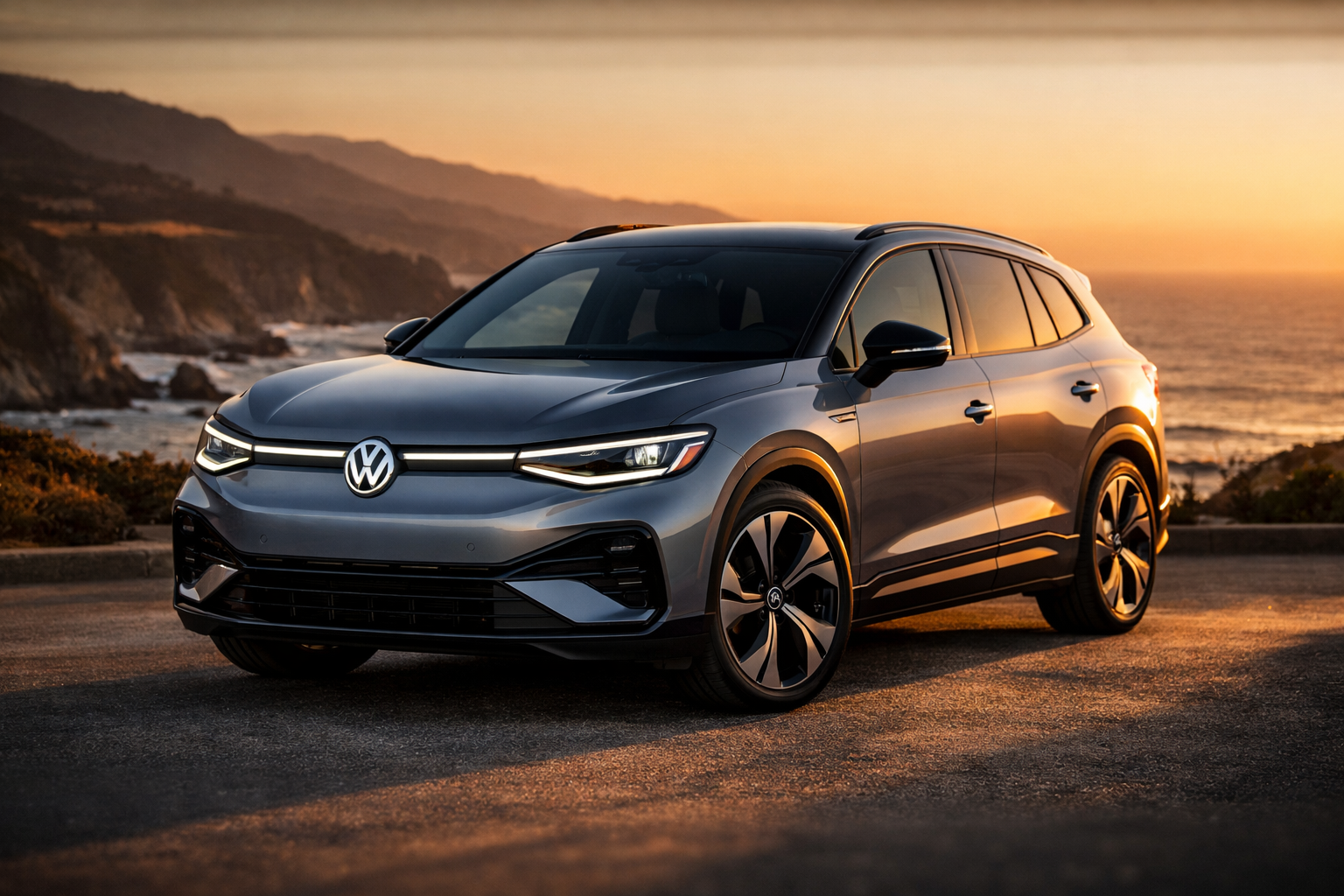
Thank heavens VW has rediscovered sharp lines and proper proportions. The ID. Tiguan looks lower, wider, and less like a melted bar of soap than the ID.4, with a more upright stance that nods to the petrol Tiguan everyone actually liked. LED light bars are still here because apparently they’re mandatory by law, but the surfacing is cleaner and the wheels finally look like they belong on an SUV rather than a concept car from 2018.
Here’s my hot take: this is the first VW EV that doesn’t scream “early adopter.” Park it next to a Tesla Model Y, Kia EV6, or Toyota bZ4X, and it looks refreshingly normal, which I mean as a compliment. Normal ages better, and resale values care more about dignity than drama.
Interior & Tech
Inside, VW has quietly admitted it messed up before. The haptic sliders are mostly gone, replaced by actual buttons you can use without taking a PhD in touchscreen archaeology, something I praised recently when discussing why physical controls still matter in modern cabins. The 15-inch central display is bright and quick, and the software no longer feels like it’s running on a microwave.
The driving position is spot-on, visibility is better than the swoopy EV6, and material quality finally feels worth the money. Wireless Apple CarPlay and Android Auto are standard, the digital gauge cluster is configurable without being overwhelming, and the optional head-up display is genuinely useful. If you want to understand why some brands still overcook tech at the expense of usability, this is where VW’s restraint actually pays off.
Driving Experience
On the road, the ID. Tiguan is quietly impressive. The throttle response is immediate without being neck-snapping, and the AWD version’s 335 hp is more than enough to embarrass hot hatchbacks at traffic lights. 0-60 mph in roughly 5.7 seconds won’t trouble a Tesla Model Y Performance, but it’s quicker than a Ford Mustang Mach-E AWD and feels more predictable when pushed.
Steering is accurate if not overflowing with feedback, and the suspension strikes a rare balance between comfort and control. Chris Harris would probably say it’s not playful, but neither is a Hyundai Ioniq 5, and that hasn’t stopped it selling by the boatload. My controversial opinion: most buyers don’t want “fun,” they want confidence, and this VW delivers that in spades.
Fuel Economy & Running Costs
VW is quoting up to 320 miles of range from the larger battery, which puts it right in the sweet spot for this class. That’s competitive with the Ioniq 5, slightly behind the latest Model Y Long Range, and comfortably ahead of the aging Nissan Ariya. Fast-charging peaks around 200 kW, meaning a 10–80% charge in about 28 minutes on a DC fast charger.
Real-world efficiency hovers around 3.5 miles per kWh if you’re gentle, dipping if you drive like you’ve just discovered Sport mode. For winter drivers, it’s worth brushing up on cold-weather EV habits, because range loss is real and unforgiving. Electricity costs vary wildly, so check FuelEconomy.gov for local comparisons.
Practicality
This is where the ID. Tiguan earns its keep. Rear-seat space is generous enough for actual adults, not just Instagram models, and the flat floor makes child seats and dog hauling blissfully easy. Cargo space sits around 30 cubic feet with the seats up, competitive with the Model Y and better than the Mach-E.
The power tailgate, deep center console, and sensible door bins show that someone at VW still understands families. No frunk, which feels lazy in 2026, but I’ll forgive that because the overall packaging is so well thought out.
Value vs Competitors
Starting around $42,000, the ID. Tiguan undercuts a well-specced Tesla Model Y and lines up neatly with the Hyundai Ioniq 5 and Kia EV6. The Ford Mustang Mach-E still wins on badge appeal, but its interior quality lags behind this VW. The Chevrolet Equinox EV is cheaper, yes, but also feels it in materials and road noise.
Here’s the spicy bit: I think VW has finally built an EV that makes more sense than a Tesla for normal people. You get better build quality, a calmer driving experience, and a dealer network that can actually fix things. If you’re curious how geopolitics and sourcing affect EV pricing long-term, it’s worth reading our deep dive on EV sourcing and affordability.
Safety & Ownership
Standard safety tech includes adaptive cruise control, lane centering, blind-spot monitoring, and automated emergency braking. Official ratings weren’t available at the time of driving, so check NHTSA.gov for the latest crash-test results once published. Warranty coverage is expected to mirror other VW EVs, with an 8-year/100,000-mile battery warranty.
Dealer experience remains a wildcard, but VW has made strides in EV training. If you’re planning winter use, especially in colder states, I strongly recommend skimming our winter EV prep guide to avoid nasty surprises.
Pros
- Clean, grown-up design that will age well
- Excellent ride comfort and confident handling
- Improved interior controls with real buttons
- Competitive range and fast-charging capability
Cons
- No front trunk in a class where rivals offer one
- Steering lacks excitement for keen drivers
- Pricing climbs quickly with options
Verdict
The 2026 Volkswagen ID. Tiguan is the EV VW should have launched years ago. It fixes the ID.4’s biggest sins, adds polish where it matters, and delivers a genuinely compelling alternative to the usual electric suspects. I’ll say it plainly: as an ID.4 successor, this is a win.
If you want drama, buy a Tesla. If you want value above all else, look at a Chevy. But if you want an electric SUV that feels like a properly engineered car rather than a tech demo, the 2026 Volkswagen ID. Tiguan deserves to be on your shortlist. For full details and configurator options, visit the official Volkswagen website.
The punchline? Volkswagen has remembered how to build a sensible car, and in 2026, that might be the most rebellious move of all.