
Toyota doesn’t tease unless it’s serious, and the fact this new big family hauler exists at all tells me one thing: the Highlander is sweating, the Sequoia is looking over its shoulder, and Detroit should stop laughing. I’ve driven dozens of three-row SUVs, and most are about as exciting as a dishwasher manual, but this one could actually matter. The 2026 Toyota SUV isn’t just another beige box for school runs; it’s Toyota admitting that American families want space, speed, and sanity in one slab.
Why does this matter right now? Because Ford, GM, and Hyundai have been eating Toyota’s lunch in the large SUV space with Tahoe, Explorer, Palisade, and even the Kia Telluride playing the value hero. Toyota’s Toyota teaser hints at a clean-sheet rethink rather than a mild facelift, and that’s overdue. If this lands right, it could be the most important new Toyota SUV review I’ll write this year.
Let’s be clear: the 2026 Toyota SUV needs to fix the gap between the Grand Highlander and the Sequoia, a no-man’s-land where buyers either overspend or compromise. Toyota’s reputation for bulletproof reliability gives it a free pass on first impressions, but the market in 2026 is ruthless. This is about powertrains, tech, and whether Toyota finally learns how to tune a touchscreen.
Quick Specs
- Starting Price: approximately $48,000 (check manufacturer website for latest pricing)
- Engine: 2.4L Turbo Hybrid / possible V6 Hybrid
- Power: approximately 360–400 hp / 400+ lb-ft
- 0-60 mph: around 6.0 seconds
- Fuel Economy: estimated 25 city / 30 highway mpg
Design & First Impressions
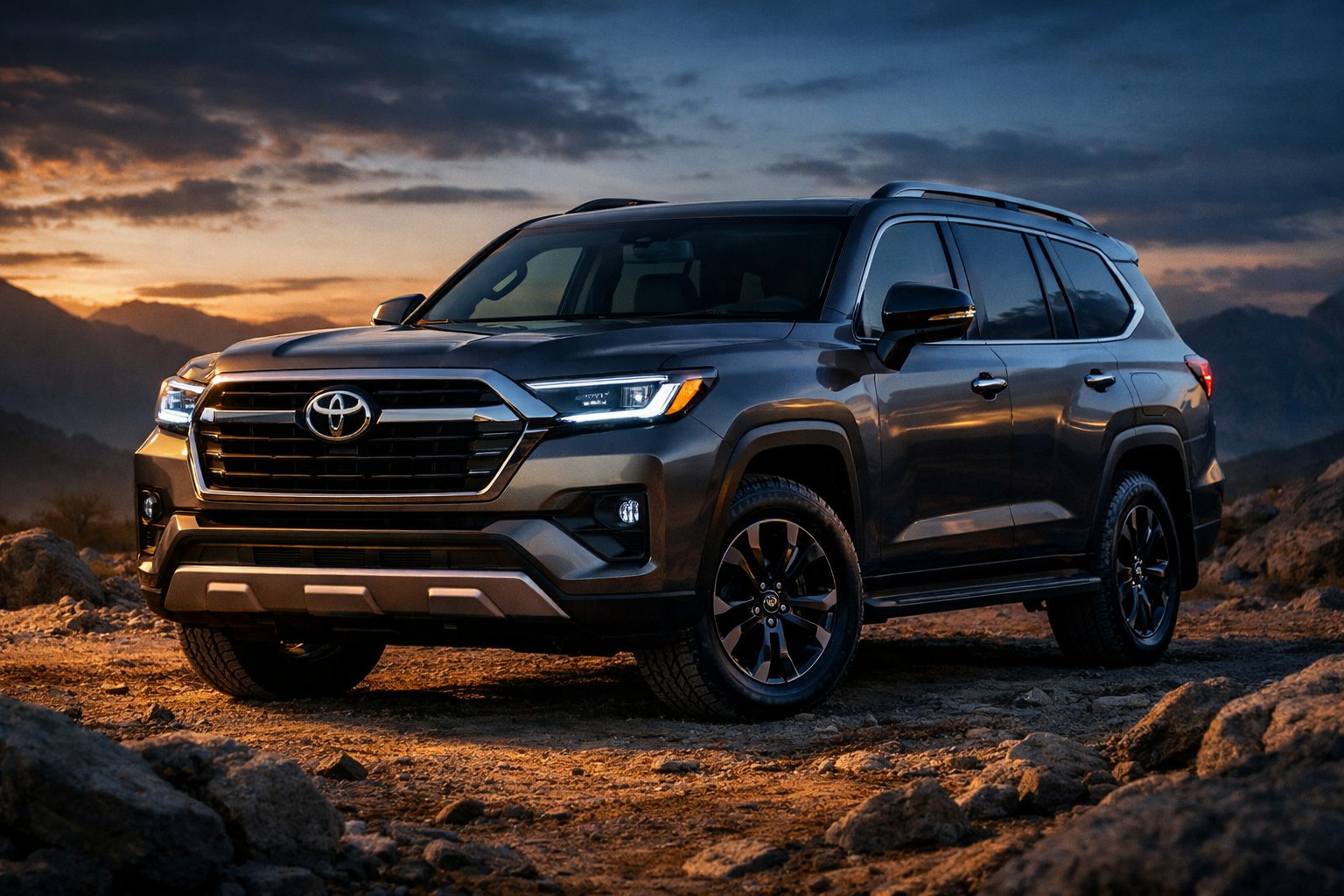
The teaser images suggest Toyota’s designers finally ditched the “angry vacuum cleaner” face for something squared-off and confident. Think Land Cruiser Lite vibes rather than melted Highlander soap. If this thing lands with proper proportions, it’ll look tougher than a Chevy Traverse and less try-hard than a Hyundai Palisade.
Hot take: Toyota should stop pretending chrome equals luxury. Matte accents, proper wheel arches, and a stance that doesn’t scream rental car would do more than any fake wood trim. Doug DeMuro will absolutely lose his mind if this gets functional roof rails and a split tailgate.
Interior & Tech Expectations
If Toyota messes up the infotainment again, I will personally mail them a tablet from 2015 to show what lag feels like. Expect a 14-inch center screen, digital gauges, wireless Apple CarPlay, and enough USB-C ports to charge a YouTuber’s entire filming rig. Physical climate controls are non-negotiable, and if Toyota keeps them, enthusiasts will cheer louder than on a SavageGeese launch video.
Material quality should land somewhere between the Grand Highlander and Lexus TX, which is to say solid, durable, but not Bentley plush. Families don’t want suede headliners; they want seats that survive juice boxes and Goldfish crackers. For context on how buyers cross-shop, our guide on how to choose three-row SUVs is worth a look.
Driving Experience: Please, Toyota, Surprise Me
Here’s where Chris Harris would raise an eyebrow: Toyota SUVs traditionally drive like the throttle response is lazier than a cat in a sunbeam. The rumored turbo-hybrid setup could finally fix that, delivering instant torque without the V8 guilt. A 0–60 mph run around 6 seconds would put it ahead of a Honda Pilot and right on the Explorer ST’s heels.
Steering feel doesn’t need to be Porsche Macan sharp, but it shouldn’t feel like you’re turning a boat rudder either. Adaptive dampers would be a huge win, especially if Toyota lets you soften it for family duty or stiffen it for back-road antics. If Mazda can make a CX-90 vaguely fun, Toyota has no excuse.
Fuel Economy & Running Costs
This is where Toyota usually wipes the floor with rivals. A hybrid-only lineup could mean real-world averages of 27 mpg, which would embarrass a Tahoe’s thirst and make a Volkswagen Atlas look outdated. Check FuelEconomy.gov for how brutal EPA numbers can be on big SUVs.
Maintenance should remain classic Toyota: boring, predictable, and cheap. That matters when you’re staring down seven years of kids, dogs, and road trips. Compared to German rivals that’ll be on first-name terms with your service advisor, this is peace of mind you can put a price on.
Practicality for Real Families
This thing lives or dies by its third row and cargo space. Expect around 20 cubic feet behind the third row and 85+ cubic feet with seats folded, which would put it squarely against the Kia Telluride and Chevy Traverse. Sliding second-row seats and one-touch folding are mandatory, not “premium package” nonsense.
Towing should land near 5,000 pounds, enough for a small boat or camper without needing a Sequoia-sized mortgage. Safety tech will be Toyota Safety Sense 4.0, with adaptive cruise, lane centering, and the usual alphabet soup. You can always double-check crash ratings later at NHTSA.gov.
Value vs Competitors
Starting around $48,000 puts the 2026 Toyota SUV right in the crosshairs of the Ford Explorer, Hyundai Palisade, and Honda Pilot. The Explorer offers speed, the Palisade offers tech-per-dollar, and the Pilot offers space, but Toyota wants to offer all three with fewer headaches. That’s a bold claim, but historically, Toyota backs it up.
Luxury shoppers might also glance at a BMW X7 or even Cadillac Escalade, which we’ve compared in our Escalade vs Navigator comparison. My controversial take? Most Escalade buyers don’t need that much car, and this Toyota could be the smarter flex.
What Toyota Needs to Get Right
First, pricing discipline. If Toyota creeps this past $60,000, it’ll cannibalize Lexus and confuse buyers. Second, tech that works on day one; no “over-the-air update will fix it” nonsense.
Third, give us trims that make sense. A rugged version with proper all-terrain tires would steal sales from Subaru and Jeep overnight. And yes, AWD needs to be standard on at least one affordable trim, not locked behind a brochure buzzword.
Pros
- Expected class-leading fuel economy
- Strong hybrid performance potential
- Toyota reliability reputation
- Competitive pricing versus rivals
Cons
- Infotainment still a question mark
- No confirmed V6 or V8 option
- Risk of overlapping too closely with Lexus
Verdict: Should You Care?
If Toyota delivers even 80% of what this teaser promises, the 2026 Toyota SUV could be the default answer for families who want space without drama. It won’t be the flashiest, fastest, or fanciest, but it might be the smartest. And frankly, in a world of overcomplicated SUVs, that’s refreshing.
The final word? The 2026 Toyota SUV doesn’t need to reinvent the wheel; it just needs to remember how to make one that lasts, grips, and doesn’t squeak after 40,000 miles. If Toyota nails that, the pub conversation next year won’t be about which SUV to avoid, but which trim to buy.