
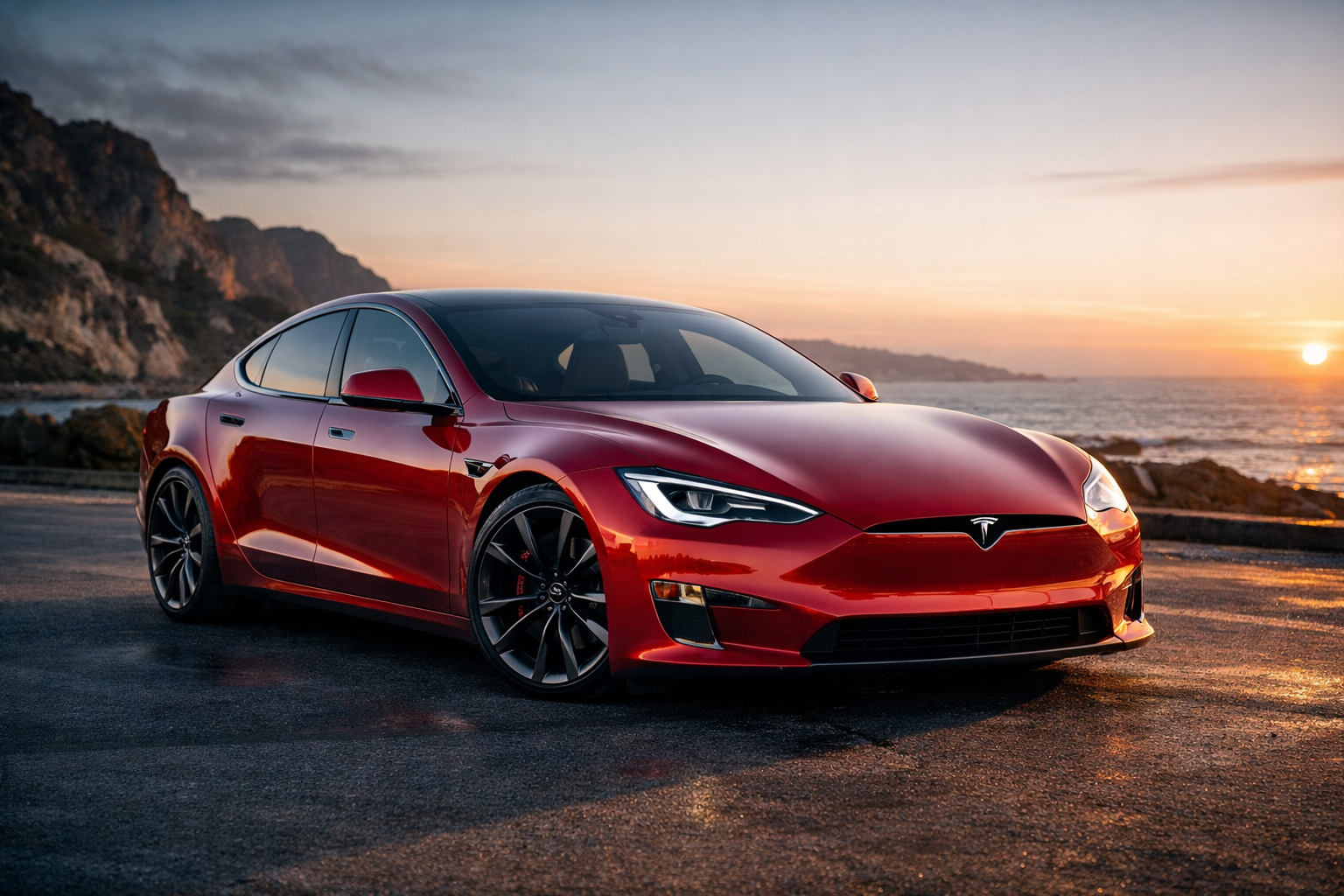
The Tesla Model S is dying, and nobody seems to be lighting a candle. That’s odd, because this sleek wedge on wheels didn’t just disrupt the luxury sedan world, it kicked the door off its hinges and shouted “electric can be cool” back in 2012. This 2026 Tesla Model S review is a farewell tour to Tesla’s original flagship, a car that once made S-Class owners spill their lattes.
Why does this matter right now? Because with SUVs everywhere and sedans treated like last season’s skinny jeans, the Model S is quietly bowing out as Tesla pivots to Cyber-this and AI-that. If you care about Tesla sedan history, or you’re wondering whether to snag one before it’s gone, pull up a stool and let’s talk.
I’ve driven dozens of fast EVs, from the Porsche Taycan Turbo to the Lucid Air Sapphire, and the Model S still feels like the car that started the bar fight. This 2026 Tesla Model S review isn’t nostalgia goggles; it’s a clear-eyed look at what still works, what hasn’t aged well, and why Tesla discontinuing its halo sedan is both understandable and a bit tragic.
Quick Specs
- Starting Price: approximately $75,000 (check manufacturer website for latest pricing)
- Engine: Dual Electric Motors (Tri-Motor on Plaid)
- Power: 670 hp (Plaid: 1,020 hp)
- 0-60 mph: 3.1 seconds (Plaid: 1.99 seconds)
- Fuel Economy: up to 405-mile range (EPA estimate)
Design & First Impressions
Park a 2026 Model S next to a Mercedes EQS, BMW i7, or Lucid Air and it looks almost… restrained. The shape is still clean and aerodynamic, but it’s also a decade-old design wearing a decent facelift and hoping you won’t notice the crow’s feet. My controversial hot take: the Model S has aged better than the EQS, which still looks like a melted bar of soap.
The flush door handles remain a party trick that impresses neighbors and annoys valets. Tesla never went full origami like some rivals, and I appreciate that, but this is no longer the head-turner it once was. You buy it for what it does, not for Instagram likes.
Interior & Tech
Inside, the Model S is minimalist to the point of stubbornness. The yoke steering wheel is still here, still divisive, and still something I’d happily swap for a normal round wheel after five minutes of spirited driving. The 17-inch center screen is fast and slick, but Tesla’s obsession with burying basic functions in menus feels lazier than a cat in a sunbeam.
Build quality is better than early Teslas, but let’s not pretend it’s Bentley-level. Compared with a Porsche Taycan, Audi RS e-tron GT, or BMW i5, the materials feel fine, not special. For a deeper dive on modern automotive UX madness, read Audi Design Chief Weighs In on Automotive UX.
Driving Experience
Put your foot down and the Model S still delivers that EV party trick: instant, neck-snapping acceleration. The Plaid’s 1,020 hp makes 0-60 mph in under 2 seconds feel hilariously antisocial, like bringing a flamethrower to a candlelit dinner. Even the standard dual-motor version feels quicker than most sane people need.
But here’s the heresy: it’s not the most fun electric sedan anymore. The Taycan dances, the BMW i5 communicates, and the Lucid Air feels otherworldly composed at speed. The Model S is brutally fast but emotionally distant, a drag-strip monster that’s less chatty on a twisty road.
Range, Efficiency & Running Costs
Range remains one of the Model S’s strongest cards, with up to 405 miles depending on configuration, according to FuelEconomy.gov. In real-world driving, expect closer to 360 miles if you’re not hypermiling like a YouTuber chasing algorithms. That still beats many rivals and makes road trips less stressful.
Charging on Tesla’s Supercharger network is still the gold standard, even as other brands catch up. Maintenance costs are low compared to German luxury sedans, but insurance can be spicy thanks to repair costs. If winter driving worries you, bookmark Winter EV Survival: Maximize Range & Safety.
Practicality
This is where the Model S quietly flexes. The hatchback-style trunk and frunk combo offer around 28 cubic feet of cargo space, which embarrasses traditional sedans like the BMW 5 Series and Mercedes E-Class. You can actually haul stuff without playing automotive Tetris.
Rear-seat space is generous, though the sloping roofline means tall passengers might brush the headliner. It’s not an SUV, but for a sedan, it’s remarkably usable. I’ve done airport runs in one without complaints, which is high praise.
Value vs Competitors
Starting around $75,000, the Model S undercuts some rivals while outperforming them in straight-line speed. Compare it with the Lucid Air Touring, Porsche Taycan 4S, and BMW i5 M60, and Tesla still looks like a performance bargain. However, resale values may soften as Tesla Model S discontinued rumors turn into reality.
This 2026 Tesla Model S review wouldn’t be honest without saying this: if you want cutting-edge luxury feel, Tesla is no longer king. If you want outrageous speed, long range, and access to Superchargers, it still makes a compelling case.
Tesla Sedan History: Why the Model S Matters
The Model S didn’t just succeed; it embarrassed the establishment. It proved EVs could be fast, desirable, and genuinely luxurious enough to steal buyers from Lexus, BMW, and Mercedes. Without it, there’s no Model 3, no Plaid arms race, and arguably no EV boom at this scale.
As discussed in EVs Outsell Gas: What It Means for Auto Strategy, the market has moved on, but that doesn’t erase the Model S’s impact. This farewell isn’t about sales charts; it’s about acknowledging a car that changed everything.
Pros
- Still blisteringly fast, especially in Plaid form
- Excellent real-world range and charging network
- Practical hatchback cargo space
- Lower running costs than most luxury sedans
Cons
- Interior quality lags newer luxury EVs
- Yoke steering wheel remains polarizing
- Less engaging to drive than key rivals
Verdict
This 2026 Tesla Model S review ends with mixed emotions. It’s still a fantastic machine, still shockingly quick, and still more practical than it has any right to be. But the world has caught up, and Tesla seems ready to move on.
If this really is the end, the Model S goes out like a retired heavyweight champ: not undefeated, but forever respected. For official details, see Tesla’s Model S page and safety data from NHTSA. The king is stepping down, and the electric world is richer for it.
Affiliate Disclosure: This article contains affiliate links. If you purchase through these links, we may earn a small commission at no extra cost to you. This helps support our work and allows us to continue providing free automotive content. Learn more about our affiliate policy.