
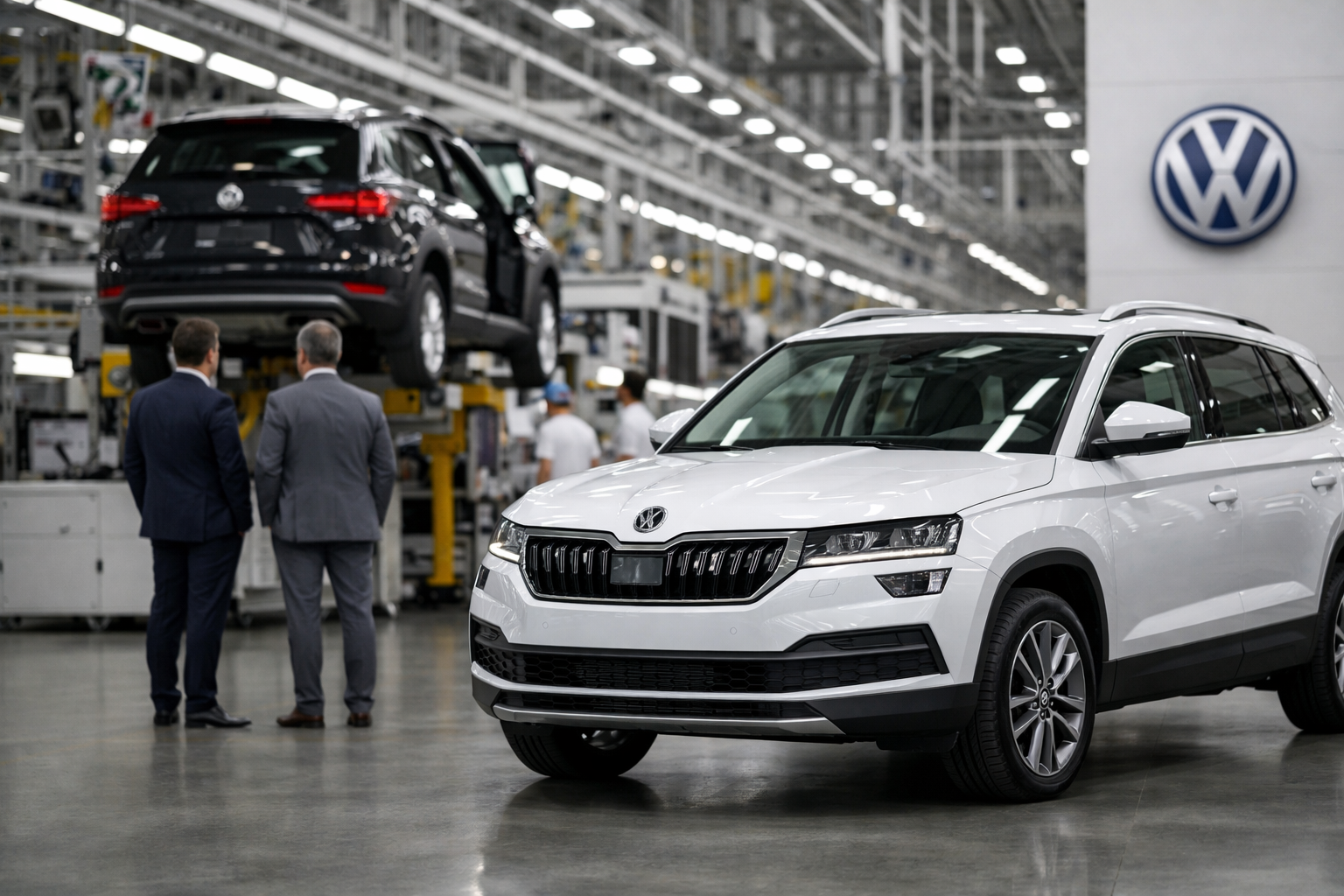
Volkswagen confirmed on April 3, 2026 that it will wind down local production and sales of its Czech subsidiary in China, marking a decisive Volkswagen Skoda China exit after nearly two decades in the world’s largest auto market. The move follows a 17% year-over-year drop in Skoda’s China sales in 2025, according to company figures, and comes as overall industry volumes in China stagnate for a second consecutive year.
However, this is more than a brand reshuffle. It’s a signal flare about the China auto market slowdown and the growing pressure on global automakers that once relied on China for a third or more of their profits. For Volkswagen Group, which still derives roughly 35% of its global deliveries from China per annual filings, pulling Skoda is a defensive maneuver in a market that no longer guarantees growth.
The Headlines
- What: Volkswagen will exit the Skoda brand from China, ending local production and sales
- Who: Volkswagen Group and Skoda Auto, in partnership with SAIC
- When: Announced April 3, 2026; phased withdrawal through early 2027
- Impact: Signals deepening pressure on foreign automakers in China’s slowing, EV-dominated market
- Key Number: 17% Skoda China sales decline in 2025
What Happened
Volkswagen said it will cease Skoda production at its joint-venture plants with SAIC in China by early 2027, shifting focus to core VW-branded models and electrified vehicles. According to a company statement and reporting from Reuters, Skoda’s China lineup will not be refreshed for the 2027 model year, effectively sealing its exit.
Skoda once sold more than 325,000 vehicles annually in China at its 2018 peak. By 2025, that figure had fallen below 150,000 units, according to Volkswagen annual reports and Bloomberg coverage. Meanwhile, domestic Chinese brands such as BYD and Geely surged, capturing a combined 35%+ share of the market as EV adoption accelerated.
In a statement, Volkswagen Group China said it would “optimize brand positioning and resource allocation to reflect evolving market dynamics.”
“We are aligning our China strategy with changing customer demand and intensifying competition,” a company spokesperson said.
The press release frames the decision as strategic optimization. The reality is more blunt: Skoda’s value-oriented positioning has been squeezed between aggressive Chinese EV startups and Volkswagen’s own mainstream offerings.
Why It Matters
The Volkswagen Skoda China exit underscores how rapidly China’s market has shifted from a growth engine to a margin battleground. According to the China Association of Automobile Manufacturers, total vehicle sales rose just 2% in 2025, a sharp deceleration from double-digit growth a decade ago. In contrast, domestic EV brands expanded at more than 25% annually.
Moreover, Chinese consumers are increasingly choosing homegrown brands that offer advanced software, over-the-air updates, and aggressive pricing. We’ve covered how that innovation cycle is accelerating in our analysis of China EV innovation and its global impact. Foreign joint ventures built for gasoline dominance are struggling to adapt.
For Volkswagen, Skoda’s retreat allows capital to be redirected toward its ID-branded EVs and China-specific platforms. However, it also reveals a hard truth: legacy European brands can no longer assume brand equity alone will carry them in China.
The Bigger Picture
This isn’t happening in isolation. The China auto market slowdown has rippled across earnings reports from BMW, Mercedes-Benz, and General Motors over the past 18 months. GM, for example, reported a 12% drop in China equity income in 2025, according to SEC filings.
Additionally, geopolitical tensions and shifting trade policies are complicating global strategy. As we detailed in Auto Tariffs 2026: U.S. Trade Shifts Hit Industry, automakers face rising costs and fragmented supply chains. China is no longer just a sales hub; it’s a geopolitical variable.
Historically, foreign automakers entered China through joint ventures in the 1990s and 2000s, trading technology for market access. That formula worked when Chinese buyers aspired to European badges. In 2026, many buyers prioritize software ecosystems, battery range, and price-to-feature ratios—areas where BYD and others often outperform.
Notably, this shift also affects global production allocation. If China no longer absorbs excess capacity, European plants could face renewed pressure, especially as EU demand softens.
What the Competition Is Doing
Volkswagen isn’t alone in recalibrating. BMW has doubled down on localized EV production, investing €2 billion in its Shenyang facilities to build Neue Klasse models for China. Meanwhile, Mercedes-Benz is partnering more deeply with Chinese battery suppliers to reduce costs.
In contrast, Toyota has taken a slower EV approach in China but continues to leverage hybrid strength. However, even Toyota’s joint ventures saw mid-single-digit declines in 2025, according to company disclosures.
Domestic players are on offense. BYD surpassed Volkswagen as China’s top-selling brand in 2024 and widened the gap in 2025. Geely and SAIC’s own brands are also expanding into Southeast Asia and Europe, exporting the same low-cost EVs that pressured Skoda at home.
The competitive reality is stark: foreign automakers are fighting for share in a market where local brands control more than 50% of EV sales. Skoda, lacking a distinctive EV identity in China, became the weak link.
What It Means for You
If you’re a buyer in Europe or North America, the immediate impact is indirect—but real. A Volkswagen Skoda China exit frees up capital that could accelerate EV launches elsewhere, including the U.S. and EU. We’re already seeing an aggressive rollout in the Volkswagen 2026 models EV push, with expanded ID offerings.
However, reduced profitability in China could also tighten global budgets. That may translate into fewer niche models and more platform sharing across brands. In practical terms, expect more standardized tech stacks and fewer region-specific experiments.
Furthermore, global oversupply could work in buyers’ favor. As we explored in Car Prices 2026: Buyer’s Market?, slower global demand is already pressuring incentives. If Chinese demand remains muted, manufacturers may lean harder on discounts in Europe and the U.S.
What to Watch Next
First, watch Volkswagen’s second-quarter 2026 earnings for impairment charges related to Skoda’s China operations. Plant write-downs or restructuring costs will reveal how painful this exit really is.
Second, monitor whether other secondary brands follow. If GM were to scale back Buick in China, or if Stellantis trims Jeep’s footprint, that would confirm a broader retreat.
Third, keep an eye on Chinese exports. According to the International Energy Agency, China became the world’s largest auto exporter in 2025. If those exports accelerate, the pressure that forced Skoda out of China could soon intensify in Europe.
The Upside
- Allows Volkswagen to focus investment on higher-margin EVs
- Reduces overlap and internal competition within VW Group
- May improve capital efficiency in a slower market
- Signals disciplined portfolio management to investors
The Concerns
- Highlights weakening foreign brand power in China
- Potential write-downs and restructuring costs
- Loss of scale in the world’s largest auto market
- Could foreshadow broader retrenchment by global automakers
The Volkswagen Skoda China exit is less about one brand and more about a recalibration of global automotive gravity. For two decades, China was the growth story that justified massive capital spending. Now it’s a hyper-competitive, EV-driven market where foreign automakers must fight for relevance.
Having covered three product cycles in China, I can tell you this pattern is familiar: when margins compress, brands consolidate. The difference this time is scale. If China no longer guarantees growth, the entire global automotive playbook for 2026 and beyond will have to change.
Disclosure: This article may contain affiliate links. If you make a purchase through these links, we may earn a small commission at no extra cost to you. This helps support RevvedUpCars.com. Learn more.