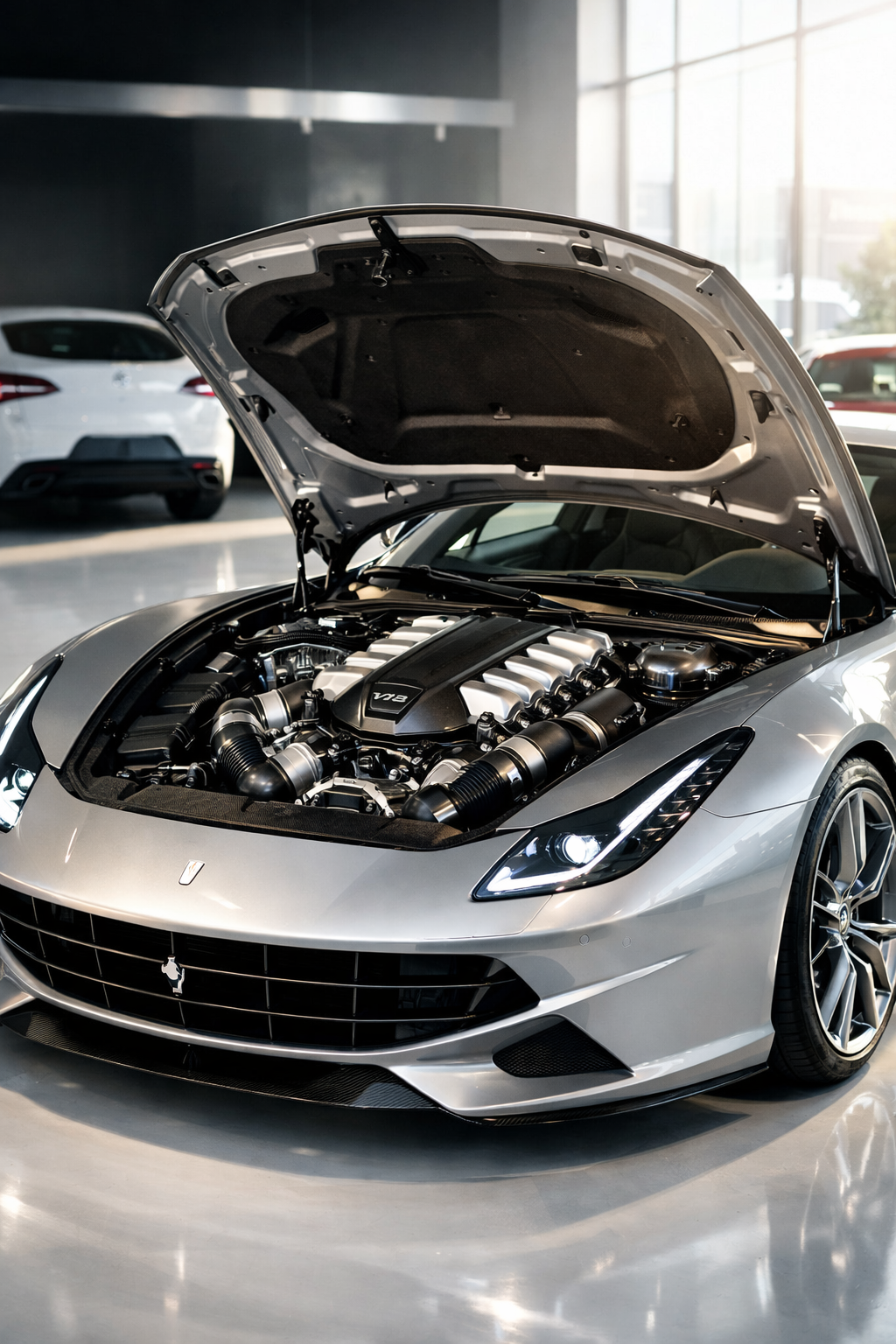

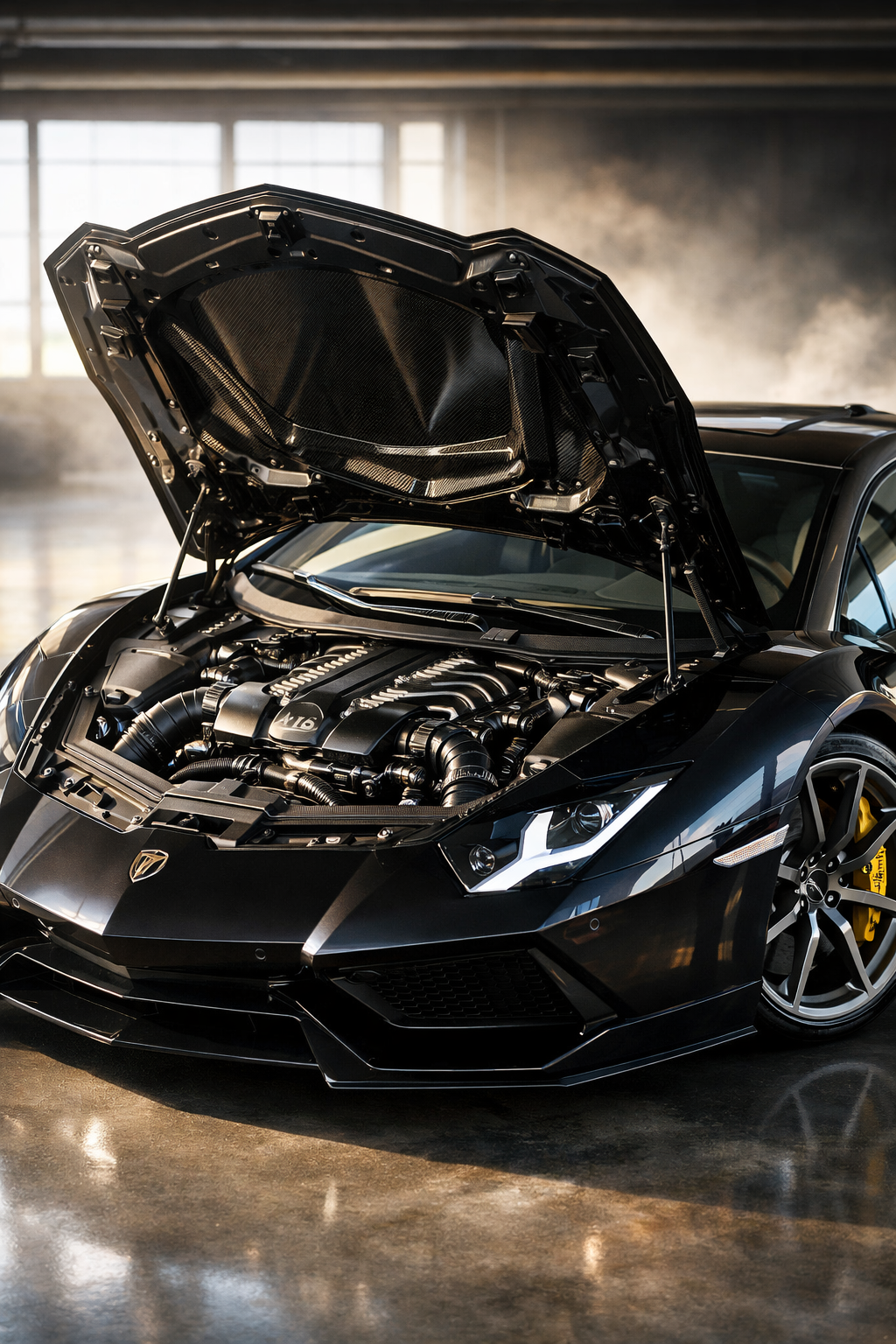
Electric cars are supposed to have killed the V12 by now, and yet here we are in 2026 watching twelve-cylinder dinosaurs strut around like they own the place. The V12 engines future looks less like a funeral and more like a black-tie afterparty with champagne, carbon fiber, and very loud guests. If you care about cars beyond appliance transport, this matters right now because the last truly excessive engines are choosing defiance over dignity.
I’ve driven dozens of EVs that’ll do 0–60 mph in under 3.0 seconds, and still, none of them hit your spine like a naturally aspirated V12 screaming past 8,000 rpm. This isn’t nostalgia talking; it’s physics, sound waves, and mechanical theater. The V12 engines future isn’t about efficiency—it’s about why some experiences refuse to be optimized away.
Manufacturers won’t admit it in press releases full of “electrified synergies,” but buyers with seven-figure bank balances still want engines with more cylinders than sense. That’s why cars like the De Tomaso P900 exist at all, and why Mercedes quietly keeps a V12 on life support. The V12 engines future is now less about volume and more about symbolic resistance.
Why the V12 Refuses to Go Quiet
A V12 is mechanical jazz: perfectly balanced, inherently smooth, and allergic to compromise. Unlike turbo V8s that cough torque like a chain smoker or EVs that deliver speed like a light switch, a V12 builds power with operatic drama. Engineers love them because a 60-degree V12 cancels vibrations so well you could balance a coin on the intake at idle.
This matters because refinement still sells at the top end. Rolls-Royce, Ferrari, and Lamborghini aren’t chasing EPA cycles; they’re chasing emotional loyalty. As I argued in our piece on the V8 Engine Future: Why Automakers Hold On, engines survive when they mean something, not when they spreadsheet well.
De Tomaso P900: A Middle Finger Made of Carbon Fiber
The De Tomaso P900 is the loudest proof that the V12 engines future is real, not theoretical. This track-only lunatic packs a naturally aspirated 6.2-liter V12 making approximately 900 hp, revving to around 12,300 rpm, and costs starting around $3 million. No hybrid assist, no regenerative braking—just mechanical excess turned up to eleven.
Is it relevant? Financially, no. Culturally, absolutely. When Gordon Murray Automotive, Pagani, and De Tomaso all double down on V12s, it tells you that the people who know engineering best aren’t ready to let go.
Mercedes V12: The Quiet Aristocrat
While supercar brands shout, Mercedes whispers. The Mercedes-Maybach S680 still offers a 6.0-liter twin-turbo V12 with about 621 hp and enough torque to rearrange continents, starting around $240,000 (check manufacturer website for latest pricing). It does 0–60 mph in roughly 4.4 seconds, which feels irrelevant when you’re floating on adaptive air suspension like a billionaire’s cloud.
Mercedes won’t sell you this engine in Europe anymore thanks to emissions rules, but in select markets, it lives on. That’s not laziness; it’s brand stewardship. For context, Bentley’s W12 is gone, BMW killed its V12 years ago, and Audi never bothered—making Mercedes’ persistence quietly heroic.
Regulations vs Reality
Yes, emissions laws are tightening like a vice, and fleet averages are the buzzkill at every engine party. But low-volume exemptions and limited-production rules mean halo cars can still cheat extinction. The V12 engines future survives in these regulatory loopholes, much like vinyl records survived Spotify.
Here’s my controversial hot take: banning V12s entirely would do almost nothing for the planet. These cars sell in the hundreds, not millions, and are driven fewer miles per year than a Prius sees in a month. If regulators were serious, they’d focus on crossovers with 22-inch wheels and 18 mpg combined.
Sound, Drama, and Why EVs Still Can’t Fake It
I’ve heard synthetic soundtracks from EVs that claim to be “emotionally engaging,” and they’re about as convincing as a dubbed kung-fu movie. A V12’s noise isn’t just loud; it’s layered, harmonic, and alive. From idle burble to full-throttle scream, it tells a story your right foot controls.
Ferrari’s 812 Competizione, Lamborghini’s Revuelto V12 hybrid, and even Aston Martin’s Valkyrie prove that sound still sells. If you want proof that design theater matters, read Why Car Design Concepts Still Matter and apply that logic to engines.
Who’s Actually Buying These Things?
Contrary to internet wisdom, V12 buyers aren’t all retired hedge fund villains. Many are collectors in their 40s who grew up watching Top Gear and binge-watching Doug DeMuro quirks videos on YouTube. They want the last chapter of a story, not the first draft of an EV future.
Brand loyalty plays a massive role here. When Ferrari or Mercedes says “this is the final V12,” wallets open faster than a twin-turbo spools. We’ve seen this psychology before, which ties neatly into how brand loyalty shapes buying choices.
Running Costs Be Damned
No one cross-shops a V12 with a spreadsheet. Fuel economy hovers around 12–16 mpg combined, oil changes cost four figures, and tires evaporate faster than dignity at a Nürburgring track day. According to FuelEconomy.gov, these cars are environmental villains on paper.
But here’s the thing: owners know this and don’t care. V12s are not transportation; they’re rolling art with pistons.
Pros and Cons of Keeping the V12 Alive
Pros
- Unmatched smoothness and sound quality
- Strong brand identity and heritage value
- High collector and resale appeal
- Mechanical engagement EVs can’t replicate
Cons
- Terrible fuel economy, often under 15 mpg
- Increasing regulatory pressure worldwide
- Eye-watering maintenance and ownership costs
The Verdict on the V12 Engines Future
The V12 engines future isn’t mass-market, but it’s far from dead. It will live on in limited-run exotics, ultra-luxury sedans, and track toys built for people who see cars as passion, not policy. Like the manual gearbox, it’ll shrink—but it won’t disappear quietly.
EVs may win the war, but the V12 will die like a rock star—loud, dramatic, and decades too late.
Frequently Asked Questions
Is there really a V12 engines future after 2026?
Yes, but only in low-volume and ultra-luxury cars. Limited-production models from Ferrari, Lamborghini, and Mercedes will keep V12s alive through exemptions.
Which new cars still offer a V12 engine?
As of 2025–2026, examples include the Ferrari 12Cilindri, Lamborghini Revuelto, Rolls-Royce models, and Mercedes-Maybach S680.
Are V12 engines banned in the US?
No, but emissions and fleet-average rules make them rare. Manufacturers rely on low-volume exemptions to sell them legally.
Do V12 cars hold their value?
Often yes, especially limited editions. Final-generation V12 models tend to appreciate as collectors anticipate their extinction.