
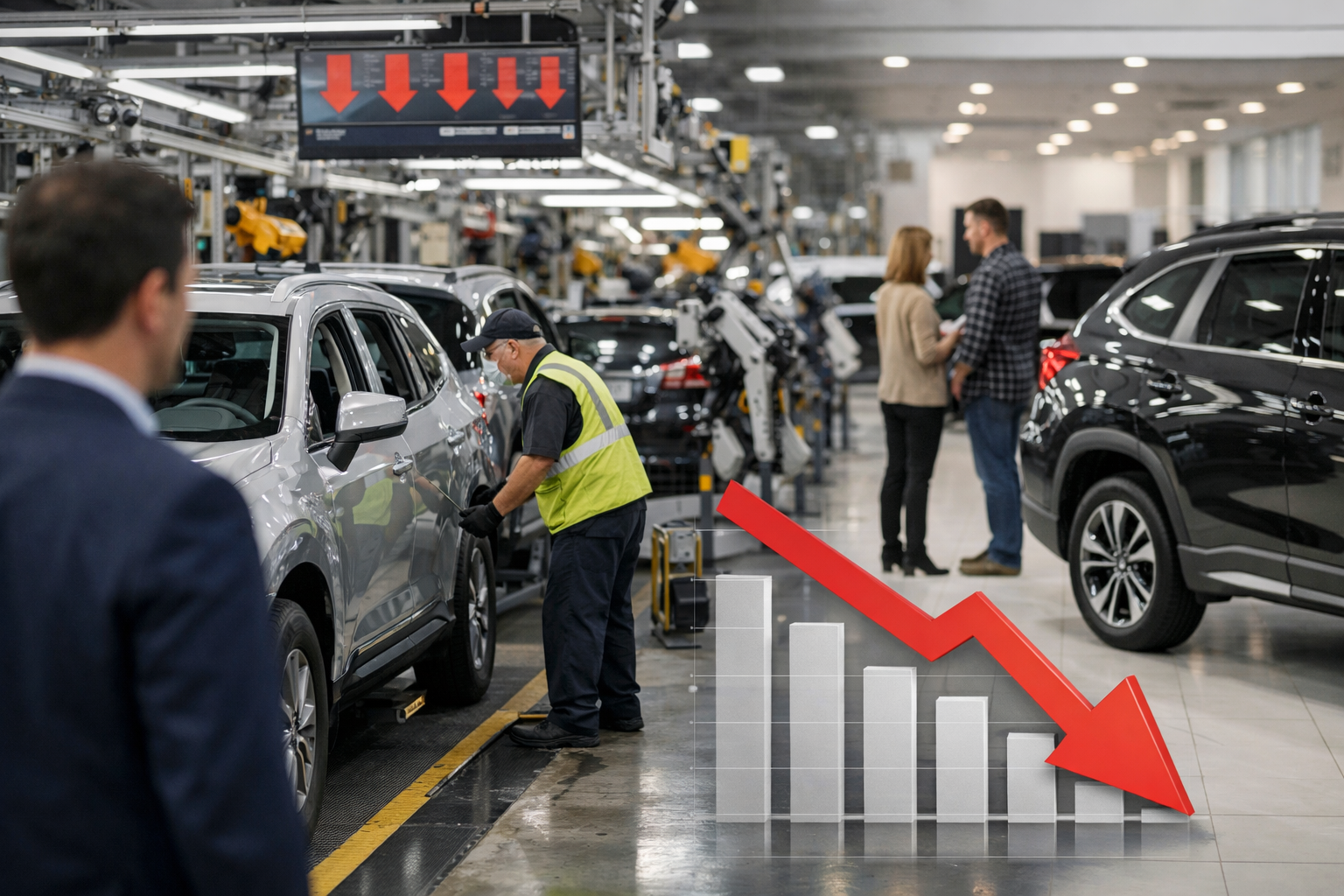
U.S. light-vehicle sales are projected to fall 2.6% in 2026, a sharp reversal after two years of post-pandemic recovery. Analysts tracking US auto sales 2026 now expect volume to slip to roughly 15.5 million units, down from an estimated 15.9 million in 2025, according to forecasts cited by Reuters and industry data from Wards Intelligence.
That may not sound dramatic, but context matters. The industry has hovered below the pre-COVID peak of 17 million units since 2019, and automakers had banked on gradual growth through 2026. Instead, higher interest rates, tariff uncertainty, and stubborn vehicle prices are converging at exactly the wrong moment.
For car buyers, this isn’t just a Wall Street headline. It signals a potential shift in incentives, inventory strategy, and pricing power—especially as 2026 model-year vehicles roll into showrooms this summer.
The Headlines
- What: U.S. light-vehicle sales forecast to drop 2.6% in 2026
- Who: Major automakers including GM, Ford, Toyota, and Stellantis
- When: Forecast issued April 2026; impacts full 2026 calendar year
- Impact: Slower demand could boost incentives but pressure profits
- Key Number: ~15.5 million projected U.S. vehicle sales in 2026
What Happened
Industry forecasters this week trimmed their outlook for U.S. vehicle demand, citing elevated average transaction prices—still hovering near $47,000 per vehicle, according to estimates from J.D. Power—and average new-car loan rates above 7%. As a result, total volume is expected to dip 2.6% year over year.
Meanwhile, automakers are facing cost pressures from trade policy shifts. The White House’s updated tariff framework, detailed by the U.S. Trade Representative and covered by Bloomberg, maintains duties on certain Chinese EV components and tightens North American sourcing rules. That raises input costs for batteries and electronics, particularly for EV-heavy brands.
General Motors said in a recent earnings call that it is “closely aligning production with real-time demand,” while Ford warned of “pricing headwinds” in its dealer channel. Toyota, which gained share in 2025 thanks to hybrid demand, indicated it expects “moderate softness” in the second half of 2026.
Notably, fleet sales—which helped prop up 2024 and 2025 volumes—are expected to flatten. Rental car companies largely completed their replenishment cycles, removing a key buffer for manufacturers.
Why It Matters
A 2.6% drop may seem incremental, but in a 15-million-unit market, that’s roughly 400,000 vehicles. Therefore, even small percentage swings translate into billions in revenue and significant factory utilization shifts.
For consumers buying car in slowdown conditions, this could finally tilt negotiating leverage back toward buyers. Incentives, which averaged about $2,800 per vehicle in early 2026 per industry estimates, may climb—especially on slower-moving EV inventory.
However, there’s a counterintuitive twist. Automakers have become disciplined about supply since the pandemic shortages. Rather than flooding lots with excess inventory, companies like GM and Stellantis are more likely to trim production to protect margins. Having covered three product cycles, I can tell you this pattern is familiar: fewer rebates, tighter supply, steadier pricing.
Additionally, EV adoption remains uneven. While EVs account for roughly 9–10% of U.S. sales, according to IEA estimates, growth has slowed outside coastal markets. That divergence complicates the auto industry outlook 2026, particularly for brands that over-indexed on battery-electric launches.
The Bigger Picture
The broader backdrop is affordability. Monthly payments on new vehicles average more than $730, according to industry data, a figure we break down in our Budget for New Cars: Average Payments 2026 Tips guide. Wages have risen, but not fast enough to offset financing costs and higher MSRPs.
Furthermore, the industry is navigating regulatory crosscurrents. The EPA’s stricter emissions targets for 2027–2032 model years, detailed at EPA.gov, are pushing manufacturers toward electrification investments that require scale to pay off. A sales slowdown makes that scaling harder.
Historically, U.S. auto sales dip during economic uncertainty but rebound quickly if credit loosens. In contrast, today’s environment combines structural affordability issues with geopolitical risk. Tariff tensions, outlined in our coverage of Auto Tariffs 2026: U.S. Trade Shifts Hit Industry, add another layer of unpredictability.
Globally, the U.S. remains one of the most profitable markets for automakers. Europe is grappling with stricter EV mandates and softer demand, while China’s market has become brutally competitive with domestic EV champions. Therefore, a U.S. dip reverberates through global earnings forecasts.
What the Competition Is Doing
General Motors, which led U.S. sales in 2025 with roughly 16–17% market share, is leaning into high-margin trucks and SUVs while pacing EV production at its Ultium plants. Additionally, it has signaled flexibility in adjusting output if dealer inventories climb above 70 days’ supply.
Ford, by contrast, is walking a tighter rope. Its F-Series remains America’s best-selling vehicle line, but EV losses in its Model e division have weighed on margins. A demand slowdown could delay its EV profitability targets beyond 2027.
Toyota continues to benefit from its hybrid-heavy strategy. While some competitors chased full EV volume, Toyota doubled down on hybrids, which now represent a significant portion of its U.S. mix. In a cooling market, that diversified powertrain approach looks increasingly prudent.
Meanwhile, Hyundai and Kia have aggressively priced EV leases to maintain share, and Stellantis has trimmed North American production in prior quarters to avoid oversupply. In contrast, Tesla has historically used price cuts to defend volume—an approach that pressures industry pricing overall.
What It Means for You
If you’re considering buying car in slowdown conditions, timing could work in your favor—but only selectively. Slower-selling EVs and certain midsize SUVs are likely to see higher incentives by late summer 2026.
However, high-demand hybrids and full-size pickups may remain tight. Dealers learned from the 2021–2023 shortage era and are less willing to overstock. As we explored in Car Prices 2026: Buyer’s Market?, a true buyer’s market requires both high inventory and manufacturer incentive support.
Additionally, pay attention to financing. If the Federal Reserve eases rates later this year, automakers’ captive finance arms could roll out sub-5% promotional loans. That often matters more than a $1,000 rebate.
One contrarian insight: a mild sales decline can improve vehicle quality. When factories aren’t running at maximum capacity, defect rates often stabilize. For shoppers, that’s an underappreciated upside.
What to Watch Next
First, monitor second-quarter earnings calls from GM, Ford, Toyota, and Stellantis. Executives will update production guidance and incentive spending. Moreover, watch inventory levels—anything consistently above 75 days’ supply signals heavier discounting ahead.
Second, track how EV tax credit rules evolve. Changes to sourcing requirements or eligibility caps could materially shift demand. Finally, keep an eye on consumer confidence data; auto purchases correlate closely with sentiment trends.
The Upside
- Potential increase in incentives and dealer flexibility
- More balanced inventories after years of tight supply
- Pressure on automakers to improve quality and value
- Opportunity for hybrids to gain share in a cautious market
The Concerns
- Production cuts could limit model availability
- EV investment timelines may stretch, slowing innovation
- Tariff-driven cost increases could offset discounts
- Higher loan rates continue to strain affordability
Stepping back, the projected decline in US auto sales 2026 isn’t a collapse—but it is a pivot point. Automakers can no longer count on pent-up demand to mask pricing excesses or strategic missteps.
If the slowdown remains modest, consumers may finally regain leverage without triggering a full-blown downturn. However, if affordability pressures persist into 2027, the auto industry outlook 2026 could mark the beginning of a more structural reset—one where efficiency, disciplined production, and realistic pricing determine who thrives and who retrenches.
Disclosure: This article may contain affiliate links. If you make a purchase through these links, we may earn a small commission at no extra cost to you. This helps support RevvedUpCars.com. Learn more.